Aerospace & Orbital Logistics
Aerospace and orbital logistics is the industrial discipline of transporting, maintaining, refueling, and manufacturing physical payloads across low Earth orbit (LEO), geosynchronous corridors, and cislunar space. It replaces single-use rocketry with reusable spaceflight architectures, automated orbital docking, autonomous tug networks, and off-planet supply chain infrastructure.
Current State (Autumn 2026)
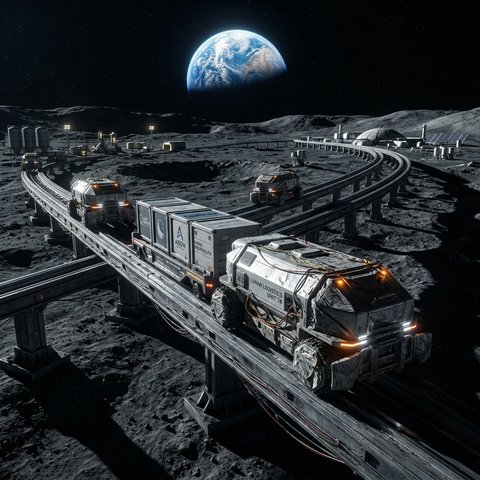
By late 2026, the orbital domain has transitioned from exploration to an industrial logistics corridor. Heavy-lift fully reusable launch vehicles achieve multiple daily turnarounds, compressing launch costs below $100 per kilogram to LEO and unlocking continuous cislunar freight routes supporting the Artemis III lunar base infrastructure. In-space propellant depots and ship-to-ship cryogenic transfer of liquid oxygen and methane have become the critical bottleneck separating orbital operations from deep space logistics.
Concurrently, orbital computing architectures have emerged as an alternative to terrestrial data center grid constraints. Prototype free-flying compute clusters equipped with radiative cooling arrays and direct solar collection take advantage of orbital vacuum conditions to dissipate heat, communicating with ground stations via optical laser downlinks while managing orbital debris avoidance autonomously via swarm navigation protocols.
Structural Tensions
The domain faces three critical architectural and physical challenges:
Cryogenic Boil-Off and Fluid Dynamics in Microgravity: Long-duration storage and zero-g transfer of cryogenic propellants require complex thermodynamic venting and magnetic fluid management to prevent systemic fuel loss.
Kessler Syndrome Density in Crowded LEO Shells: Compounding satellite megaconstellations and upper-stage debris elevate orbital collision probabilities, requiring mandatory active deorbit tethering and autonomous collision avoidance.
Cislunar Situational Awareness and Sovereign Jurisdiction: The lack of unified international orbital traffic coordination and contested lunar south pole landing claims threaten to transform vital orbital transfer corridors into geopolitical flashpoints.