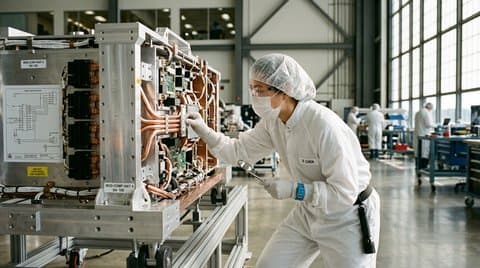
Data Centers in Orbit: The Trillion-Dollar Bet to Bypass Earth's Power Grid
On the surface of the Earth, artificial intelligence is running headlong into the unforgiving laws of thermodynamics and political geography.
Across Northern Virginia, Dublin, the Rhine-Ruhr corridor, and Singapore, the global expansion of hyperscale artificial intelligence clusters has encountered a hard electrical ceiling. Municipal utilities are refusing new interconnection requests; regional transmission grids are destabilized by gigawatt-scale transient loads; and local communities are actively rebelling against the environmental cost of evaporative cooling towers consuming tens of millions of liters of potable water daily.
To maintain the exponential compute trajectory of frontier foundation models, the technology industry is being forced into an extraordinary engineering conclusion: the future of high-density artificial intelligence compute cannot remain tethered to the surface of our planet.
Driven by the collapse of heavy launch costs below five hundred dollars per kilogram and the maturation of high-throughput inter-satellite optical laser cross-links, a sovereign coalition of aerospace consortia and compute syndicates is preparing the most audacious infrastructure migration in human history: deploying modular, nuclear- and solar-powered data centers directly into Low Earth Orbit (LEO) and Sun-Synchronous Orbits (SSO).
The Terrestrial Grid Wall: Why Earth Has Become Compute-Hostile
The fundamental vulnerability of terrestrial compute is not silicon availability; it is thermodynamic dissipation and bureaucratic grid interconnection queues.
In 2026, building a three-gigawatt terrestrial artificial intelligence data center requires between seven and nine years of bureaucratic negotiations: securing rights-of-way for high-voltage transmission lines, negotiating with municipal water authorities, retrofitting substations, and navigating contentious environmental impact litigation. Even when power is secured, hyperscalers find themselves locked in an acute moral paradox: utilities are delaying coal plant retirements and restarting decommissioned fossil facilities solely to feed the insatiable baseline power demands of GPU inference clusters.
Furthermore, terrestrial cooling is an open thermodynamic loop. Conventional data centers reject heat by transferring thermal energy into the local biosphere—either through atmospheric cooling fans that generate severe acoustic pollution or through evaporative towers that deplete regional water tables.
In orbit, this entire thermodynamic and political liability is inverted.
The Orbital Thermodynamics of Compute
To the untrained observer, space appears hostile to electronics: cosmic radiation, micrometeorites, and extreme thermal cycling between direct sunlight and planetary eclipse. But to an orbital thermodynamicist, the vacuum of space offers two structural advantages that terrestrial geography can never replicate: infinite unobstructed solar flux and an infinite, zero-cost heat sink.
In a Sun-Synchronous Orbit (SSO) positioned along Earth’s dawn-dusk terminator, a satellite array is never eclipsed by the planetary shadow. It receives uninterrupted, unfiltered solar irradiance of approximately 1,361 Watts per square meter, twenty-four hours a day, 365 days a year. There are no clouds, no atmospheric scattering, no nighttime battery storage deficits, and zero carbon emissions.
Cooling in the vacuum of space, however, obeys fundamentally different physics. Without an ambient atmosphere to carry heat away via convection, an orbital data center must reject its entire thermal load through radiative dissipation governed by the Stefan-Boltzmann law.
The Vacuum Radiative Heat Dissipation Invariant:
Q = ε · σ · A · (T_radiator⁴ - T_deep_space⁴)Where `ε` is emissivity, `σ` is the Stefan-Boltzmann constant, `A` is radiator surface area, and deep space acts as a nearly absolute thermal sink at 2.7 Kelvin.
By circulating closed-loop dielectric liquid fluorochemicals through high-density compute blades and routing them into deployable blackened carbon-composite radiator panels, an orbital compute node can radiate hundreds of kilowatts of waste heat directly into the cosmic background without consuming a single drop of water.
Infrastructure Dimension | Terrestrial Hyperscale Data Centers | Low Earth Orbit Compute Arrays |
|---|---|---|
Power Source & Availability | Terrestrial grid mix (strained by fossil backslide); 6–8 year queue | Continuous 24/7 unfiltered solar irradiance (1,361 W/m²) in Sun-Synchronous Orbit |
Cooling Mechanism | Evaporative water consumption & ambient air convection | Closed-loop dielectric fluid circulating to deep-space radiative cooling panels |
Water Consumption | Millions of liters per day of potable municipal water | Exactly zero water consumption (radiative transfer to 2.7K cosmic sink) |
Interconnection Latency | Decoupled from municipal grid permits; zero local bureaucratic friction | Optical inter-satellite laser mesh (speed of light in vacuum: 300,000 km/s) |
Jurisdictional Status | Bound to municipal taxes, local zoning laws & national sovereignty | International space law (Outer Space Treaty); air-gapped sovereign execution |
Physical Vulnerabilities | Seismic events, physical sabotage, local grid blackouts | Solar energetic particle events, single-event upsets & orbital debris |
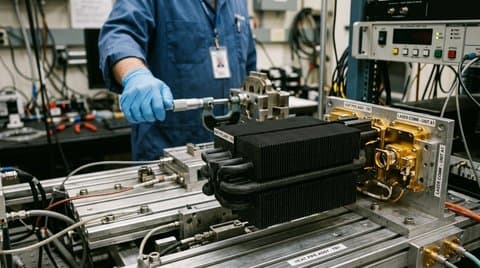 Detailed macro photograph of carbon-composite radiative heat pipe fins and optical laser communication transceiver on aerospace test fixture
The Network Geometry: Overcoming the Latency Paradox
The immediate objection raised by classical network engineers is communications latency: can a data center orbiting five hundred kilometers above the Earth meaningfully serve global inference workloads?
The answer lies in the physics of optical transmission. In terrestrial fiber-optic cables, light travels through fused silica glass at roughly 200,000 kilometers per second—one-third slower than the speed of light in a vacuum. Light traveling through an inter-satellite optical laser link in the vacuum of Low Earth Orbit travels at 300,000 kilometers per second.
Consequently, for long-distance data transit—such as routing a query from Frankfurt to Tokyo or from London to Sydney—an orbital constellation utilizing optical laser cross-links can achieve lower end-to-end latency than transoceanic submarine fiber cables, even after accounting for the initial 500-kilometer uplink and downlink hops.
Furthermore, artificial intelligence workloads are bifurcating structurally into two distinct domains:
Interactive Human Latency-Critical Inference (Sub-50ms): Conversational voice interfaces and real-time edge controls that remain anchored on localized edge nodes and sovereign devices.
Asynchronous Deep Reasoning and Foundation Pre-Training: Massive batch reinforcement learning, synthetic data generation, protein folding simulations, and multi-day agentic planning loops.
These deep compute workloads are throughput-bound, not latency-sensitive. A foundation model pre-training run requiring forty megawatts of uninterrupted power for four months cares nothing about thirty milliseconds of propagation latency; it cares solely about continuous electrical uptime, thermal stability, and levelized cost per token.
Hardening the Silicon: The Radiation Defense
The primary engineering obstacle to orbital compute is the harsh radiation environment of the Van Allen belts and galactic cosmic rays. Unshielded terrestrial GPUs exposed to high-energy protons and heavy ions suffer catastrophic Single-Event Latchups (SEL) and bit-flip corruptions that corrupt gradient calculations.
Rather than attempting to launch heavy, multi-ton lead shielding that would destroy launch payload economics, orbital compute architects are implementing a multi-layered defensive hierarchy:
1. Magnetic Deflection Architecture
Miniaturized high-temperature superconducting (HTS) magnetic coils generate localized Lorentz deflection shields around the core processor chassis, steering charged solar wind particles away from sensitive silicon dice with minimal structural mass.
2. Dual-Rail Redundant TMR Logic
Compute architectures employ Triple Modular Redundancy (TMR) combined with real-time Byzantine consensus. Every tensor calculation is distributed across three independent execution paths; if radiation induces a bit-flip in path Alpha, the hardware arbiter instantly overrides the corrupted core and initiates a zero-overhead microsecond memory refresh.
3. Graceful Orbital Degradation Cycles
Because satellite life cycles in low-inclination orbits are governed by atmospheric drag and solar cycle fluctuations, compute nodes are designed for disposable, rolling replacement. As advanced starship-class launch systems reduce payload deployment costs below two hundred dollars per kilogram, launching next-generation GPU nodes every thirty-six months becomes vastly cheaper than executing physical hardware refreshes in terrestrial data halls.
The Sovereign Jurisdiction of Orbital Compute
Beyond thermodynamics and energy economics, the migration to orbit introduces a profound geopolitical disruption: the absolute decoupling of artificial intelligence from nation-state zoning regimes.
A compute constellation operating in high international orbit exists beyond the sovereign tax boundaries, municipal water restrictions, and physical seizure authority of any single nation. Governed by the Outer Space Treaty of 1967, orbital compute nodes constitute an unseizable, air-gapped sovereign substrate.
For international scientific consortia, neutral multilateral arbitration bodies, and decentralized cryptographic protocols, an orbital data center represents the first truly incorruptible computing infrastructure: an epistemic sanctuary operating high above the atmospheric noise, powered by the pure light of the sun.
The industrialization of artificial intelligence will not be won by paving over fertile river valleys with diesel backup generators and concrete data centers. It will be won by looking upward: claiming the infinite energy and cryogenic calm of the solar system, and establishing the permanent computational foundations of human civilization in the stars.