
Chamber Geometries: How Single-Location Cinema Outsmarts Hollywood's Spectacle Trap
Every summer, the industrial Hollywood apparatus releases another three-hundred-million-dollar confection of digital noise. Cities are leveled by celestial beams; planets collide in hyper-saturated particle simulations; camera rigs execute physics-defying 720-degree orbital swoops through synthetic corridors. We watch these monstrosities with glazed, unblinking eyes, inundated by visual stimuli yet entirely untouched by emotional gravity.
The corporate studio system has trapped itself in an inflationary spiral of hollow spectacle. When an audience begins to feel the dramatic vacancy of a scene, the algorithm prescribes more visual velocity: cut faster, shake the virtual lens, detonate another skyscraper, hire twelve more outsourced VFX vendors in Seoul and Vancouver to render photorealistic debris.
Yet, throughout the history of moving images, the most devastating, unforgettable cinema has operated on an inverse principle. It does not escape outward into infinite synthetic space. It contracts inward.
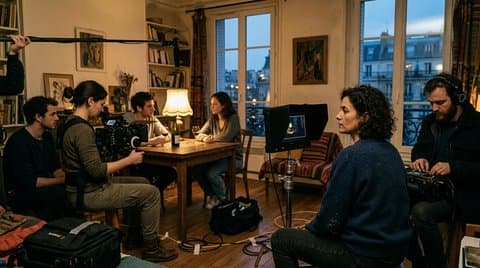
It locks the door, draws the curtains, places three human beings inside an ordinary apartment room, and lets the psychological pressure cooker slowly build to boiling point. This is chamber cinema (Kammerspiel). It is cinema stripped of its corporate safety nets, where narrative tension cannot be outsourced to a digital explosion and where every millimeter of physical architecture becomes an instrument of existential terror.
The Architecture of the Inescapable Room
The single-location film is often dismissed by commercial producers as an uncinematic compromise—a filmed stage play born of budgetary poverty. This prejudice betrays a profound misunderstanding of cinematic spatial geometry.
Theater is bounded by the fixed proscenium arch; the audience member sits in seat G-14 and views the performance from an invariant perspective. Cinema, however, possesses the camera. And when the camera is trapped inside a single room, the room ceases to be a static backdrop. It becomes an elastic, living organism.
Consider how masters of spatial compression manipulate the geometry of the room across ninety minutes:
The Lens Compression Arc: In Sidney Lumet’s 12 Angry Men (1957), Lumet and cinematographer Boris Kaufman executed a silent, mathematical camera strategy. As the sweltering jury deliberation drags on, Lumet gradually swapped his focal lengths from wide-angle 28mm and 35mm lenses to long 75mm and 100mm telephotos, while physically lowering the camera angle below eye level. The walls appeared to slide closer together; the ceiling seemed to press down onto the jurors' foreheads; the background blurred into a claustrophobic cage. The viewer feels physically suffocated without ever consciously realizing that the focal geometry has shifted.
The Domestic Minefield: In Alfred Hitchcock's Rope (1948) or Rear Window (1954), the apartment is not just four walls; it is a topography of threat. A kitchen door that swings shut, an antique chest sitting in plain sight containing a corpse, a telephone sitting on an unvarnished oak credenza—every domestic object is charged with lethal dramatic potential.
The Weaponization of the Threshold: In Roman Polanski’s Carnage (2011) or Death and the Maiden (1994), the front door of the apartment is approached half a dozen times. Characters put on their coats, reach for the brass doorknob, and seem poised to exit back into civil society. Yet each time, a stray barb, an unaddressed accusation, or an instinctive flare of vanity pulls them back into the room. The door is unlocked, yet leaving is impossible. The prison is entirely psychological.
When there are no car chases to distract from a hollow line of dialogue, the writer and the actor have nowhere to hide. Every glance, every hesitation, every shift in vocal timber carries the seismic weight of a continent.
The Economic Discipline of Four Walls
From an engineering and production standpoint, the single-location feature film represents the ultimate manifestation of radical narrative economy.
The average studio tentpole spends eighty percent of its production budget on logistical friction: moving two hundred crew members between five international shooting locations, paying hotel per-diems, securing city permits, catering for three hundred people, and managing fleets of transport trucks. By the time the director calls "action," ninety percent of the energy of the production has been consumed by administrative waste.
A chamber film cuts through this bureaucratic parasite with surgical precision.
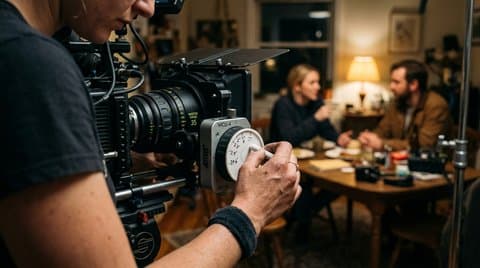 First assistant camera operator marking follow-focus distances on an apartment set
Consider the operational reality of shooting a film like Louis Malle’s My Dinner with André (1981), Richard Linklater’s Tape (2001), or J.C. Chandor’s Margin Call (2011).
By anchoring the entire narrative within a single restaurant, a seedy motel room, or a corporate boardroom over a twelve-hour window, the entire logistical footprint collapses:
No Company Moves: The crew never wastes three hours packing grip trucks to change locations during golden hour.
Mastered Lighting Grids: The director of photography can rig a dedicated, nuanced lighting setup into the ceiling or practical lamps on day one, spending the remainder of the shoot fine-tuning subtle mood gradations rather than wrestling with changing weather.
Actor Immersion: The actors do not spend four hours sitting in air-conditioned luxury trailers waiting for green-screen lighting adjustments. They inhabit the physical set continuously, allowing their fatigue, their irritability, and their natural domestic intimacy to bleed directly into the performance.
A micro-budget chamber film shot for fifty thousand dollars with four actors over twelve consecutive days can achieve a level of psychological nuance that a three-hundred-million-dollar corporate production cannot purchase with all the compute in Silicon Valley.
The Blocking Diagonal: Choreography as Subtext
In lazy cinema, blocking is treated as simple traffic management: Actor A walks to the refrigerator to grab a beer, Actor B sits on the sofa, the camera cuts back and forth in mechanical shot-reverse-shot coverage.
In master-level chamber cinema, blocking is the visual grammar of power.
When two actors sit across a rectangular dinner table, the space between them is not empty air; it is a negotiated border. The director who understands spatial geometry uses the diagonals of the room to map the shifting balance of dominance:
A character standing while another sits asserts vertical hierarchy.
A character leaning into the foreground shadow while their interlocutor remains illuminated in the middle-ground creates an agonizing sense of predatory observation.
The simple physical act of one actor crossing between the camera lens and another actor’s face can register as a psychological slap far more violent than a staged fistfight.
Because the camera cannot flee to a scenic vista, the frame must be composed with the dense pictorial rigor of a seventeenth-century Dutch interior painting. Every doorway, every mirror reflection, every glass of wine resting on the table must contribute to the dramatic architecture. The room becomes a musical instrument, and the director plays it by moving human bodies across its floorboards.
The Antidote to the Frictionless Pixel
We are rapidly entering an era where generative artificial intelligence tools can synthesize expansive, hyper-detailed virtual worlds from a text prompt. If you want a thousand digital starships clashing above a burning gas giant, you can generate it in seconds for the cost of a few inference tokens. The marginal cost of digital spectacle is plummeting toward zero.
And as spectacle becomes cheap, its cultural and emotional value will evaporate completely.
When infinite digital scale is free, the only scarce and precious commodity remaining in cinema is human emotional friction under constraint.
A generative model can synthesize a photorealistic alien planet, but it cannot authentically simulate the micro-tension in an actor's throat when they realize their spouse is lying to them across a breakfast table. It cannot recreate the tangible, suffocating silence that fills a dim room when an unpardonable truth has been spoken and cannot be taken back.
Chamber cinema is the ultimate anti-slop fortress. It resists algorithmic inflation by returning to the primal fire around which human beings first told stories: the small, intimate circle where we look each other in the eye and dare to tell the truth.
The Sovereign Crucible
Hollywood will continue to build its billion-dollar theme-park rides, and those rides will continue to grow louder, more synthetic, and more spiritually vacant.
Let them have their crumbling digital empires.
The true vanguard of cinema will remain where it has always been: in an old room with creaking floorboards, a camera mounted on a rigid tripod, an unyielding script, and three actors who have nowhere to run. Close the door. Turn on the table lamp. Roll camera. The universe is already inside.