
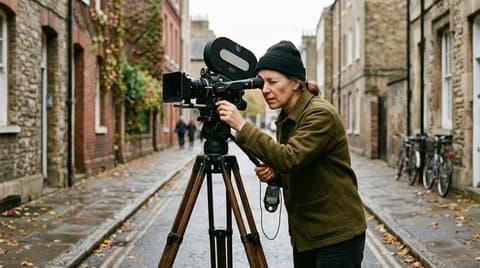
Grain Over Polish: The Aesthetics of Resource Scarcity in Micro-Budget Filmmaking
There is an unspoken panic quietly settling over the modern film industry, and it has nothing to do with box office receipts or the consolidation of streaming platforms. It is the panic of unlimited choice. When every camera sensor can capture clean footage in pitch darkness, when every sky can be digitally replaced in post-production, and when an algorithm can generate sixty variations of an establishing shot before lunch, image-making ceases to be an encounter with reality. It becomes an administrative exercise in composite rendering. The frame no longer captures the friction of light bouncing off a physical body in a specific room; it presents a mathematically smoothed simulation where nothing is at stake, nothing is scarce, and nothing can be permanently lost.
Cinema did not earn its soul through frictionless abundance. It earned its soul through resistance. The history of cinema’s most vital movements—from Italian Neorealism to the French New Wave, from the kitchen-sink realism of the British New Wave to the early American independent explosion of the 1990s—was never written by creators who had everything they needed. It was written by people who were cornered. They were cornered by light that was dying, by magazines containing only four hundred feet of film stock, by actors who had to leave at sunset, and by micro-budgets that permitted exactly two takes before the money ran out. Scarcity was not an obstacle to be endured; it was the crucible that forged dramatic economy and aesthetic intentionality.
Today, as independent filmmakers confront the glossy monoculture of corporate spectacle on one side and the tidal wave of synthetic generative imagery on the other, the path forward is not to compete on polish. Competing on polish is a suicide pact with corporate balance sheets. The true counter-offensive lies in the deliberate, radical reclaim of material constraint: grain over polish, presence over perfection, and the aesthetic dignity of resource scarcity.
The Tyranny of the Infinite Take
The digital revolution of the early 2000s arrived wrapped in the promise of democratization. Digital cameras would liberate storytellers from the extortionate costs of film processing and lab fees. You could shoot all day. You could shoot fifty takes without checking the gate. You could “fix it in post.”
Yet twenty years later, the consequence of that liberation is plain to see: a structural collapse of onset discipline. When a director knows that a roll of 16mm film costs eighty dollars every two and a half minutes, every second of roll-time carries moral weight. The director does not yell "action" simply to see what might happen; they yell "action" because the actors have rehearsed until their timing is razor-sharp, because the boom operator has memorized the actor’s breathing pattern, and because the camera operator knows exactly when the actor will cross the doorway. The ticking mechanical motor inside the camera creates an electrical field of collective attention. Everyone in the room is alive, present, and hyper-focused, knowing that failure leaves a physical scar on the production’s remaining cash reserves.
"When every take is free, no take is sacred. Frictionless shooting breeds lazy rehearsals, aimless performances, and an editorial suite buried under four hundred hours of digital bloat."
In contrast, the digital set is frequently characterized by cognitive drift. Directors let cameras run continuously across resets, capturing sprawling, unfocused chatter. Actors perform with half-conviction, subconsciously comforted by the knowledge that digital memory cards are effectively infinite and that their best moments will be salvaged by an assistant editor chopping up three different takes into an artificial Frankenstein rhythm. The absence of material consequence produces an absence of dramatic urgency. The image feels cheap not because it was made with little money, but because it was made without reverence for time.
Celluloid as an Acoustic Counterpart to Magnetic Tape
In his recent critique of algorithmic audio, The Cassette Underground, music archivist Julian Mercer observed that physical magnetic tape forces musicians out of the quantized, grid-aligned sterility of modern digital workstations. The cassette tape refuses to hide its mechanical hum; it demands that listeners engage with its dynamic ceilings and physical wear.
Cinema shares the exact same mechanical lineage. 16mm celluloid is not a retro gimmick; it is an active physical collaborator. When light strikes silver halide crystals suspended in photographic emulsion, the reaction is photochemical, irregular, and chaotic. No two frames of film grain are mathematically identical. The grain breathes. It vibrates at twenty-four frames per second, creating a perpetual kinetic texture that reminds the human eye that it is witnessing an organic event rather than a synthetic raster grid.
Furthermore, 16mm film introduces immediate optical boundaries. It does not boast forty megapixels of sharpness. It cannot resolve the individual pores on an extra's face fifty meters away in the background. And that limitation is precisely its blessing. By reducing superfluous background detail to an impressionistic, painterly swirl of grain, 16mm forces the spectator's gaze directly toward the focal point: the tremble of an actor’s lip, the tension in their posture, the shift in a glance. Polish distracts; grain concentrates.
When micro-budget directors choose to shoot on refurbished Arriflex SR2s, Aatons, or Bolexes, they are not indulging in hipster fetishism. They are purchasing a boundary condition. They are buying the creative tension that only a physical spool of film can impose on an artist.
The Single Room and the Geometry of Scarcity
One of the greatest fallacies taught in modern film schools is that scale equals production value. Film programs routinely encourage students to write screenplays featuring multiple locations, complex crowd scenes, and elaborate set-pieces, only to watch them flounder under the logistical impossibility of executing those visions on modest funding.
The history of true auteur cinema demonstrates the opposite principle: mastery is found in the architectural compression of space. When a filmmaker is stripped of the ability to move from location to location, they are forced to master the interior geometry of a single room.
Consider what occurs when a dramatic short or micro-budget feature is restricted to one four-walled apartment:
Camera Placement Becomes Ideological: With only twenty square meters to operate in, every camera position makes a philosophical statement about power, intimacy, and distance. You cannot simply drop a wide establishing shot and cut to conventional over-the-shoulder coverage. You must study how corners trap light, how doorways frame exclusion, and how the proximity of the lens to a subject induces visceral claustrophobia.
Dialogue Must Carry Spatial Weight: When characters cannot be interrupted by car chases or external spectacle, their words must do the heavy lifting of narrative velocity. Every pause, contradiction, and tonal evasion becomes high drama. The audience leans forward, listening not just to what is spoken, but to what is choked back.
Sound Design Becomes Three-Dimensional: In a single room, the world outside the window carries monumental dramatic weight. The squeal of subway brakes three blocks away, rain drumming against a single-pane glass, or the muffled footsteps of an upstairs neighbor cease to be background noise; they become the atmospheric walls of the narrative world.
This is the geometry that gave us Chantal Akerman’s Jeanne Dielman, Sidney Lumet’s 12 Angry Men, and Roman Polanski’s Repulsion. These works do not apologize for their confinement. They weaponize it. Confinement turns the camera into an instrument of microscopic psychological observation.
Natural Light and the Rejection of the Clean Void
Take a look at any contemporary ninety-million-dollar streaming production. Even when scenes are set in dingy alleyways or decaying warehouses, every surface is bathed in a uniform, flat, edge-lit luminescence. Two dozen LED panels, bounce boards, and wireless diffusion tubes ensure that no shadow is ever too deep, no highlight is ever blown out, and no actor is ever lost to the dark. The image is "safe." It can be graded for HDR10 and Dolby Vision without offending corporate quality-control algorithms.
The result is visual anesthesia. By eliminating the fear of darkness, modern productions have eliminated mystery.
Micro-budget filmmaking, by necessity, must make peace with the sun and the practical lamp. When you cannot afford three five-ton grip trucks and a team of forty electrics, you are forced to observe the world as it actually behaves. You notice that at 4:30 in the afternoon in October, the sun cuts through a dust-mote-filled kitchen window at a brutal, thirty-degree angle for twenty-two minutes, turning an ordinary linoleum counter into a stage of amber warmth. You don't try to overpower it with artificial daylight; you block your actors directly inside that beam of light and shoot until the sun drops below the chimney tops.
When you embrace natural light, shadows stop being an error to be corrected. Shadows become negative space. They allow the viewer’s imagination to fill in the missing half of an actor’s face. The darkness holds secrets, grief, and terror. An image that allows things to disappear into the dark respects the audience’s cognitive agency far more than an image that aggressively illuminates every corner of the set.
The Independent Short as Cinema’s True Crucible
In an era where feature-length cinema has become an asset class for global venture debt and intellectual property exploitation, the independent short film—running anywhere from eight to eighteen minutes—remains the purest laboratory left in the medium. It is the only space where narrative rules can be torn up without committee approval.
In a twelve-minute short:
You do not need to construct a three-act redemptive arc designed to placate test audiences in four suburban malls.
You do not need to explain the backstory of every character’s trauma through patronizing dialogue.
You can focus on an unresolved ethical rupture: two estranged siblings sitting in an idling car in a hospital parking lot, a night-shift tollbooth operator noticing an anomaly in a passing vehicle, an archivist discovering a redacted sentence in an official municipal manifest.
The short film demands radical narrative compression. Every cut must eliminate unnecessary exposition. The filmmaker must trust that the viewer is intelligent enough to infer an entire relationship from the way a woman sets down a tea glass or the way a man avoids holding eye contact. By stripping away narrative padding, the short film achieves an emotional density that bloated two-and-a-half-hour blockbusters can never replicate.
The Manifesto of Radical Scarcity
To the young filmmaker preparing their first or fifth project under the shadow of corporate entertainment conglomerates and synthetic video generators, the lesson of 2026 is clear: do not imitate their machines.
Do not lease the latest 8K sensor that you cannot afford to color-grade properly. Do not hire twenty crew members when three committed collaborators with clear roles will work with tenfold the intimacy and speed. Do not write a screenplay that requires sixteen CGI green-screen composites when you have access to a damp basement, a public library annex, or an overgrown community garden with real wind shaking real leaves.
Cinema’s mortality has been predicted with the arrival of sound, with the arrival of television, with the arrival of home video, and now with the arrival of algorithmic diffusion models. Yet cinema has never died from technological shifts; it only dies when filmmakers surrender their curiosity about the physical world.
Load the magazine with 16mm stock. Meter for the shadows. Rehearse the scene until the rhythm lives in the actors' pulses. Wait for the cloud to pass. Pull the trigger on the camera motor, listen to the silver roll through the gate, and remember: the grain is not an imperfection—it is the evidence that a human being was there.