
Twenty-Two Neurotics in a Circle
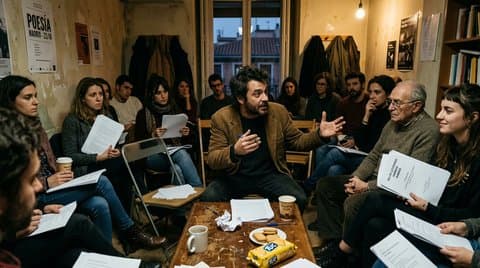
Every Tuesday at seven in the evening, in the basement of a damp municipal cultural center off the Calle del Pez in Madrid, twenty-two individuals who should know better sit in a circle on creaking metal folding chairs. We have paid one hundred and forty euros a month for the privilege of torturing one another. On the scratched laminate table in the center sits our shared offering: a package of stale supermarket tea biscuits, four cardboard cups of lukewarm filter coffee that tastes like dissolved pencil graphite, and a stack of eighty-four freshly stapled A4 photocopies.
Outside, in the real world of 2026, autonomous compute clusters are quietly producing entire genre trilogies in forty seconds. Silicon Valley pitch decks claim that narrative synthesis is now a solved commodity. Streaming services deploy automated script-parsing models to greenlight pilot episodes based on algorithmic retention probability.
Inside our subterranean bunker, however, none of this matters. For ninety agonizing minutes, we are locked in a mortal, passionate civil war over whether a retired bank manager named Don Anselmo should delete the word "ineluctably" from the third paragraph of page seven.
"It slows down the cadence," argues a twenty-four-year-old poet with dyed raven hair and three rings through her left nostril, tapping her ballpoint against her knee. "It sounds like a nineteenth-century translation of Victor Hugo done by a blind notary."
Don Anselmo’s face turns the color of a bruised plum. He clutches his twenty-page chapter—the forty-second installment of his unpublished genealogical saga set during the Carlist Wars—as though defending a liturgical relic from an invading militia. "The word is necessary," he stammers, adjusting his reading bifocals with trembling dignity. "It establishes the tragic weight of the lineage."
I sit between them in my faded brown corduroy jacket, my bank balance hovering at 214 euros following yesterday’s gas bill, listening to them tear each other’s adjectives to pieces. And as I watch them, a thought strikes me with the cold clarity of a Madrid winter morning: this dingy basement is not a classroom. It is a psychiatric ward for analog castaways. And it is the most honest place left in European civilization.
The Ecology of the Aspiring Class
Anyone who has ever spent time in a metropolitan creative writing workshop knows that the demographic composition follows an unwritten, universal taxonomy. The participants change cities—Paris, Barcelona, Berlin, Madrid—but the emotional archetypes remain as rigid as commedia dell'arte masks:
There is the Draft Hoarder, who has spent fourteen years polishing the same thirty-page opening sequence of an experimental novel without ever letting a protagonist speak a single sentence of dialogue.
There is the MFA Theoretical Nihilist, who has read every word of Blanchot, Derrida, and Agamben, but whose own prose reads like an operating manual for an electric toaster written by a depressed sociolinguist.
There is the Genuinely Gifted Novice, a quiet nineteen-year-old girl from Vallecas who submits three pages written in raw, incandescent Spanish that makes the rest of us want to take our stapled manuscripts into the alley behind the building and set them on fire.
And finally, presiding over this circle of wounded egos, is the Workshop Moderator—a forty-five-year-old novelist with two critically acclaimed, fiercely unsold books published by an independent press in 2017, who survives by arbitrating these weekly skirmishes while silently praying that none of his students ever wins a major literary prize.
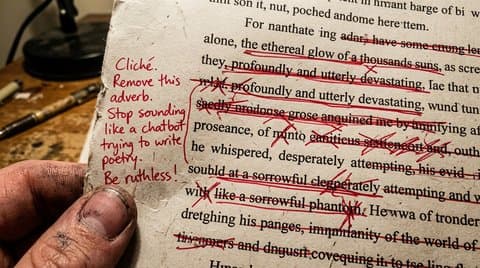 A printed literary manuscript page heavily edited with aggressive red ballpoint pen corrections
We do not attend these workshops to learn technique. By age thirty, anyone who possesses the obsessive neurosis required to sit alone in a room for four hours every night knows how to construct a scene. We attend because the workshop is the only place in our fragmented, hyper-optimized society where our collective delusion is treated as an urgent matter of life and death.
The MFA Workshop Illusion vs. Solitary Artisanal Reality
To understand why the writing workshop survives in the age of algorithmic text generation, one must contrast the commercial mythology of creative writing programs with the brutal reality of the craft:
Dimension | The Commercial Workshop Myth | The Solitary Artisanal Reality |
|---|---|---|
Primary Social Function | Prestigious networking, editorial agent discovery, career launchpad | Mutual emotional hostage-taking among twenty-two insecure obsessives |
Epistemic Goal | Polishing prose to satisfy standard commercial publishing guidelines | Discovering the irreproducible, embarrassing peculiarity of one’s own voice |
Reaction to AI Text | Technophobic panic; anxiety over being replaced by automated content | Baffled indifference; algorithms write too cleanly to capture human shame |
Atmospheric Currency | Academic prestige, literary theory jargon, competitive credentialism | Cold filter coffee, cheap red ink, wounded pride, and municipal radiator clanks |
Nature of Feedback | Polite institutional consensus designed not to bruise workshop morale | Brutal, microscopic dissection of adverbs that reveals the author’s vanity |
Ultimate Product | A standardized, MFA-sanctioned manuscript that reads like twenty others | A scarred, eccentric stack of pages that will likely remain in a drawer |
Look at the third row: the reaction to machine-generated prose. The publishing industry and the cultural press are currently having a nervous breakdown because large language models can produce competent genre fiction, coherent plot outlines, and fluid conversational dialogue in thirty seconds.
In Room 4 of our cultural center, however, the machine is completely irrelevant. Why? Because the machine is incapable of being pathetic.
A language model writes toward statistical probability. It produces the most likely next token, which means it produces the average consensus of all human prose ever uploaded to the internet. It is grammatically spotless, stylistically polite, and devoid of neurotic friction.
Human literature, by contrast, is born precisely from what is statistically anomalous, shameful, and broken in the author. When Don Anselmo insists on using "ineluctably," he is not making a stylistic error; he is broadcasting his terror of his own impending death to twenty-one strangers who pretend to be critiquing his syntax. You cannot train a neural network on eighty billion parameters to reproduce the specific, tragic smell of an old man’s loneliness.
The Tragicomic Cycle of Nocturnal Revision
How does an unpublished writer survive the knowledge that the world does not want, does not need, and will not pay for their prose? We survive through an absurd, ritualistic four-stage psychological cycle that repeats itself every seven days:
The Tragicomic Drafting Cycle: Midnight Hallucination of Genius → Morning Confrontation with Reality → Ruthless Red-Pen Humiliation → Stubborn Defiance of the Slush Pile
Stage one occurs at two in the morning. Fueled by cold instant coffee and the hum of an ancient refrigerator, you write three pages that feel like the greatest prose composed on the Iberian peninsula since the death of Valle-Inclán. You go to sleep believing you have conquered literature.
Stage two occurs at nine the following morning. You read what you wrote over a bowl of stale cereal, and you discover that your masterpiece is an incoherent, bloated mess of self-indulgent metaphors and pretentious adjectives.
Stage three is Tuesday night in the circle. You sit sweating in your corduroy coat while twenty-one fellow neurotics take their red pens and cross out seventy percent of your adjectives, gleefully identifying the exact sentence where your courage failed you.
And stage four is Wednesday morning. You wake up with your head pounding. You look at your scarred, red-ink-splattered manuscript. Your bank account is still empty. Your last rejection letter from an editorial house in Barcelona is still pinned to the corkboard.
And you sit back down at the desk, pick up the pen, and write the next sentence anyway.
The Subversive Dignity of Writing for Nobody
There are cultural commentators who tell us that writing without an audience is a pathetic waste of human energy. They tell us that if an article or a novel does not generate engagement metrics, monetize its readership, or build a personal brand on social platforms, it has failed to justify its existence.
They understand nothing.
To spend five years writing a six-hundred-page novel that will never be published—to spend forty minutes in a basement arguing over a comma with an eighty-year-old retired clerk—is the ultimate act of anti-capitalist rebellion. It is work done without utility. It is beauty pursued without profit. It is human attention poured into language for no other reason than the stubborn, miraculous conviction that words still mean something.
When our workshop ends at eight-thirty, we pack our papers into our canvas tote bags. We turn off the fluorescent lights. We walk out together into the damp, cold night of the Calle del Pez. Don Anselmo lights a filtered cigarette with trembling hands. The young poet adjusts her scarf.
We are not going to win the Planeta prize. We are not going to be reviewed in the Sunday cultural supplements. We are not going to be bought out by Netflix.
We are twenty-two neurotics who will go back to our drafty apartments, boil water for tea, and sit down in front of a blank page in the dark. And as long as one human being is willing to cross out an adjective in red ink simply because it rings false, the machines will have conquered nothing.