

In Praise of the Physical Margin
In our Turin workshop, when we pull a fresh sheet of damp cotton rag paper from the felt blankets of the platen press, the first thing an apprentice notices is not the black architecture of the lead type. It is the unprinted white space surrounding the text block.
A modern commercial publisher, obsessed with unit margins and pulp yield, views blank paper as wasted capital. They crop the margins to eleven millimeters, squeeze fifty-two lines onto a page, and compress the gutters until the reader must crack the glued spine just to decipher the inside words. In the digital feed, the margin does not merely shrink; it ceases to exist altogether. The interface of the glass tablet or smartphone is an edge-to-edge panopticon: every square millimeter of the display is occupied by text, animated navigation banners, recommended algorithm feeds, or pulsating notifications.
In classical Renaissance printing—from Aldus Manutius in Venice to the Kelmscott Press in London—the margin was never an empty void. The margin was an architectural moat. It was the white fortress that protected the reader’s sovereign deliberation from the clamor of the world outside.
When you hold a book whose margins comprise more than forty-five percent of the page's total surface area, your peripheral vision is bathed in stillness. The eye does not dart toward an adjacent hyperlink or an auto-refreshing sidebar. It rests within a deliberate pool of silence.
The Colonization of the Blank Page
To understand why the digital mind suffers from chronic cognitive fatigue, one must examine what happened when reading was transferred from bound physical sheets to infinite computational streams.
A physical page possesses an uncompromising geometry. It has a beginning at the top left and an ending at the deckle edge of the bottom right. When your thumb turns the leaf, your neuromuscular memory registers a discrete physical transaction: an idea has concluded, a pause has intervened, and a new mental room has been entered.
The infinite digital scroll destroyed the pause. By removing page breaks and eliminating the physical margin, modern software designers engineered a state of perpetual unfinished consumption. You do not read an article; you tread water inside an endless current of text designed never to let your attention come to rest.
Textual Dimension | The Borderless Infinite Stream | The Bound Archival Margin |
|---|---|---|
Spatial Architecture | Fluid, dynamic viewport with zero fixed borders | Rectilinear, fixed golden ratio with generous white moats |
Reader Attention | Dispersed peripheral scanning hunting for visual cues | Deep foveal focus anchored by high-contrast unprinted space |
Material Friction | Frictionless capacitive glass with zero tactile feedback | Mechanical resistance of cotton rag paper and letterpress bite |
Marginalia Capacity | Fleeting digital highlights locked in proprietary vendor silos | Permanent graphite pencil notes and personal intellectual dialogue |
Cognitive Temporality | Real-time temporal urgency demanding instantaneous response | Generational slowness designed to outlive centuries of digital noise |
As the comparative table reveals, the margin is not a decorative luxury for bibliophiles; it is a prerequisite for independent thought.
When an interface eliminates the white space, it eliminates the temporal gap between perception and reaction. The reader is denied the crucial five seconds required to lift their eyes from the paragraph, gaze into the white void of the paper, and ask the decisive question: Is this claim true, or is it merely persuasive?
The Scriptorium of the Hand
In my studio on Via Po, we print on two-hundred-gram cotton paper hand-cast in Fabriano. When the heavy cast-iron bed of the press presses inked lead into the damp fiber, it creates a tactile depth that no laser printer or high-resolution OLED screen can reproduce.
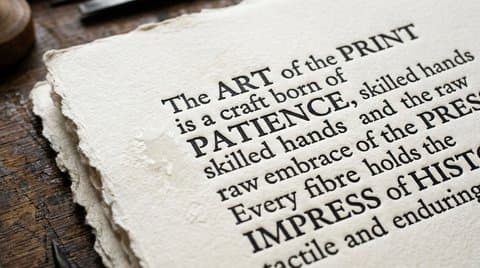 Debossed letterpress print on deckle-edge cotton rag paper
You can close your eyes and run your fingertips across the printed page; you will feel the deep, crisp relief of every serif letter. That relief is the physical imprint of pressure, oil, and mineral carbon biting into vegetable fiber.
The Cognitive Sanction of the Margin: Lead Movable Type Bite → Unprinted Cotton Moat → Still Peripheral Field → Generational Marginalia → Undivided Sovereign Contemplation
This tactile tooth invites the reader's own hand into the work. A true reader does not merely passively absorb a book; they deface it with graphite. In the wide white borders of an eighteenth-century volume of Vico or Leopardi, you can trace three centuries of conversation: Latin corrections from a Jesuit scholar in 1780, pencil objections from an Italian patriot in 1848, and blue fountain-pen reflections from a student in 1968.
The physical margin is a communal scriptorium where the reader speaks directly to the author across time.
In contrast, modern digital readers reduce your interaction to a sanitized yellow highlight that syncs to a corporate database, aggregated with thousands of other users to feed an algorithm that optimizes next quarter's advertising engagement. Your private marginalia is stripped of its idiosyncratic handwriting, extracted from the page, and monetized as user telemetry.
The Gutenberg Secession
We are witnessing the emergence of what I term the Gutenberg Secession: a deliberate, growing withdrawal of serious thinkers, poets, and scholars from the synthetic flood of digital text.
They are not Luddites reacting out of unthinking nostalgia; they are cognitive preservationists who recognize that when language becomes infinitely cheap, instantaneous, and automated, it loses its capacity to anchor human culture.
When an artificial intelligence can generate ten thousand words of immaculate, grammatically flawless prose in thirty seconds, the volume of synthetic text on the internet ceases to be an asset and becomes an environmental hazard. The web is drowning in automated summaries of automated papers, reviews of books that were never read, and commentary generated to satisfy the keyword density requirements of search crawlers.
In this ecosystem of synthetic saturation, the only defense of truth is material scarcity:
The Scarcity of Time: Setting a sixteen-page quire in lead type by hand takes two weeks of patient, physical labor. That friction guarantees that you do not print trivia. You commit to metal only words that have survived the scrutiny of sleepless nights.
The Scarcity of Matter: Pure rag paper, cold-pressed linseed oil, and bindery thread are finite physical resources that demand care, craftsmanship, and expense.
The Sanctuary of the Border: The physical book cannot be updated over the air. It cannot send a notification to interrupt your sentence. It cannot track which paragraph made your pupils dilate.
Reclaiming the White Space
The crisis of our era is not a scarcity of information; it is a total, catastrophic collapse of silence.
Every commercial app on your device is an engineered attack on the margin. They fill your peripheral vision with badges, recommendations, and synthetic prompts because a quiet, uncolonized mind is an economically unproductive mind. The moment you are allowed to rest in the white space, you stop clicking. You stop generating ad revenue. You start thinking for yourself.
To open a hand-bound book with generous four-inch margins is an act of radical civil disobedience against the noise of the digital empire.
It is a declaration that some things must remain bounded, finite, and unmonitored.
When you sit at your wooden desk with an open book, smelling the bitter linseed oil of the ink and the clean cellulose of the paper, look not only at the black letters of the poem. Look at the wide, calm expanse of white that surrounds them. That white space is not empty. That white space is the sanctuary of your own freedom.