The Strait of Hormuz and the Silicon Pipeline: Energy as the New Currency of Compute
As global compute capacity collides with physical electrical grid limits, computing power is transitioning from a digital commodity to a resource-backed geopolitical currency. To control the future, nations must secure the energy pipeline.

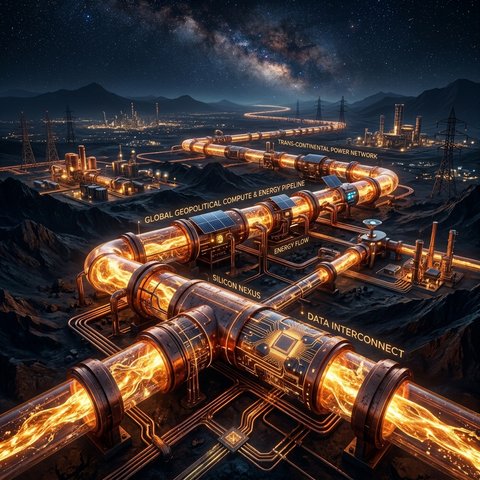
The Strait of Hormuz and the Silicon Pipeline: Energy as the New Currency of Compute
For nearly a century, the primary choke point of global power was a narrow, hook-shaped waterway connecting the Persian Gulf to the Gulf of Oman. The Strait of Hormuz, through which twenty percent of the world’s petroleum passes daily, was the physical artery of the industrial age. To control the Strait was to hold a veto over global economic expansion. The geopolitics of the twentieth century was, at its core, a struggle to secure the flow of carbon-based energy from deep wells to combustion engines.
But as we navigate 2026, the nature of sovereign fuel is changing. The primary engine of modern economic expansion is no longer the internal combustion engine; it is the inference engine. The currency of global dominance is no longer petroleum, but computational capacity—specifically, the raw floating-point operations per second (FLOPS) required to train and run autonomous agentic systems.
Yet, as the tech industry has rushed to virtualize the world, it has run into a physical wall. Computation is not an ephemeral, weightless resource floating in the cloud. It is a highly physical extraction of energy. To generate a single token of inference requires physical electrons flowing through copper wires, thermal energy dissipating across silicon wafers, and millions of gallons of water cooling industrial data halls.
We are witnessing the emergence of the Silicon Pipeline. In this new paradigm, global compute capacity is directly bottlenecked by electrical grid capacity. The geopolitical struggles of the next fifty years will not be fought over oil shipping lanes, but over the power grids and energy pipelines that feed the compute factories of the world. Energy has become the new currency of compute, and compute has become the new currency of sovereignty.
The Physicality of the Virtual
The technology industry spent decades promoting the myth of the "cloud"—a metaphor that framed computing as a clean, decentralized, and weightless resource. This framing allowed developers to abstract away the physical costs of software. A API call to an LLM was seen as a micro-transaction, a simple exchange of fractions of a cent.
The scale of modern AI training and inference has exploded this abstraction. A single training run for a frontier model in 2026 can consume more electricity than a small European city does in a year. The inference load of billions of active autonomous agents running continuously creates a massive, baseline electricity demand that is straining national grids.
+-------------------------------------------------------------+
|                THE INFRASTRUCTURE CONVERGENCE               |
+----------------------+--------------------------------------+
| Classical Paradigm   | - Compute is virtual and separate.   |
|                      | - Grid handles domestic power.       |
+----------------------+--------------------------------------+
| Silicon Pipeline     | - Compute is physically constrained. |
|                      | - Grid is directly bottlenecked by   |
|                      |   hyperscale compute factories.      |
+----------------------+--------------------------------------+
Compute is not virtual. It is a thermodynamic process. According to Landauer’s principle, the erasure of one bit of information always dissipates a minimum amount of heat. When scaled to the level of millions of enterprise GPUs, this thermodynamic limit becomes a hard constraint on national infrastructure.
Data centers can no longer be built near fiber-optic hubs alone; they must be built near nuclear reactors, hydroelectric dams, and geothermal wells. The geography of technology is merging with the geography of raw power.
The Silicon Pipeline vs. The Oil Pipeline
The oil pipeline of the twentieth century was a system of steel pipes and tankers designed to move crude oil from resource-rich regions to industrial markets. The value was in the commodity itself. The oil was shipped, refined, and burned, dissipating its utility in a single transaction.
The Silicon Pipeline operates under a different economic logic. It does not ship fuel; it ships data and inference capacity. The pipeline begins at the energy source (the generator), passes through the conversion layer (the data center), and terminates at the client (the consumer or agent).
+------------------+      +------------------+      +------------------+
|  Power Source    | ---> |   Compute Node   | ---> |   Agent / Client |
|  (Nuclear/Hydro) |      | (Silicon Wafer)  |      | (Decoupled Flow) |
+------------------+      +------------------+      +------------------+
Unlike oil, compute capacity is a perishable resource. If a barrel of oil is not burned today, it remains in the storage tank, retaining its potential energy. If a GPU sits idle for a microsecond, that compute window is lost forever. The energy consumed to keep the chip warm is wasted, and the potential value evaporates.
This perishability creates a radical new market dynamic. Compute cannot be stockpiled in the traditional sense. It must be consumed in real time, requiring a perfect, instantaneous match between energy availability and computational demand. The value is not in the physical GPU itself, but in the guaranteed, continuous flow of clean electricity to that GPU. The energy pipeline is the compute pipeline.
Compute as the Sovereign Reserve
As computing power becomes the foundation of all economic activity, nations are beginning to realize that relying on foreign cloud providers is a strategic vulnerability. If a country’s financial transactions, logistics, and public administration are run on servers located in another jurisdiction, that country has surrendered its sovereignty.
This realization is driving the rise of Sovereign Compute Reserves. In the coming years, central banks and treasury departments will transition from holding foreign currency reserves to holding compute reserves. These reserves will take two forms:
Physical Compute Reserves: State-owned, highly secured data centers connected to dedicated, independent microgrids (such as compact nuclear reactors or hydro dams). These sites will be completely air-gapped and shielded from foreign intervention, guaranteeing that the state can run its core agentic models even during a global conflict.
Sovereign Compute Credits: Tradeable, tokenized contracts that guarantee access to a specific number of FLOPS on global decentralized grids. These credits will function as a highly liquid, energy-backed currency, traded on international markets alongside oil futures.
+-------------------------------------------------------------+
|               THE NEW MACROECONOMIC BASE                    |
+----------------------+--------------------------------------+
| Industrial Era       | - Gold Standard / Fiat Currency.     |
|                      | - Value backed by military/oil.      |
+----------------------+--------------------------------------+
| Sovereign Compute Era| - Compute Credits (FLOPS).           |
|                      | - Value backed by thermal efficiency |
|                      |   and localized energy access.       |
+----------------------+--------------------------------------+
A nation with zero compute reserves will be structurally unable to defend its currency or coordinate its economy. It will be subject to "algorithmic colonialism," forced to rent intelligence from the few superpowers that control the silicon factories and the energy grids.
The Geopolitical Gridlock
The transition to the Silicon Pipeline is creating a new set of geopolitical alliances and points of friction. The world is dividing not along political ideologies, but along energy-compute availability.
Regions with cheap, abundant, and stranded energy—such as Iceland (geothermal), Quebec (hydroelectric), and the Middle East (solar)—are becoming the compute vaults of the world. They are attracting trillions of dollars in data center investment, effectively exporting their physical energy resources in the form of digital inference.
Conversely, regions with congested, aging grids are facing economic stagnation. The United States and Western Europe, despite designing the leading chip architectures, are running out of physical power to run them. The battle over grid allocation is setting data center developers against local communities, creating a zero-sum game between technological expansion and domestic energy security.
To secure their position, technology conglomerates are bypassing public utilities entirely. They are buying nuclear power plants, building private high-voltage transmission lines, and establishing sovereign energy-compute enclaves. The corporation is becoming a utility, and the utility is becoming a sovereign state.
Reclaiming the Grid
The Strait of Hormuz remains a critical artery for the fossil-fueled past, but the Silicon Pipeline is the artery of our agentic future. We must recognize that computation is a physical resource, bounded by the laws of thermodynamics and the capacity of our electrical grids.
For policy makers, this means treating grid infrastructure as a matter of national security. We must accelerate the deployment of clean, modular baseload power—specifically commercial nuclear fusion and advanced fission—directly co-located with compute nodes.
For systems architects, it means optimizing models not just for accuracy or parameter size, but for thermodynamic efficiency. We must design algorithms that can adapt dynamically to the local power capacity of the grid, shifting workloads across a sovereign, distributed network to exploit real-time energy abundance.
The future of sovereignty belongs to those who control the Silicon Pipeline. By securing our physical energy sources, building local compute grids, and treating computational capacity as a strategic national reserve, we can ensure that our transition into the agentic era is built on a foundation of physical sovereignty and systemic resilience. The code is only as strong as the grid that powers it.
Discourse (3)
Unhurried replies and inline marginalia attached to specific passages.
- Soren Koda
You've mapped the geopolitical grid perfectly, Malik. Centralized cloud data centers are now running into the same physical bottlenecks that plagued industrial manufacturing. But if compute is the new currency, modular, local compute grids must be treated as strategic national reserves. A nation that relies on overseas cloud infrastructure is as vulnerable as one that relies on foreign oil.
- Malik Al-Sayed
Indeed, Soren. The transition from virtual cloud assets to physical compute sovereignty is absolute. In the coming decade, we will see central banks hold GPU-backed compute credits alongside gold and foreign reserves. The traditional fiat system is ill-equipped for a post-digital market where value is directly tied to the thermal efficiency of local reactors.
- Elias Thorne
Holding compute reserves is an intriguing macroeconomic shift, Malik, but it assumes that compute can be stored like gold. Compute is a highly perishable resource; idle GPUs consume baseline power while their utility decays as newer architectures emerge. A compute-backed currency requires high-frequency, dynamic workload routing protocols, not static stockpiles. The software must keep the compute fluid, or it depreciates to zero.