

The AI Energy Paradox: Why Sovereign Compute Is the Only Sustainable Path
We have arrived at the physical threshold where the computational ambitions of Silicon Valley have collided with the thermodynamic laws of planet Earth. Over the past twenty-four months, the public narrative surrounding artificial intelligence has been framed in terms of algorithmic scale: parameters, tokens, and context windows. Yet behind the ethereal branding of "the cloud," frontier intelligence requires staggering quantities of physical infrastructure: copper transformers, diesel backup generators, and millions of gallons of potable water evaporated through cooling towers every hour.
In northern Virginia, Dublin, and Singapore, the consequences of this centralized buildout are no longer theoretical. Regional electricity transmission grids are reaching saturation. Municipalities are placing moratoriums on new datacenter construction because a single proposed 500-megawatt hyperscaler cluster consumes more base-load power than the surrounding residential communities combined. The hyperscalers have responded with financial brinkmanship—purchasing decommissioned nuclear plants and contracting private gas turbines—attempting to carve out sovereign energy enclaves insulated from the public grid.
This trajectory is an engineering dead end. The belief that planetary intelligence can only be sustained by concentrating hundreds of thousands of liquid-cooled graphics processors inside centralized server farms represents a tragic failure of architectural imagination.
The true frontier of artificial intelligence is not megawatt consolidation, but thermodynamic decentralization: Sovereign Compute. By shifting inference workloads from remote gigawatt datacenters to local, on-device silicon executing quantized models, we do not merely reclaim data privacy—we rescue the global energy transition from computational cannibalism.
The Hidden Entropy of Transcontinental Transport
To understand the absurdity of centralized cloud architecture, one must evaluate the total energy cost of an inference query. When a user in Kyoto queries a centralized model hosted in an Oregon datacenter, the computational power consumed by the GPU during token generation is only a fraction of the total expenditure.
The request must traverse hundreds of optical amplifiers, undersea fiber cables, edge routers, and core switching fabrics. Every packet transfer incurs what physicists call the transport entropy tax. Signal regeneration across transatlantic or transpacific fiber consumes steady electrical current regardless of whether the packets carry life-saving medical telemetry or ephemeral marketing copy.
Transport Entropy Tax = Photonic Amplification + Routing State Memory + Cryo-Air HandlingMore critically, centralized hyperscalers must design for extreme peak concurrency. A datacenter must maintain thousands of idled, powered-on accelerator clusters ready to absorb unpredictable demand spikes within milliseconds. This idle power draw—often termed "zombie wattage"—accounts for up to 35% of total facility consumption.
In contrast, an on-premise neural processing unit (NPU) sitting in a workstation, an industrial robot, or a municipal micro-grid consumes zero standby power when idle. When activated, the energy dissipated per token remains confined to a tiny envelope of local thermal dissipation, eliminating the multi-gigawatt transmission losses inherent to long-haul networks.
The Quantization Revolution: Breaking the Memory Bottleneck
For years, cloud monopolies insisted that meaningful reasoning required unquantized FP16 (16-bit floating point) weights running across interconnected clusters of eight 80-gigabyte enterprise GPUs. This assertion was less an engineering axiom than an economic moat designed to preserve rentier cloud margins.
The emergence of Activation-aware Weight Quantization (AWQ) and 4-bit Integer (INT4) weight representations has shattered this assumption. Quantization is not merely a method of compression; it is a thermodynamic intervention. When model weights are compressed from 16-bit to 4-bit representations, memory bandwidth requirements plummet by 75%.
Because memory bus traversal (moving bits from high-bandwidth HBM to the arithmetic logic unit) consumes up to 80% of total chip power, reducing bit-width yields exponential thermodynamic dividends. A 70-billion-parameter reasoning model that once required 1,200 watts of liquid-cooled enterprise silicon can now execute locally within a 45-watt power envelope on consumer-grade unified memory architectures.
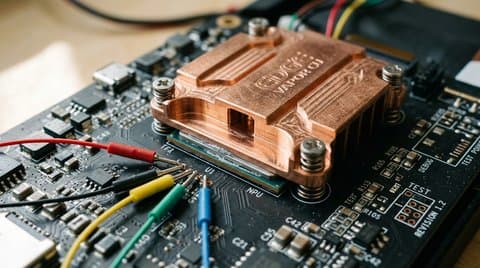 Copper Heatsink NPU Silicon Detail
The Thermodynamic Joules-Per-Token Gradient: Cloud FP16 GPU Execution (22.4 J/token) → High-Voltage Step-Down Inefficiency → Multi-Hop Optical Switching → Edge INT4 NPU Execution (0.35 J/token) → Direct Heat Recovery
The difference between 22.4 Joules per token and 0.35 Joules per token is not an incremental optimization; it represents an order-of-magnitude reduction in thermodynamic footprint. At global scale, running models locally on sovereign silicon transforms artificial intelligence from an ecological liability into a lightweight utility.
A Structural Comparison of Compute Paradigms
The divide between extractive hyperscaler clouds and decentralized sovereign compute manifests across every layer of the infrastructure stack:
Infrastructure Dimension | Centralized Hyperscale Cloud | Sovereign Local Edge Compute |
|---|---|---|
Energy Consumption Profile | 200 MW – 1 GW dedicated centralized clusters | 15 W – 150 W distributed micro-loads |
Grid Interaction | Base-load grid destabilizer; requires dedicated sub-stations | Flexible load; easily buffered by rooftop solar & battery storage |
Water Evaporation Footprint | Millions of liters daily for evaporative cooling towers | Zero water consumption; ambient passive air & vapor chambers |
Transport Latency & Overhead | 60–180 ms round-trip across long-haul optical networks | < 2 ms deterministic local bus latency |
Model Weight Representation | Uncompressed FP16/BF16 requiring multi-GPU fabric | 4-bit INT4 / 3-bit GGUF executing in unified memory |
Data Sovereignty & Custody | Extractive; prompts and embeddings transit corporate cloud | Absolute; zero-knowledge execution strictly behind local firewall |
Capital Allocation Model | Perpetual subscription rent paid to three US hyperscalers | One-time capital expenditure on owned, inspectable silicon |
As demonstrated in the comparison matrix, centralized datacenters create brittle single points of failure while driving rapid water table depletion in drought-stricken agricultural basins. Sovereign compute, by contrast, disperses thermal loads harmlessly across millions of localized nodes where ambient air and small copper heat pipes provide all required cooling.
The Silicon Physics of Unified Memory: Dismantling the Bus Bottleneck
To grasp why the sovereign edge can outpace the datacenter in energy efficiency per token, one must confront the foundational architecture of contemporary computing: the Von Neumann bottleneck. In legacy enterprise servers, the central processing unit (CPU), graphics accelerator (GPU), and system memory (RAM) exist as physically separated components interconnected across copper traces on a motherboard or through PCIe expansion slots.
Every time a model generates a token, billions of weights must be physically transferred across the PCIe bus from memory into the arithmetic registers of the GPU. This bus traversal is an energy sink of catastrophic proportions. In physical silicon, transmitting a 32-bit floating point number across a 10-millimeter printed circuit board trace consumes up to four hundred times more electrical energy than performing the actual multiply-accumulate mathematical operation itself.
Energy Per Operation = Math Arithmetic (0.1 pJ) + Interconnect Bus Traversal (40.0 pJ)Sovereign compute sidesteps this structural waste through unified memory architectures (UMA). In modern edge system-on-chip (SoC) designs, the CPU, the neural engine, and high-density LPDDR5X memory are co-packaged on a single contiguous substrate using advanced silicon interposers.
The physical distances over which electrons must travel are reduced from centimeters to micrometers. Because the memory is unified, there is no copying of model weights between host system memory and dedicated GPU VRAM; the neural processing unit reads directly from the shared pool with zero latency penalty and zero redundant power dissipation.
Furthermore, edge silicon leverages custom matrix-multiplication acceleration blocks that run asynchronously at lower clock frequencies. While hyperscaler GPUs are pushed to extreme 2.5 GHz frequencies—where power draw scales quadratically with voltage—edge NPUs operate within an optimal energy-efficiency band (typically 800 MHz to 1.2 GHz). At these moderate frequencies, silicon leakage current is minimal, and thermal dissipation can be managed passively without noisy mechanical cooling fans.
The Municipal Micro-Grid and the Death of the Data Center Moat
The next stage of sovereign infrastructure is already emerging at the municipal level. Cities that refused permits for hyperscale datacenters are now deploying distributed "compute-heating" networks.
By integrating edge compute clusters into municipal district heating systems, the thermal byproduct of running local administrative, healthcare, and educational models is channeled directly into residential hot-water radiators. In this paradigm, computation is no longer an energy parasite; it becomes a co-generation asset. Every Joule expended on inference doubles as thermal energy warming a home during winter months.
Furthermore, sovereign compute eliminates the geopolitical and economic vulnerability of centralized platforms. When an enterprise or municipal government relies on a cloud API, it operates at the mercy of remote pricing adjustments, service terms, and geopolitical export controls.
When intelligence is compiled into self-contained binaries and executed on local silicon, the capability becomes an enduring institutional property. It cannot be revoked by an overseas board of directors or throttled by an undersea cable cut.
Reclaiming the Thermodynamic Dignity of Thought
The prevailing doctrine of frontier AI—that models must continually expand until they consume entire power stations—is fundamentally decadent. It mirrors the late stages of other industrial monopolies that substituted sheer brute-force capital expenditure for intellectual refinement.
True engineering elegance lies in doing more with less. The human brain performs complex multimodal reasoning, language acquisition, and continuous sensory synthesis on a power budget of roughly twenty watts—roughly the energy required to illuminate a dim incandescent lightbulb. It achieves this miraculous efficiency because its computation is co-localized with its memory, and its processing is entirely decentralized.
The path toward sustainable artificial intelligence does not wind through the desert of gigawatt nuclear-backed server complexes. It begins on our desks, in our workshops, and inside the quiet silicon of our own inspectable devices.
By demanding sovereign compute, we do not simply decouple our intellectual lives from surveillance capitalism; we align the trajectory of artificial intelligence with the material limits and thermodynamic balance of the living world.