
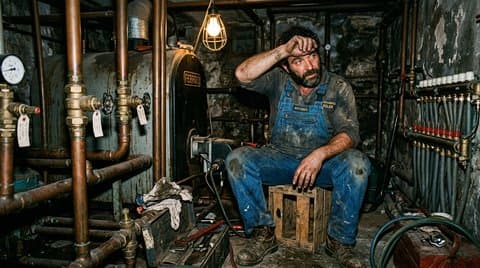
The Smell of Burning Flux at Midnight
There is an acrid, chemical sweetness that enters your nostrils when a zinc chloride paste hits a cherry-red copper fitting at one in the morning. It smells like boiled vinegar, scorched pine resin, and clean ionized air. If you spend twenty-four years crawling under the suspended floors of Barcelona apartment blocks with a propane blowtorch tucked under your arm, that smell becomes your compass. It is the smell of a seal being made. It is the exact sensory boundary where two pieces of cold, stubborn metal are forced into an irrevocable metallurgical marriage by four hundred degrees of flame and two inches of melting silver wire.
Upstairs, three floors above the damp masonry of the boiler room, the tenants are asleep. Above them, somewhere in the ether of fiber-optic cables and server farms, algorithms are busily generating synthetic essays, adjusting algorithmic investment portfolios, and simulating human empathy for ninety euros a month.
Down here, beneath six stories of damp brick and vibrating waste pipes, nobody cares about your prompt. The hydrostatic pressure in the riser is holding at five point eight bars. If my solder joint has a single microscopic pinhole—if a grain of limescale fell into the socket, or if I failed to clean the pipe with emery cloth until the raw pink metal shone—the water will find it before the sun comes up. It will not negotiate. It will not offer an apologetic disclaimer. It will carve a channel through the weakness, soak through the ceiling plaster of the third-floor apartment, and drop cold, brownish water onto a sleeping tenant's antique parquet floor.
The False Promise of Disembodied Omnipotence
Our culture is currently drunk on the illusion of frictionless abstraction. For two decades, we have been told by technologists that physical matter is merely a slow, inconvenient legacy layer—that wealth, thought, and even human identity will soon be entirely abstracted into digital weightlessness. They call this progress. They call manual labor an undignified chore waiting to be eliminated by robotic dexterity or synthetic workflow automation.
Let them spend an hour under the sanitary floor of a 1920s building in the Eixample.
When you slide on your stomach through a crawlspace thirty centimeters high, your cheek pressed against damp gravel and century-old sewer pipe dust, you discover real humility. You cannot zoom out. You cannot refactor the physical layout of cast-iron drainpipes that were sloped at one percent grade by an anarchist stonemason in 1923. You have to work within the physical constraints left behind by dead men. You have to carry the weight of your own spine, your own breath, and the cold draft whistling through the air bricks.
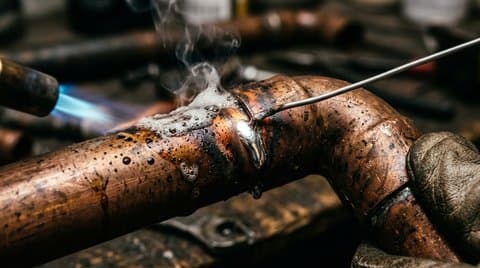 A master plumber applying heat and tin solder to a copper pipe joint
The digital class believes that the world can be debugged through clever syntax. But physical systems do not obey code; they obey thermodynamics, galvanic potential, and gravity. When you connect a new copper pipe directly to an old galvanized iron riser without a dielectric union, the copper will literally eat the iron from the inside out through galvanic corrosion. The electrons will flow from the less noble metal to the more noble metal whether you have a doctorate in computer science or whether you dropped out of school at fourteen. Nature does not read your credentials.
Virtual Omnipotence vs. Subterranean Resistance
The existential divide between the symbolic economy and physical craftsmanship is not a matter of social prestige. It is a fundamental difference in epistemic honesty:
Operational Dimension | The Virtual Symbolic Sphere | The Subterranean Physical Trench |
|---|---|---|
Epistemic Arbiter | Social consensus, algorithmic engagement, investor pitch | Hydrostatic head, gravity, thermal expansion, tensile shear |
Cost of an Error | Mild reputational discomfort, software rollback, hotfix deployment | Structural flooding, scalding water burns, collapsed ceilings |
Material Resistance | Near-zero friction; keystrokes and prompts are effortlessly reversible | Stubborn physical density; cold bronze, seized iron, caustic sewer gas |
Temporality | Microsecond latency; illusion of instantaneous completion | Biological endurance; hours on knees waiting for a riser to drain |
Sensory Atmosphere | Glare of backlit LEDs, sterile office acoustic cancellation | Hiss of blue propane flame, smell of burnt flux, vibration of pumps |
Existential Grounding | Disembodied cognitive drift, anxiety of synthetic obsolescence | Indisputable material proof of utility; dry floors and hot radiators |
Notice the fourth row: the cost of an error. In the world of enterprise software, when an engineer writes sloppy code, the cloud infrastructure simply scales horizontally to absorb the inefficiency. The client pays an extra hundred dollars on their monthly hosting bill, and nobody bleeds.
In hydraulic infrastructure, there is no horizontal scaling. If you don't use enough heat, the solder forms a cold joint—a brittle, crystalline sludge that looks solid on the outside but fails the moment a washing machine solenoid valve slams shut and sends an eight-bar water hammer rebounding through the copper manifold. When that happens at three on a Sunday morning, it is not an abstract incident ticket. It is an emergency that requires you to crawl out of bed, drive your battered diesel van through the empty rain-slicked avenues of the city, and submerge your arms up to the elbows in murky, freezing water to turn off an unlabelled curb stop.
The Metallurgical Capillary Arc
How does a joint actually hold five bars of continuous pressure for fifty years without a single drop escaping? It holds because of capillary attraction—a physical law that is as beautiful and indifferent as the orbit of Saturn:
The Metallurgical Capillary Arc: Mechanical Deoxidation (Emery) → Chemical Activation (Zinc Flux) → Thermal Equilibrium (400°C) → Capillary Suction of Liquid Alloy → Crystalline Hermetic Bond
You cannot push liquid solder into a joint. If you try to force it, the molten metal simply beads up and falls to the floor in useless silver drops.
You must heat the fitting—not the pipe, but the fitting itself. You hold the torch flame against the back of the socket until the copper turns a dull, dark orange. You watch the white flux turn clear and bubble furiously at the seam. Then, and only then, you touch the cold wire to the opposite lip of the joint.
If the temperature is true, the liquid tin-antimony alloy is miraculously sucked inward against gravity by the capillary tension of the microscopic clearance between the pipe and the fitting. It travels upward and around the entire circumference in a fraction of a second, drawing a perfect silver ring around the seam.
You take away the heat. You wipe the excess flux away with a damp rag before the acid can pit the copper. The joint cools, clicks quietly as the crystals lock into place, and turns rigid.
That joint will outlive me. It will outlive the startup that hired the apartment on the fourth floor. It will outlive whatever fashionable language model is currently dominating the headlines. Long after our current digital artifacts have been lost to link rot, server shutdowns, and proprietary format obsolescence, that small ring of silver-soldered copper will be sitting in the darkness beneath the floorboards, holding back six bars of cold river water, doing exactly what it was made to do.
The Last Bastion of Working-Class Dignity
They tell us that artificial intelligence is coming for every profession. They say that writing, drawing, legal drafting, and accounting will be handled by autonomous agentic swarms. Perhaps they are right. Perhaps the intellectual classes are finally about to experience the precarious obsolescence that industrial factory workers suffered forty years ago.
But I know this: no neural network will ever crawl into a flooded crawlspace beneath an old tenement building to unstick a jammed flapper valve in a cesspit. No synthetic model will ever use the tip of its calloused thumb to feel whether a threaded brass nipple is cross-threaded or whether the Teflon tape has bound cleanly into the grooves.
Physical work is the last unassailable sanctuary of human presence. When you work with your hands, your mind cannot wander into the narcissistic anxieties of the internet. You cannot be depressed while you are holding a torch against a gas line; the immediate danger demands that your entire consciousness inhabit the present millimeter.
At three in the morning, when I finally pack my heavy steel toolboxes back into the van, my overalls smell of damp brick, motor grease, and burning flux. My knuckles are skinned and my knees ache from the concrete. But as I start the engine and look up at the dark windows of the building, I hear the quiet, steady hum of the heating boiler firing on schedule. The pipes are hot. The pressure needle is motionless at two bars. The basement floor is bone-dry.
I don't need an algorithm to tell me who I am. The city is warm tonight because I was down there in the dark. That is enough. That has always been enough.