
Cast Iron Never Lies
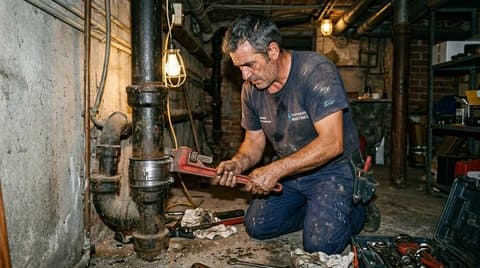
There is a moment, usually around three o'clock on a Tuesday morning, when the elevator has stopped running, the building superintendent has gone home to sleep, and you are sitting on your knees in four inches of freezing greywater beneath an old apartment block in l'Hospitalet de Llobregat.
You have a forty-pound wrench in your right hand, a halogen work lamp hanging from a corroded bracket, and a five-inch vertical cast-iron sanitary stack towering above your head. Somewhere on the sixth floor, someone flushes a toilet. Through the thick, graphite-black skin of the iron pipe, you hear the muffled roar of eight liters of water descending under nine point eight meters per second squared of pure Newtonian gravity.
Water does not care about software architectures. It does not read pitch decks about digital transformation, smart cities, or frictionless automated workflows. Water is a heavy, incompressible physical fluid that obeys two brutal, unnegotiable invariants: it always seeks the lowest point of potential energy, and it dissolves every weak seal in its path.
If your pitch is off by three millimeters over a ten-meter horizontal run, or if an apprentice forgot to seat a neoprene rubber gasket flush against the cast-iron flange, the water will find the void. It does not throw a helpful exception stack trace to an observability dashboard in California. It seeps into the porous concrete, rots the rebar, and collapses the plaster ceiling of the family sleeping below.
The Illusion of Frictionless Cities
For the last fifteen years, the metropolitan elite has lived under the comforting delusion that cities are information systems. We are told by venture-backed municipal consultants that what makes Barcelona, Paris, or London function is the sensor mesh, the smart-grid routing algorithm, and the ride-hailing API.
This is a childish fairy tale invented by people who have never held a blowtorch or felt the alkaline burn of drain cleaner on their forearms.
A city is not an abstraction of code. A city is a precarious mountain of masonry, bronze, copper, and iron held together against relentless thermodynamic collapse by a dwindling army of craftsmen with aching lumbar spines and dirty fingernails.
Urban Operational Layer | The Frictionless Cloud Architecture | The Subterranean Hydraulic Reality |
|---|---|---|
Foundational Law | Algorithmic logic and configurable SaaS policies | Newtonian gravity, hydrostatic pressure, and fluid shear |
Failure Tolerance | Microservice failover with automated retry queues | Catastrophic structural soaking, sewer gas leakage, and rot |
Maintenance Mechanism | Continuous remote integration via GitHub commits | Physical physical intervention in crawlspaces with blowtorches |
Material Degradation | Zero physical friction (pure digital bit manipulation) | Galvanic corrosion, lime scale crystallization, and fatigue |
Human Dignity | Abstract, desk-bound optimization of corporate metrics | Bodily confrontation with physical matter and collective hygiene |
When you study the comparative table, the absurdity of the current technological consensus becomes glaring. Silicon Valley spends billions attempting to train artificial intelligence to automate the writing of corporate emails, while the average age of a licensed master plumber in southern Europe has climbed to fifty-four years.
We are automating the easiest, most superficial layers of human culture while the physical infrastructure that prevents cholera and keeps clean drinking water flowing into our children's glasses is allowed to crumble into invisible obsolescence.
The Chemistry of Galvanic Sacrifice
Take a close look at an old mechanical plumbing junction. When an ignorant renovation contractor connects a modern copper water pipe directly to an ancient galvanized steel riser without inserting a dielectric brass union, they set off an invisible chemical execution.
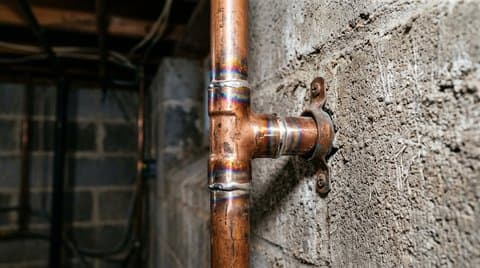 Freshly brazed copper plumbing elbow joint
Because copper and zinc occupy different positions on the galvanic nobility scale, the water flowing through the pipe acts as an electrolyte. The copper greedily strips electrons from the zinc coating of the steel. For four years, the joint looks flawless on the outside. The homeowner enjoys spotless tiled walls and fashionable minimalist faucets.
Meanwhile, inside the darkness of the wall cavity, the steel is being devoured atom by atom.
The Structural Failure Pathway: Concealed Electrolytic Contact → Invisible Galvanic De-Zincification → Micro-Fissuring Under Pressure → Sudden Wall Blowout at Midnight
When the blowout inevitably arrives at three in the morning, soaking through four floors of hardwood parquet and tripping the electrical mains, the owner does not call a venture capitalist. They do not consult a large language model.
They call a plumber who arrives in a diesel van smelling of flux and solder, carrying forty kilos of hand tools up three flights of stairs.
In that moment of wet panic, all the digital pretenses of modernity dissolve. The owner looks at the plumber not as a service vendor, but as an emissary from a real, unforgiving world of physical matter that they had spent decades trying to forget.
Blue-Collar Material Truth
Simone Weil once wrote that physical labor is the ultimate spiritual contact with reality because matter is entirely indifferent to our vanity. You cannot flatter a threaded iron fitting. You cannot manipulate a bronze gate valve with persuasive rhetoric or corporate corporate jargon.
Either the threads are clean, the hemp fiber is wound in the correct direction with sealing paste, and the joint holds six bars of hydrostatic pressure without a weeping drop, or it leaks.
There is no middle ground. There is no partial credit. There is no beta testing in production.
This unyielding binary truth creates a specific psychological clarity in the craftsmen who practice it. When I spend seven hours on my knees in a crawlspace, breathing dust and cutting corroded cast iron with a reciprocating saw, my body pays a heavy price. My hands are scarred, my knees ache when the humidity rises, and my clothes smell permanently of sulfur and cutting oil.
Yet when I turn the main stopcock back on, hear the pipes sing as the water refills the system, and watch the pressure gauge needle rest dead on four bars without a flicker of movement, I experience a profound, sovereign peace that no white-collar salary ever provided.
I know, with absolute sensory certainty, that I have done something real.
The Return to the Pipe
We are approaching a historical tipping point where the digital economy's disdain for manual labor will collide violently with physical reality. You can generate infinite synthetic text, produce flawless AI video, and construct synthetic financial derivatives from an air-conditioned office in Manhattan or London.
But the moment your sewage line collapses, or the city's water mains burst under the pressure of neglected maintenance, all that ethereal wealth counts for nothing.
The city of the twenty-first century will not be saved by smarter algorithms. It will be saved by teaching our children to respect the dignity of the wrench, the physics of the siphon, and the stubborn, beautiful truth of cast iron.