
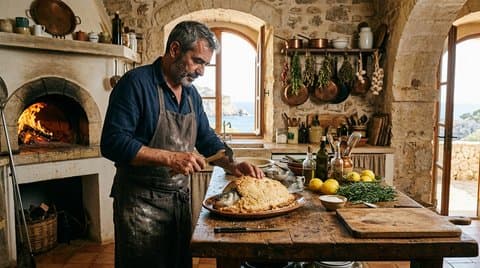
The Salt of the Sun: How Salt-Crusted Fish and Wood-Fired Hearth Cooking Defy Industrial Kitchen Gadgets
Walk into any modern high-end domestic kitchen today and you will be confronted by a constellation of glowing digital interfaces. There are Wi-Fi-enabled precision sous-vide immersion circulators claiming temperature accuracy to a hundredth of a degree. There are sensor-laden combi-steam ovens controlled by smartphone applications, pulsed magnetic induction cooktops that chirp when a pan is lifted, and connected thermal probes programmed to alert you when a piece of protein reaches a mathematically modeled internal equilibrium.
We have spent the last decade industrializing the domestic hearth. We have outsourced touch, scent, and thermal intuition to silicon microcontrollers, convinced that cooking is merely an optimization problem waiting to be solved by algorithmic sensors.
Yet, three thousand years ago along the jagged coastlines of Sicily, Campania, and Andalusia, Phoenician and Greco-Roman fishermen cooked wild sea bream and sea bass using a technique so radically elemental that modern culinary gadgetry still fails to replicate its results. They took fish straight from the morning net, wrapped them in whole fig leaves or wild sea fennel, buried them entirely under mounds of moist, coarse sea salt harvested from coastal solar pans, and shoved them directly into the dying embers of a wood-fired kiln.
When you crack open that calcified white dome forty minutes later with a wooden mallet, what emerges is not salty fish. It is a revelation of pure moisture, pristine protein integrity, and aromatic concentration that reduces a five-thousand-dollar combi-oven to an expensive toy.
The Counterintuitive Physics of the Salt Sarcophagus
The uninitiated home cook instinctively recoils from the idea of burying a fresh whole fish beneath three kilograms of sea salt. The immediate fear is obvious: will the flesh not absorb the salt and become an unpalatable, brine-cured relic?
The answer lies in basic osmotic chemistry and thermodynamics.
When coarse sea salt—sale grosso harvested through the slow solar evaporation of seawater in salt flats like those of Trapani or the Guérande—is blended with a splash of water or beaten egg white and packed tightly around an unscaled, whole fish, it forms a coherent, dense shell. As the vessel enters a hot oven or a wood-fired hearth heated to 220°C (425°F), heat conducts rapidly into the outer layer of salt crystals.
The moisture on the surface of the salt flashes into vapor, dissolving the sharp edges of the sodium chloride crystals. As this vapor seeks to escape, it leaves behind recrystallized, fused mineral bridges between the grains. Within ten minutes, the pliable mound of wet salt transforms into an impervious, porcelain-hard ceramic sarcophagus.
Here is the culinary miracle:
The salt crust is not a seasoning agent. It is an airtight, self-regulating pressure vessel that traps the natural moisture of the fish, transforming internal cellular liquids into an aromatic micro-climate of pure steam.
Because the skin and scales of the fish remain intact, they serve as a semi-permeable protective lipid barrier. Salt cannot penetrate the dermis through simple diffusion during the thirty-minute cooking window because the direction of thermodynamic flux is outward: steam generated from within the fish pushes against the crust, maintaining positive pressure. Only a minute, perfectly calibrated fraction of ionic sodium migrates through the skin, seasoning the flesh far more delicately and evenly than any superficial pinch of salt ever could.
Gentle Conduction Versus Convective Violence
To appreciate why hearth baking under salt yields superior texture, one must examine how heat attacks food in conventional cooking.
In a standard convection or fan-assisted oven, hot air is violently circulated around the ingredient. Air has poor thermal mass and high evaporative capacity. As the dry circulating air sweeps across the fish, it strips away surface moisture, denaturing delicate proteins on the exterior long before the thermal center near the spine reaches 52°C (125°F). By the time the thickest part of the fillet is safely cooked, the outer musculature has tightened, squeezing out intracellular juice and leaving the flesh chalky and dry.
In contrast, the salt dome acts as a colossal thermal ballast. Salt has a high specific heat capacity and low thermal conductivity compared to metal. It absorbs the scorching radiant heat of the wood embers or oven walls and moderates it, diffusing the energy slowly and uniformly into the enclosed chamber.
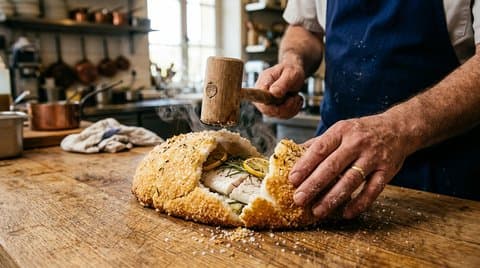 Artisanal chef cracking open a golden baked sea salt crust with a wooden mallet
Inside this miniature stone tomb, the temperature never spikes violently. The fish does not fry; it does not roast; it does not boil. It steams in its own concentrated juices. Furthermore, because no aromatic volatile compounds can escape through the hardened mineral dome, every molecule of citrus essential oil from the lemon wheels tucked in the cavity, every pinene terpene from fresh rosemary branches, and every marine aroma of the fish itself is forced back into the steaming tissues.
When the crust is finally fractured, the perfume that billows out is intoxicating. It smells not of burnt fat or Maillard char, but of the open Mediterranean Sea, distilled into crystalline vapor.
The Terroir of Solar Evaporation
Not all salt is created equal, and this is where industrial cooking strips culinary heritage of its nuance.
The modern supermarket shelf is dominated by refined vacuum-evaporated table salt: pure, bleached sodium chloride (99.9% purity), stripped of all trace minerals and treated with anti-caking ferrocyanides or calcium silicate to ensure free-flowing convenience. Using this industrial powder to bake fish is a catastrophe; the fine granules melt into a sodden, impenetrable paste that clings to the skin and creates localized salinity spikes.
Artisanal Mediterranean salt-crust cooking requires unwashed, coarse gray or white sea salt harvested by hand from coastal salinas.
In the salt pans of Trapani along western Sicily, seawater from the Tyrrhenian Sea is channeled through a sequence of shallow evaporation basins—the frigomar, the vaso da coltivare, and the salinaio. Over months of intense summer heat and relentless scirocco winds, the sun evaporates the water, leaving behind thick crystalline beds. This salt contains only about 94% sodium chloride. The remaining six percent consists of vital trace minerals: magnesium chloride, calcium sulfate, potassium, and trace iodine.
These "impurities" are precisely what give artisanal sea salt its structural and culinary value:
Magnesium Chloride (Nigari): Delays the melting point of the crust and imparts a subtle, bittersweet mineral depth that counterbalances the rich lipids of oily sea fish.
Coarse Crystal Geometry: Large, irregular pyramid-shaped crystals create microscopic air pockets within the crust, acting as an insulating honeycomb that prevents thermal shock.
Residual Brine Moisture: Hand-harvested salt retains four to six percent natural brine moisture, eliminating the need for excessive binders like egg whites or flour.
When you cook with solar sea salt, you are not merely employing a chemical compound. You are utilizing the crystallized labor of the sun, the wind, and the tidal currents of the sea from which the fish was pulled.
The Master Ritual: Spigola al Sale in the Wood Hearth
To execute this dish is not to follow an algorithmic recipe with a countdown timer; it is to engage in a sensory ritual of heat and time.
1. The Anatomy of the Fish
Procure a wild European sea bass (Dicentrarchus labrax, or spigola) or a gilthead sea bream (orata) weighing between 1.2 and 1.5 kilograms. The fish must be impeccably fresh: clear, bulging eyes, bright red gills, and firm flesh that bounces back under thumb pressure.
The Golden Rule: Instruct the fishmonger to gut the fish through a small, neat incision in the belly, but under no circumstances allow them to remove the scales. The scales are the armor plate that shields the sweet flesh from direct salt contact and allows the baked crust to peel away cleanly in one intact sheet.
2. The Aromatics
Rinse the cavity under cold water and pat it thoroughly dry with clean linen. Inside the belly, tuck:
Two thick sprigs of woody mountain rosemary, bruised between your fingers to rupture the oil glands.
A handful of fresh flat-leaf parsley stems.
Two cloves of purple garlic, crushed lightly in their skins.
Four thin wheels of unwaxed Mediterranean lemon.
A single tablespoon of early-harvest, peppery extra virgin olive oil rubbed along the interior walls.
Do not add salt inside the cavity; the ambient ionic migration from the exterior dome will season the fish to perfection.
3. Building the Sarcophagus
In a wide terracotta or ceramic bowl, combine three kilograms of coarse Mediterranean sea salt. If the salt is dry, flick two to three tablespoons of water or one beaten egg white over the crystals, tossing them with your hands until the texture resembles damp coastal sand that holds its shape when squeezed into a ball.
On an earthenware baking platter or a heavy sheet pan, spread a base layer of salt roughly two centimeters thick. Lay the prepared fish upon this bed. Now, with both hands, mound the remaining salt over the fish, packing and sculpting it firmly around the contours until the entire sea bass is entombed beneath an even, two-centimeter blanket, leaving only the very tip of the tail exposed as a visual gauge.
4. The Hearth Fire
Slide the platter into a wood-fired hearth that has burned down to glowing hardwood embers (olive, oak, or almond wood) with an ambient dome temperature of roughly 220°C (425°F). If cooking in a conventional oven, preheat thoroughly to the same temperature without convection fan assistance.
Bake undisturbed for thirty-two to thirty-five minutes.
How do you know when it is done without an electronic probe? Observe the exposed tail fin: when it has turned brittle, dark amber, and releases a faint toasted aroma, the internal temperature at the spine has reached precisely 54°C (130°F).
The Breaking of the Stone
The presentation of salt-crusted fish is pure theater, but it is theater born of structural necessity.
Bring the steaming platter directly to the table. The salt will have turned a pale golden-tan, rigid and ringing like fired clay when tapped with the back of a fork.
Using a small wooden mallet or the edge of a heavy kitchen spoon, firmly tap the perimeter of the fish along the lateral line. The crust will fracture with a crisp, satisfying crack. Gently lift off the upper dome of salt in large, clean slabs.
Because the scales acted as a barrier, the skin will adhere directly to the underside of the salt dome, peeling away effortlessly to reveal the glistening, pearlescent white flesh beneath. Using two dessert spoons, slide the whole fillets off the central spine onto warm plates. Drizzle nothing more than a thread of grassy, cold-pressed extra virgin olive oil and a final squeeze of fresh lemon.
Take a bite. The flesh does not disintegrate into mush as it so often does in plastic sous-vide pouches. It flakes in firm, juicy, succulent sheets. The flavor is clean, sweet, and intensely oceanic, carrying the faint perfume of woodsmoke and wild herbs.
The Return to Thermal Truth
We live in an era seduced by the frictionless and the automated. We are told that culinary excellence can be coded into circuit boards, that cooking is a nuisance to be minimized through pre-packaged meal kits, algorithmic air fryers, and app-controlled thermal baths.
Elena Rossi recently observed that when a culture is inundated with synthetic ease, human consciousness naturally seeks refuge in friction, in tactile resistance, and in the irreplaceable gravity of the physical hand. Gastronomy is perhaps the purest battlefield of this resistance.
A smart combi-oven knows nothing of the humidity of the afternoon air. It knows nothing of the wind that dried the salt pans of Sicily last August, nor does it understand the crackle of seasoned olive branches burning down to gray ash in an open masonry hearth.
When we pack damp sea salt around a wild fish with our bare hands, we are stepping outside the digital noise. We are trusting in mineral physics, thermal latency, and three thousand years of collective human memory. In the warmth of the hearth and the hardness of the salt, we find something no algorithm can replicate: the taste of patience, of the sun, and of living truth.