
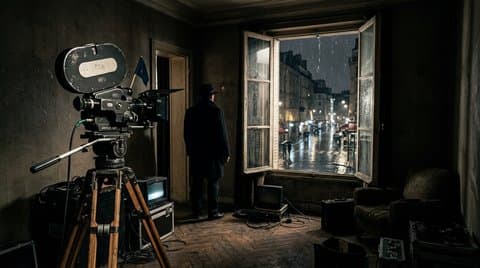
The Radical Economy of Twelve Minutes: Why Independent Shorts Are Cinema's True Vanguard
There is an unspoken pathology haunting the contemporary multiplex: the delusion that scale equals significance. As Hollywood studios pour a quarter of a billion dollars into single tentpole productions—allocating tens of millions to post-production visual effects houses tasked with rendering digital debris in climate-controlled rendering farms—the films themselves feel curiously weightless. We sit before three-hour running times where planets are obliterated and multi-tiered universes collide, yet leave the theater with the hollow sensation of having consumed digital air.
The camera moves with supernatural ease through walls, through explosions, through impossible geometries, yet it reveals nothing about the human condition. When every physical law can be negotiated by a compositing algorithm, gravity ceases to matter. And when gravity ceases to matter, human stakes evaporate.
To witness cinema in its vital, combative, and dangerous state today, one must turn one's back on the studio lot. One must look instead toward the subterranean ecosystem of independent short films and micro-budget auteur cinema. It is here—in twelve-minute festival entries made for five thousand euros and feature-length chamber pieces shot inside a single apartment over four sleepless weekends—that the Seventh Art is quietly reinventing its soul.
The Tyranny of Visual Abundance
The central crisis of contemporary commercial filmmaking is not a lack of talent, but the complete absence of resistance. In classical cinema, every aesthetic breakthrough was born from a physical barrier. Film stock was expensive and strictly limited; cameras were heavy mechanical instruments requiring precise optical calibration; and lighting a dark interior required profound knowledge of shadow, emulsion sensitivity, and photochemical latitude.
Filmmakers like Robert Bresson, Chantal Akerman, or John Cassavetes did not adopt their austere visual languages out of arbitrary minimalism; they stripped away artifice because scarcity demanded absolute clarity of purpose. Every cut was a moral decision because you could not afford to waste a single foot of celluloid.
Today, digital sensors can capture eighty hours of continuous 8K raw footage under ambient street lighting without breaking a sweat. Yet this very abundance has paralyzed the cinematic imagination. Because a director can shoot twenty takes from seven coverage angles simultaneously, the necessity to stage a scene with precise blocking has all but disappeared. The result is visual coverage rather than visual composition: an endless parade of bland shot-reverse-shot dialogue sequences assembled by committee in an editing room months after the actors have departed the set.
Cinema has mistaken technical capability for visual language. When you can show everything, you end up looking at nothing.
The Masterclass of Twelve Minutes
Enter the independent short film. For decades, industry gatekeepers regarded the short merely as an audition tape—a calling card designed to prove to risk-averse financiers that a young director could handle a feature-length script. This view fundamentally misjudges the medium. The great short film is not a truncated feature; it is an autonomous artistic form possessing the concentrated velocity of a masterwork short story by Raymond Carver or Jorge Luis Borges.
In a twelve-minute film, there is zero margin for narrative fat. You cannot indulge in thirty minutes of expository backstory, nor can you rely on manufactured subplots to pad the running time. The filmmaker must accomplish in sixty seconds what a studio feature takes half an hour to articulate: establish a world, define spatial relationships, calibrate emotional tension, and introduce a catalytic dilemma.
Consider the craft required to make an audience care about a stranger's face in five hundred feet of film. The director cannot lean on an orchestral score swelling to signal pathos. Instead, the storytelling burden falls entirely on the economy of the cut, the cadence of an actor's breathing, and the psychological charge of the frame.
"A short film does not summarize an experience; it isolates an incision. It cuts into the flow of time at precisely the moment where a life pivots, and it departs before the wound has scabbed over."
The finest short films circulating through festivals like Clermont-Ferrand, Oberhausen, Tampere, or Locarno are masterclasses in cinematic compression. In these works, an unspoken glance across a diner table or the nervous tapping of a fingernail against a steering wheel carries more dramatic voltage than a fifteen-minute CGI battle sequence. By forcing the filmmaker to choose only the indispensable details, the short format restores narrative dignity to the medium.
Grain, Rust, and the Tactile Glory of 16mm
Parallel to the renaissance of the narrative short is the stubborn, insurgent return of small-gauge film formats in micro-budget feature filmmaking. While major studios boast of shooting on high-end digital cine cameras with clean, noise-free sensor readouts, independent auteurs are actively hunting down vintage Arriflex 16SR and Bolex H16 cameras.
This is not reactionary Luddism; it is a search for ontological friction. A digital sensor records an image as an array of discrete numerical values arranged in a mathematical grid. An analog emulsion, by contrast, captures light through the chemical mutation of microscopic silver halide crystals randomly suspended in gelatin.
When you project a 16mm film, the image is not static. The grain pattern shifts across twenty-four distinct crystalline configurations every second. The surface of the frame buzzes with organic vitality. Shadows possess an inky, velvety depth; skin tones hold a fragile warmth that resists digital clinicality; and highlights bloom with a physical softness that software LUTs can never convincingly simulate.
More significantly, shooting on 16mm re-imposes discipline on the set. When a 400-foot magazine of 16mm provides only eleven minutes of shooting time, the entire production crew behaves differently. The frivolous casualness of the digital set vanishes. Rehearsals are conducted with meticulous theatrical precision. The director and the cinematographer wait for the exact moment of natural sunlight cutting across the dust. When the camera rolls, the whir of the mechanical motor fills the room like a ticking metronome, demanding that every actor bring their absolute presence to that specific, irreplaceable strip of film.
The Invisible Spectacle of Off-Screen Sound
When you cannot afford a fifteen-million-dollar CGI sequence to depict an approaching disaster or an urban riot, how do you communicate scale? You build it in the sound design. The most inventive micro-budget filmmakers understand that cinema is only half-visual; the other half is auditory imagination.
In low-budget masterworks, the off-screen world is continually brought to life through acoustic precision. A siren echoing down a concrete stairwell, the muffled murmur of a television through a thin hotel wall, the persistent rattle of windowpanes caused by a passing freight train—these soundscapes cost almost nothing to record, yet they construct a vast psychological architecture around the actors.
By refusing to show everything visually, the director enlists the audience's imagination as a creative co-conspirator. The horror or beauty that the viewer imagines in the darkness off-screen is invariably more terrifying or evocative than whatever digital monster an effects house could paste into the frame. Sound becomes a weapon of narrative expansion, turning a fifty-dollar set into an expansive universe.
The Architecture of the Chamber Piece
Where the blockbuster attempts to conquer infinite external space, micro-budget cinema discovers infinite depth within architectural confinement. Some of the most thrilling independent films of the modern era are single-location chamber dramas—works staged within the perimeter of a kitchen, a rented car, a motel room, or an interrogation cell.
Confining a story to a single room is the ultimate test of a director's spatial intelligence. Without external spectacle to distract the viewer, the architecture of the room becomes an active character. The angle of a shadow cast by a venetian blind, the reverberation of footsteps on worn linoleum, the proximity between two bodies seated on an unmade bed—these micro-elements dictate the psychological rhythm of the scene.
In a chamber piece, editing is not a cosmetic rhythm; it is a territorial negotiation. When does the camera cut from a medium shot to an extreme close-up? In a low-budget masterpiece, that shift feels seismic. Because the camera has stayed respectful and distant for twenty minutes, moving three inches closer to an actor's eyes carries the emotional force of an earthquake.
This is the secret that Hollywood has forgotten: tension is not generated by the size of the explosion, but by the magnitude of the restriction.
The Dignity of Resource Scarcity
We must celebrate low-budget cinema not merely for what it achieves in spite of its financial limitations, but for what it achieves because of them. A budget of thirty thousand dollars does not permit green screens, celebrity entourages, or layers of corporate executive interference. It permits something far rarer in contemporary culture: uncompromised authorial voice.
When a filmmaker cannot afford lavish period costumes, they are forced to locate drama in the raw humanity of non-professional actors cast from the streets. When they cannot afford complex artificial lighting packages, they learn to read the movements of the sun across a brick wall. Scarcity strips away the decorative vanity of cinema and leaves behind the essential scaffolding: light, shadow, human gesture, and time.
To love cinema today is to become an active scout. You will not find the vital signs of the medium in the heavily advertised algorithm queues of global streaming monoliths, which treat cinematic works as disposable "content" designed to prevent user churn. You will find it in small repertory theaters, curated short-film platforms like MUBI, Le Court Métrage, or Vimeo Staff Picks, and independent festival sidebars where young directors put their entire lives on the line for twenty minutes of screen time.
The future of cinema does not belong to the empires of visual bloat. It belongs to the guerillas with a Bolex camera in a rucksack, two actors in a dimly lit hallway, and the radical courage to tell an unforgettable truth in twelve breathtaking minutes.