
The Micro-Scene Cartography: Surviving the Streaming Monoculture in Bedroom Studios
Every morning, algorithmic streaming platforms ingest over one hundred thousand new audio tracks. They arrive formatted into lossless digital packages, metadata-tagged for immediate ingestion into mood-based recommendation engines: Chill Study Beats, Deep Focus Ambient, Morning Commute Serotonin, Downtempo Workout. Within minutes of hitting the server farms, each waveform is subjected to mathematical normalization. Its dynamic range is crushed to fit an average perceived loudness of -14 LUFS; its silence is truncated; its eccentricities are classified as retention hazards.
This is the great acoustic flattening of our era.
Under the surveillance capitalism of major streaming conglomerates, music has ceased to be an encounter between human consciousnesses. It has been demoted to functional acoustic wallpaper—a frictionless, mood-stabilizing solvent engineered to prevent the listener from ever experiencing boredom, surprise, or discomfort. If a song does not deliver its primary melodic hook within the first seventeen seconds, the skipping algorithm penalizes its distribution. If it contains abrupt dynamic shifts, dissonant frequency clustering, or unquantized polyrhythms, it is quietly purged from the algorithmic playlist rotisserie.
Yet, in attics in Bristol, basements in Leipzig, converted bedrooms in Neukölln, and tiny second-floor walk-ups in Osaka, a decentralized insurgency is taking root. A generation of musicians who came of age during the height of algorithmic convenience is actively seceding from the streaming economy. They are not waiting for an invitation to an editorial playlist. They are drawing their own maps.
The Tyranny of the Algorithmic Grid
To understand why the bedroom micro-scene has become a battleground, one must look closely at the structural pathology of platform streaming.
For twenty years, digital audio workstations (DAWs) have encouraged producers to snap every transient to a visual grid. Every snare hit is quantised to the nearest sixteenth note; every vocal take is pitch-corrected to 440 Hz concert pitch; every bass frequency is mono-summed and side-chained to an identical 4/4 kick pulse. The result is mathematical perfection—and emotional rigor mortis.
When this compositional uniformity meets streaming platform incentives, the distortion becomes existential. Because streaming royalties are calculated solely on play counts exceeding thirty seconds, regardless of whether the track is an eighteen-minute modal jazz suite or a ninety-second synthetic loop, economic incentives reward maximum compression and instant gratification.
The consequences have been catastrophic for musical form:
The Death of the Intro: Extended atmospheric openings, acoustic scene-setting, and patient harmonic development have been pruned away to avoid the fatal thirty-second skip threshold.
Dynamic Range Liquidation: In the quest for maximum volume in noisy mobile headphone environments, the difference between the quietest whisper and the loudest crescendo has been flattened to a uniform, exhausting roar.
Genre Homogenization: Streaming categorization demands algorithmic legibility. Hybrids that defy classification—say, microtonal Turkish folk crossed with industrial noise and tape loops—are rendered invisible because the collaborative filtering algorithm cannot calculate which demographic cluster to recommend them to.
The streaming monoculture does not hate difficult music; it simply cannot monetize it. It is structurally incapable of nurturing friction.
The Return of the Hand: Tape Splicing and Physical Friction
The response of the underground has not been theoretical; it is stubbornly physical.
Across Europe, North America, and Japan, micro-labels are reviving the cassette tape and the short-run 7-inch vinyl record not out of fetishized hipster nostalgia, but as an operational defense mechanism. A physical cassette tape cannot be algorithmically skipped with a thumb twitch. It possesses mechanical inertia. To hear the third track, you must fast-forward through the magnetic tape, listening to the high-pitched chirping of the analog capstan; to experience the album, you are forced to submit to the temporal duration ordained by the creator.
In an era of limitless digital abundance where sixty million songs sit behind a ten-dollar monthly paywall, friction is the only remaining guarantor of value.
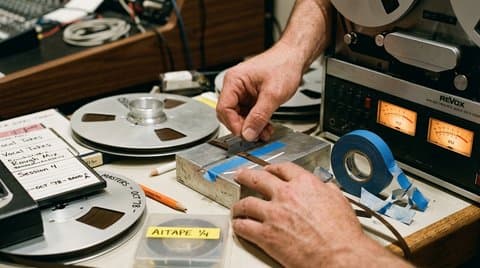 Close-up of human hands splicing quarter-inch magnetic tape on an aluminum block
Consider the tactile ritual of tape manipulation in contemporary bedroom ambient and drone micro-scenes. In studios barely larger than a storage closet, producers are cutting, looping, and physically splicing quarter-inch magnetic tape using razor blades and blue adhesive tabs on aluminum editing blocks.
When magnetic tape passes over an un-demagnetized playback head at 3.75 inches per second, physical reality intervenes. The tape stretches slightly; the polyester backing introduces subtle flutter; the oxide particles generate a continuous, warm noise floor. These are not software glitches to be patched. They are the acoustic signatures of atomic matter resisting digital perfection.
A quantized synth patch played from a cloud VST plugin exists nowhere in physical space. A magnetic tape loop tumbling across an old Revox deck exists in this room, at this exact barometric pressure, bearing the fingerprints of the person who cut it.
By working with physical media, the bedroom producer escapes the trap of infinite digital undoing. When you commit a mix to a two-track reel-to-reel master, you are forced to make a decision. The decision is final. You cannot adjust the hi-hat volume three months later in an automation lane. You accept the take, imperfections and all, and you release it into the world.
Peer-to-Peer Cartography: Soulseek, Bandcamp, and the Secret Web
How do these micro-scenes circulate their work if they refuse to bend the knee to Spotify, Apple Music, and algorithmic discovery?
They are revitalizing the decentralized infrastructure of the early internet.
While commercial media proclaims that peer-to-peer file sharing died with Napster, platforms like Soulseek have experienced a profound renaissance among crate-diggers, underground techno producers, and avant-garde tape collectors. Soulseek does not use machine learning recommendation algorithms. It has no sponsored placements; it has no editorial curators; it has no corporate metrics. It is simply a shared directory of folders running on individual hard drives across the world.
Finding music on Soulseek requires active cartographic effort:
You browse the personal shared music folder of a user in Sheffield who has uploaded rare 1990s Sheffield bleep techno rips.
You discover hand-typed
.txtnotes detailing the specific club nights where those tracks were tested.You initiate a direct peer-to-peer chat, trading an unreleased live cassette rip from a basement in Kyoto for an obscure dubplate cut in Manchester.
This is discovery as social labor. It creates community through shared friction. Unlike an algorithmic playlist that delivers music like municipal tap water, peer-to-peer exchange demands that the listener invest time, curiosity, and cultural reciprocity.
Simultaneously, platforms like Bandcamp—despite recent corporate acquisitions—and open-source alternatives like Mirlo, Jamstash, and federated ActivityPub audio relays provide the economic lifeline for physical runs. When an artist presses fifty cassette tapes, silk-screens the cardboard J-cards by hand, and sells them directly to eighty listeners worldwide for ten euros each, they earn more direct income than they would from two million streams on a commercial platform.
More importantly, they know the names of the fifty people who bought the tape. They write a handwritten note on the envelope. They drop in a dried ginkgo leaf or a stamped risograph postcard. They have built an authentic social reality that cannot be de-indexed by a quarterly algorithm change.
The Geography of the Bedroom Sanctuary
The bedroom studio is the architectural antithesis of the corporate commercial recording facility.
The commercial studio of the late twentieth century was an acoustic vacuum—a million-dollar acoustic isolation booth lined with floating floors, bass traps, and heavy acoustic baffles designed to eliminate every trace of ambient environmental reflection. It was an industrial processing plant for sound.
The bedroom studio, by contrast, embraces its domestic leaks.
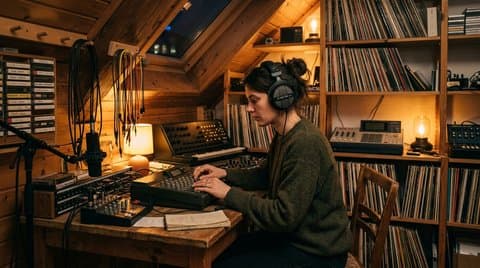
In a top-floor attic in Berlin-Neukölln, the microphone picks up the rumble of the U-Bahn passing beneath the pavement, the rain striking the slanted skylight, the floorboard creaking under the chair, the sound of tea water boiling on the stove in the adjoining room. Far from being unwanted artifacts, these ambient bleedings anchor the music in lived reality. They transform the recording into a spatial diary of survival.
In this space, the equipment is often idiosyncratic and rescued from obsolescence:
An ancient Roland JV-1080 rack synthesizer bought for fifty euros at a flea market.
A four-track Tascam Portastudio whose drive belt has stretched, giving acoustic guitars a ghostly, warbling detune.
A pair of Sennheiser HD600 headphones worn until the velour ear pads have frayed down to the plastic.
A single dynamic microphone wrapped in a wool sock to serve as an impromptu pop filter.
These limitations are not obstacles; they are the crucible of style. When you have access to fifteen thousand free pirated software plugins, you spend four hours auditioning kick drums and end up with nothing. When you have only one synthesizer, one guitar, and four tracks of magnetic tape, you are forced to invent an entire sonic universe using touch, harmony, and arrangement.
The Last Bastion of Human Timbre
We stand at the precipice of an era where synthetic music generation engines will be capable of outputting infinite, mathematically competent compositions on command: prompt a system for "melancholic shoegaze with female vocals in the style of 1993 Cocteau Twins" and it will generate twenty variations in five seconds. The algorithmic streaming platforms will gladly flood their mood playlists with this synthetic audio, because synthetic music requires no royalty disbursements to human composers.
In such a world, what is the role of the human musician?
The answer lies in the bedroom studio. It lies in the unquantized groove, the tape hiss, the missed note that was kept because it carried more emotional truth than the correct one, the voice that cracks under the strain of genuine grief, the cassette tape that will inevitably degrade twenty years from now.
The micro-scene is not a relic of the past; it is the vanguard of the future. It is a sovereign archipelago of quiet rooms where people gather to listen, to play, and to feel the grain of physical reality against their fingertips. The algorithms may own the pipes, but the bedroom owns the soul.