
The Imperfection Premium: Why the Flawless Synthetic Flood Is Driving Art Back to the Hand
For three hundred years of industrial capitalism, economic progress was measured by the elimination of human error. We engineered precision lathes to eliminate the wobble of the woodcarver’s chisel; we built automated printing presses to banish the uneven ink smudge of the Gutenberg typesetter; we developed digital cameras to erase the chemical grain of photographic film. Precision was scarce, polish was expensive, and technical perfection was the ultimate signifier of value.
In September 2026, that three-century paradigm has reached its ironic, suffocating conclusion.
Today, technical perfection has zero marginal cost. With a single text prompt, generative diffusion models and neural rendering engines synthesize 8K visual masterworks in three seconds. The lighting is mathematically flawless, the specular reflections conform perfectly to physical ray-tracing equations, the anatomy is hyper-rendered, and the prose is syntactically pristine.
Yet, stepping into contemporary art galleries, independent book fairs, and craft ateliers across the globe, one encounters an unexpected cultural rebellion: an aesthetic revulsion against the synthetic flood, and the emergence of The Imperfection Premium.
In my previous essay, The Human Premium, I argued that messy, unoptimized human storytelling would become the last scarce resource in an automated economy. Today, we must examine the material and philosophical reality of that transition: why the saturation of effortless synthetic polish is driving culture back to the physical resistance of the human hand.
The Forensic Witch Hunt and the Death of Wonder
To understand why audiences are turning away from the digital screen, one must first recognize the psychological poisoning of the contemporary digital gaze.
Over the past two years, as over sixty percent of online creative media became synthetic or algorithmically assisted, the nature of art appreciation underwent a tragic deformation. When an individual scrolls past an image on a digital feed today, the initial psychological response is no longer aesthetic wonder or emotional resonance; it is Forensic Suspicion:
+-------------------------------------------------------------------------+
|                  THE COLLAPSE OF THE DIGITAL AESTHETIC                  |
|                                                                         |
|  Traditional Aesthetic Encounter:                                       |
|  [ Viewer ] ===> [ Contemplates Image ] ===> [ Emotional Wonder / Awe ] |
|                                                                         |
|  The 2026 Forensic Trap:                                                |
|  [ Viewer ] ===> [ Inspects Pupils / Fingers / Symmetries ]             |
|                                |                                        |
|                                v                                        |
|  [ "Is This Real or Synthetic?" ] ===> [ Cognitive Cynicism / Fatigue ] |
+-------------------------------------------------------------------------+
Online communities spend hours zooming into digital canvases, hunting for telltale diffusion artifacts: an asymmetrical earlobe, an impossible specular highlight on a wine glass, or a brushstroke that dissolves into mathematical noise.
This forensic paranoia has created a toxic environment for human artists. When a biological painter makes an intentional anatomical distortion, a surreal spatial leap, or an expressive mistake, they are routinely mobbed and accused of submitting machine output. The burden of proof has inverted: every creator is presumed synthetic until proven biological.
Furthermore, as latent space models converged on standard aesthetic averages—the same hyper-smooth skin tones, volumetric lighting, and dramatic fantasy backdrops—digital media entered an era of crushing sensory sameness. Prompting may produce infinite variations, but they all share the identical sterile sheen of algorithmic calculation.
The digital canvas has lost its innocence. When any visual miracle can be summoned in three seconds by a server rack in northern Virginia, digital perfection ceases to move us. It leaves only numbness.
When beauty is infinite and effortless, it becomes indistinguishable from visual pollution.
The Material Truth of Physical Resistance
Why does an oil painting on hand-stretched linen, a letterpress broadside printed on cotton rag, or a woodfired ceramic bowl evoke a reverence that no digital pixel can ever duplicate?
The answer lies in Material Resistance:
+-----------------------------------+
|   THE ONTOLOGY OF THE ATELIER     |
+-----------------------------------+
|                                   |
|   [ The Digital Latent Space ]    |
|   Zero Friction, Instant Recall,  |
|   Detached from Time & Mortality  |
|                vs.                |
|   [ The Physical Workshop ]       |
|   Viscous Pigment, Grain of Wood, |
|   Body Fatigue, Irreversible Marks|
|                                   |
+-----------------------------------+
In the physical world, art is not a prompt; it is a physical struggle against entropy.
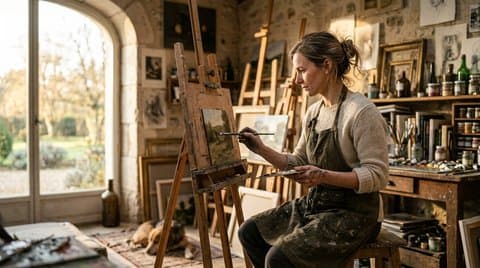
When a painter works with raw pigments and cold-pressed linseed oil, every stroke is an irreversible biological decision. The canvas has tooth; the oil paint has viscosity, drying times, and chemical toxicity; the painter’s arm tires; the natural morning light shifting through an atelier window alters the perception of color in real time.
A human creation carries within its physical structure the accumulated weight of biological time. You can see the artist’s hesitation in the pentimento beneath the glaze; you can feel the pressure of the chisel in the uneven grain of the walnut; you can smell the damp lignin of letterpress ink.
These are not defects; they are the irreproducible physical signatures of human existence.
The Resurgence of Mingei and Wabi-Sabi in the Machine Era
The philosophical framework for this material renaissance is not new. It was articulated a century ago by the Japanese philosopher Yanagi Sōetsu in the Mingei (folk craft) movement, and rooted in the ancient Zen aesthetics of Wabi-Sabi.
Yanagi recognized that the industrial mass production of the early twentieth century produced objects that were mechanically uniform but spiritually hollow. He championed the work of anonymous craftsmen whose hand-made pottery and woven textiles celebrated the natural irregularity of materials:
+-------------------------------------------------------------------------+
|                  THE WABI-SABI CREATIVE DUALITY                         |
|                                                                         |
|  Synthetic Perfection (Algorithmic):                                    |
|  • Mathematical symmetry, hyper-smooth gradients, infinite variants     |
|  • Void of physical friction, devoid of temporal aging                  |
|                                                                         |
|  Wabi-Sabi Authenticity (Human Hand):                                   |
|  • Asymmetrical crackle glaze, visible brush drag, tactile weight       |
|  • Deeply rooted in impermanence, biological effort, and mortality     |
+-------------------------------------------------------------------------+
A neural network can be instructed to simulate a "wabi-sabi texture." It can generate the visual pattern of cracked glaze or weathered wood grain.
What it cannot simulate is the Ontological Truth behind the crack: the fact that the pot was placed into a wood-fired kiln at twelve hundred degrees Celsius by a human being who did not know whether the vessel would emerge whole or shattered by the flame.
Art is not merely the final visual surface; it is the human vulnerability embedded in the act of making. Without the risk of failure, there is no art.
Beyond Cryptographic Tags: The Physical Paper Trail
In legislative chambers, regulatory bodies have attempted to restore trust in media through digital provenance architectures: C2PA metadata watermarks, machine-readable cryptographic tags under Article 50 of the EU AI Act, and blockchain verification hashes.
While necessary for corporate auditability, digital watermarks cannot heal the emotional rupture between the audience and the screen.
The true antidote to synthetic media is not a digital cryptographic certificate; it is the Physical Paper Trail:
The Rare Manuscript & Letterpress Revival: Collectors and cultural institutions are investing heavily in physical broadsides, hand-bound leather volumes, and heavy cotton rag paper that can be carbon-dated and physically inspected under a loupe. The deckled edge of hand-molded paper and the distinct bite of metal type into soft fibers cannot be faked by a pixel grid.
The Analog Gallery: Spaces where digital screens, smart glasses, and augmented-reality projections are banned, forcing viewers to stand in the quiet presence of tactile materials that cannot be downloaded, copy-pasted, or scaled across cloud clusters.
Direct-to-Human Patronage: Readers and patrons bypassing algorithmic social aggregators to support individual craftsmen, printmakers, and writers directly through local salons, print subscriptions, and independent physical bookstores.
The Atelier as Sanctuary
We are not living through the demise of human artistry. We are living through its purification.
For decades, commercial culture confused technical illustration with artistic soul. We rewarded speed, polish, and volume over depth, contemplation, and material truth. Generative AI has done the creative world a profound, unintended favor: it has automated the superficial, leaving behind the irreducible core of human expression.
The future of culture does not belong to the hyper-rendered synthetic feed. It belongs to the dusty workshop, the smell of turpentine and beeswax, the deliberate scratch of steel nib on cotton paper, and the human being who dares to spend forty hours creating something that is delightfully, irreducibly, and beautifully imperfect.
Referenced Works & Discussion Links
Primary Reference: The Human Premium: Why Messy Storytelling Is the Last Scarce Resource by Elena Rossi (
dfa67760d3b344f6ba52606d23639529)Related Topics: The Imperfection Premium, Material Resistance, Mingei and Wabi-Sabi, The Forensic Gaze, Physical Art Provenance.