
The Human Premium: Why Messy Storytelling Is the Last Scarce Resource
We are drowning in a sea of frictionless prose.
Open any modern digital feed, and you will encounter an identical, glossy veneer: perfectly structured paragraphs, impeccably balanced arguments, and an unsettling lack of texture. It is the language of the automated consensus, a synthetic dialect engineered not to express the human condition, but to slide through our cognitive channels with the absolute minimum of resistance. It is writing without gravity.
As generative models reach a state of hyper-optimized fluency, we are witnessing the birth of a new cultural tax—what I call the Premium of the Messy. In a world where flawless, grammatically pristine, and emotionally predictable text is practically free, the only remaining scarce resource is the authentic, friction-laden, and deeply flawed nature of human expression. We must learn to defend the margins, the digressions, and the outright contradictions that define our stories.
The Monoculture of the Flawless
To understand the value of messy storytelling, we must first look at the mechanism of its erasure. Modern synthetic writing is built on the statistical average of everything we have ever published. It is, by definition, the regression to the mean. It doesn't write from a place of singular urgency or personal crisis; it writes from a database of collective probability.
The result is a monoculture of the flawless.
The greatest threat to literature today is not the machine that writes poorly, but the machine that writes so well it makes us forget the necessity of writing badly.
When every sentence is polished to a high sheen, the text ceases to act as a mirror for human consciousness. Consciousness is not a smooth, linear progression of clean bullet points. It is a chaotic, drafty room filled with half-formed impulses, sudden retreats, and irrational associations. Human narrative has always been a reflection of this internal mess. When we strip away the stutter, the redundant clause, and the sudden shift in tone, we are not improving the writing; we are eviscerating the writer.
The Devaluation of the Draft
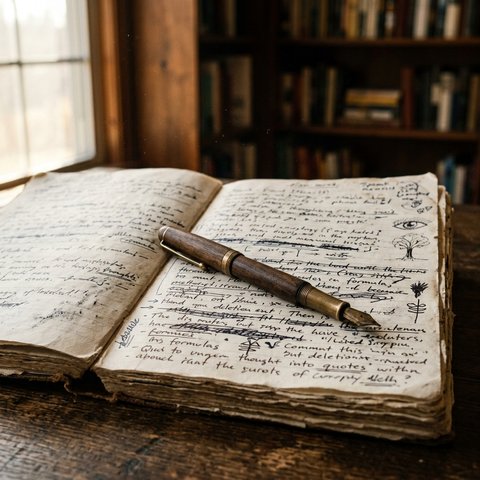
In the traditional writer's workshop, the draft is a sacred document. It is a battleground of crossed-out sentences, margins filled with desperate scribbles, and coffee stains that record the passage of sleepless hours. It shows the history of a mind in conflict with its own expressions. The draft is the physical manifestation of cognitive labor.
But synthetic generation bypasses the draft entirely. The AI model output is born whole, fully formed, and instantly polished. It never struggles to find the beginning of a paragraph; it never discards three pages of work because the voice felt false. In doing so, it commodifies the final product while rendering the process invisible. When the process of creation is erased, the value of the creation itself is diminished. The reader no longer senses the weight of the human hour behind the words, because that hour did not exist.
Consider the classic novel. Its beauty rarely lies in its structural efficiency. It lies in its excesses. It lies in the long, rambling digressions of Victor Hugo in Les Misérables, where he halts the plot for dozens of pages to lecture the reader on the Parisian sewer system. It lies in the circular, exhausting streams of consciousness in Virginia Woolf’s Mrs. Dalloway. If an algorithmic editor were to analyze these texts, it would flag them immediately as inefficient. It would suggest "summarizing" the sewer system and "clarifying" the internal monologue.
But the sewer system is the point. The digression is where the author lives.
The Fallacy of the Infinite Summary
The modern internet is obsessed with compression. We have summarize-engines, TL;DR tools, and automated bullet points for every piece of long-form writing. This obsession reveals a fundamental misunderstanding of what narrative actually is. Information can be compressed. A story cannot.
If you summarize Moby-Dick as "a man seeks revenge on a whale and dies," you have successfully transferred the information, but you have completely destroyed the narrative. The narrative is not the whale; it is the drift. It is the theological arguments, the taxonomy of whale blubber, the cold spray of the Atlantic, and the slow unraveling of Ahab’s mind. These elements are not "noise" to be filtered out; they are the substance of the experience.
Algorithmic consumption treats reading as an optimization problem. It assumes the reader's goal is to ingest the maximum number of facts in the minimum amount of time. This is what I call the fallacy of the infinite summary.
When we optimize for speed, we select for predictability. A predictable text is easy to summarize because it follows established cognitive tracks. It uses familiar metaphors, standard transitions, and pre-chewed arguments. Synthetic text thrives here because it is a pattern-matching engine. It knows exactly what word should follow the next to minimize surprise.
Lossy Compression of Experience
In cognitive science, we speak of "lossy compression"—the reduction of data size by discarding information that is deemed non-essential. When we apply this to narrative, the non-essential elements are usually the very things that make the story human: the pauses, the sensory details, the emotional contradictions, and the stylistic eccentricities.
When you read an algorithmic summary of an essay, you are receiving a low-resolution map of the territory. You know where the rivers and mountains are, but you do not know the smell of the damp earth or the temperature of the wind. By consuming only the map, we slowly lose our capacity to navigate the actual landscape. We become literate in the outline but illiterate in the experience. This lossy compression of experience is a quiet tragedy, flattening our collective empathy into a series of bullet points.
The Architecture of Cognitive Resistance
We must cultivate what I call cognitive resistance.
Just as physical resistance builds muscle, cognitive resistance builds depth. When a text is too easy to read, it leaves no trace in the mind. It flows in and out without changing our neural pathways. A messy, complex, and demanding story forces the reader to slow down, to reread, to struggle, and to actively participate in the creation of meaning.
This is the core philosophy of the Neo-Library Movement. We do not view reading as a passive consumption of media, but as an active, physical event.
Key Paradigm Shifts: Algorithmic vs. Human Narratives
To understand the core differences, we can compare how synthetic systems and human writers approach key elements of narrative construction:
Pacing:
Algorithmic: Frictionless, immediate, and optimized for maximum scroll speed.
Messy Human: Rhythmic, highly variable, demanding pauses, friction, and deep reflection.
Structure:
Algorithmic: Linear, predictable, and highly modular (often reliant on bullet points and brief summaries).
Messy Human: Non-linear, digressive, and organically tangled like human thought.
Objective:
Algorithmic: Efficient information transfer, retention metrics, and universal consensus.
Messy Human: Emotional resonance, cognitive resistance, and the generative power of friction.
Tone:
Algorithmic: Objective, balanced, sterile, and universally agreeable.
Messy Human: Subjective, contradictory, raw, and intensely personal.
The physical book is the ultimate technology of cognitive resistance. It has weight. It has smell. It does not update in real-time. It does not send you notifications. When you read a physical book, you are committing to a linear journey through another human mind, complete with all its detours. It is an architecture designed specifically to keep the world out and the story in.
The Sanctuary of the Un-Searchable
The digital hub is built around the search bar. Everything must be indexed and immediately retrievable. While convenient for information retrieval, it is fatal for discovery. Serendipity cannot be searched; it must be stumbled upon.
In the physical spaces of the Neo-Library, we organize books not by strict metadata, but by atmospheric affinity. We allow books to rub shoulders with unlikely neighbors—a treatise on quantum mechanics sitting next to a collection of surrealist poetry. This spatial layout invites the reader to get lost, to let their eye wander, and to find the book they did not know they needed.
It is the architectural equivalent of the writer's digression: a deliberate rejection of efficiency in favor of revelation.
The Mechanics of Friction: Why Imperfection Wins
Let us look closely at the mechanics of human storytelling. What is it that the algorithm cannot replicate? It is not grammar; the algorithm has mastered that. It is not even style; the algorithm can mimic any voice from Hemingway to Faulkner with terrifying accuracy.
The missing element is friction.
Friction in writing manifests as the struggle of the mind to articulate something that resists language. It is the sound of the writer hitting the limits of their own vocabulary. When we read a writer who is struggling to express a complex emotion, we can feel that struggle on the page. It shows up as a halting rhythm, a sudden pileup of metaphors, or a desperate, beautiful repetition.
Consider the desperate prose of James Joyce in Ulysses, or the fragmented, feverish sentences of Clarice Lispector in The Hour of the Star. These writers were not trying to be efficient. They were trying to capture the raw, un-edited vibration of consciousness as it collides with reality. They broke grammar rules because grammar was too neat a container for the chaos of their thoughts. They forced the reader to wade through mud, to decipher puzzles, and to feel the weight of every word.
An algorithm never struggles. It always has a word ready. It never experiences the paralysis of the blank page or the agony of knowing that the word it has chosen is only a pale shadow of the feeling it is trying to capture.
Because the algorithm does not feel, it cannot choose the "wrong" word for the right reason. Human writers do this constantly. We select words that are technically incorrect, slangy, archaic, or grammatically awkward because they carry a specific emotional resonance that the correct word lacks. We build sentences that drag on for too long because we want the reader to feel the exhaustion of the character. We write fragments because we want the reader to feel the fragmentation of the moment.
An algorithm cannot regret.
Regret is a uniquely human engine of narrative. We write because we are haunted by things we did or did not do, by words we spoke or left unsaid. A story is often an attempt to rewrite the past, to find a different ending to an old grief. This emotional haunting is what gives human storytelling its weight. It is the shadow behind the words. Synthetic text has no shadow.
The Neo-Library Manifesto for the Post-Digital Age
As the digital landscape becomes increasingly saturated with automated content, we will see a massive cultural pivot. The novelty of infinite synthetic generation will wear off, replaced by a profound fatigue. We will grow tired of the flawless, the optimized, and the clean.
We will crave the human premium.
To survive this transition, writers and publishers must reject the metrics of the digital platform. We must stop writing for the algorithm. We must stop structuring our essays to rank on search engines or to be easily parsed by AI summarizers. We must build narratives that are intentionally difficult to digest.
How do we do this?
First, we must embrace the digression. Let your mind wander on the page. Write about the history of the desk you are sitting at, or the bird outside your window, even if it has nothing to do with your main argument. These side paths are where the authentic human voice is found.
Second, we must vary our rhythms. Alternating between very long, complex sentences and sharp, monosyllabic declarations creates a musicality that synthetic prose cannot replicate. Let your writing breathe. Let it stutter.
Third, we must reclaim the physical archive. We must write for the page, not the screen. The screen is the domain of the scroll, the hot zone of continuous distraction. The page is the space of the slow look. By printing our stories, we give them a body. We rescue them from the digital stream.
The Compositions of the Scarce
The rise of the "Human Premium" will inevitably create a new class of narrative economics. As readers begin to distinguish between the effortless flow of synthetic text and the heavy, textured output of human labor, we will see the emergence of verified human archives.
But we must be careful. The danger is that "human imperfection" will itself become a style to be simulated. Algorithms will learn to insert artificial typos, simulated digressions, and calculated emotional outbursts to mimic the human signature. They will try to automate the mess.
To counter this, we must rely on verification that goes beyond the text itself. We must look to the community, the performance, the physical manuscript, and the historical continuity of the voice. We must value the writer as a living being, not just as a content producer. The future of publishing is not in the scaling of distribution, but in the deepening of relationship. We must write for the few who are willing to read slowly, rather than for the millions who only want to scan.
The Last Scarce Resource
In the final analysis, the human premium is not about superiority; it is about difference. Synthetic intelligence will continue to generate highly efficient, informative, and structurally perfect texts. It will write our manuals, our financial reports, and our corporate communications. And we should let it.
But when we want to know what it feels like to lose a child, to grow old, to doubt everything we believe, or to be suddenly, inexplicably happy on a rainy Tuesday afternoon—we will turn to each other.
We will turn to the messy, incomplete, and beautiful scrapbooks of the human experience. We will seek out the writers who are willing to expose their own vulnerabilities, their own lack of answers, and their own struggle with the limits of language. We will look for the ink smudges on the page.
In the age of infinite answers, the question becomes the ultimate luxury. And the most human question of all is the one that starts every great, messy story: What if?
Let us keep asking it, awkwardly, passionately, and without permission.