
The Geometry of Torta Caprese: Almond Lipid Mechanics, Cocoa Crystallization, and the Master Recipe of Flourless Mediterranean Baking
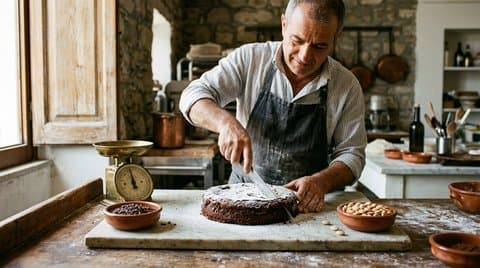
The legend of Torta Caprese begins not in an academy of culinary science, but in an act of frantic human distraction. In the early summer of 1920, inside a sun-bleached artisan bakery nestled on the limestone cliffs of Capri, pastry chef Carmine di Fiore was commissioned to bake an American-style chocolate cake for a trio of visiting travelers associated with the Chicago underworld. Working under the nervous pressure of foreign clientele, di Fiore committed what would conventionally be classified as a catastrophic artisan failure: he completely forgot to add wheat flour to the mixing bowl. When the tin emerged from the wood-fired masonry oven, its crust was papery, cracked like parched terra cotta, while its interior possessed a dense, moist, velvety cohesion that defied traditional confectionery logic. What di Fiore had stumbled upon was not a defective sponge, but an alchemical revelation: the realization that the structural scaffolding of a great cake does not require the elastic lattice of gluten if one understands the thermodynamic partnership between almond lipids, egg albumen, and crystallized cocoa butter.
For over a century, commercial pastry has treated wheat flour as an indispensable crutch. Modern industrial food processing relies on wheat gluten to entrap moisture, emulsify water-in-oil systems mechanically, and create an artificial shelf life through chemical leaveners. In contrast, traditional Mediterranean confectionery has always operated on an ecology of scarcity and local agricultural reality. Across Campania, Sicily, and the Balearic archipelago, almond groves flourished in mineral-dense, arid soils where wheat farming was impractical. Pastry artisans learned to build structural crumb through raw physical chemistry: the natural oil suspension of finely ground almonds, the amphiphilic properties of egg yolk lecithin, and the slow, isotropic heat of stone hearths.
To bake a true Torta Caprese today is an act of deliberate cultural secession. It is a rejection of the hyper-sweetened, aerated confections pushed by algorithmic social media, demanding instead an unhurried communion with temperature, lipid stability, and the subtle bitterness of roasted Mediterranean nuts.
The Physics of Flourless Architecture: Why Gluten Is Superfluous
To understand why Torta Caprese holds its form without a single grain of milled grain, one must examine the micro-architecture of the almond seed. Unlike wheat flour, which is dominated by starches (amylose and amylopectin) and gluten-forming proteins (gliadin and glutenin), sweet blanched almonds (Prunus dulcis) are approximately 50% lipids by weight, 21% proteins, and less than 10% digestible carbohydrates. The dominant fat is oleic acid, a monounsaturated fatty acid that remains liquid at room temperature but behaves with extraordinary stability under thermal duress.
When whole Mediterranean almonds—ideally Sicilian Pizzuta d'Avola or Spanish Marcona—are lightly toasted and ground into a coarse meal, their cellular walls rupture, releasing microscopic lipid droplets across an irregular suspension of solid seed fragments. In a conventional batter, this abundance of free fat would destroy crumb development by coating gluten strands and preventing them from bonding. In a flourless cake, however, these almond fragments serve as structural micro-pillars. The coarse almond meal acts as an inert aggregate within a biological concrete, while the almond proteins (amandin) partially denature under oven heat, forming a delicate secondary protein matrix that traps moisture without creating rubbery elasticity.
[ Albumen Foam Network ]
(Denatured Ovalbumin Webs)
│
┌──────────────┴──────────────┐
▼                             ▼
[ Almond Lipid Matrix ]       [ Crystallized Cocoa Mass ]
(Oleic Acid Suspensions)      (Polymorphic Form V Network)
│                             │
└──────────────┬──────────────┘
▼
[ Isotropic Velvety Crumb ]
(Stable, Moisture-Retentive Core)
The second structural pillar is cocoa butter. Pure dark chocolate—specifically a single-origin 70% dark chocolate derived from Trinitario or Criollo beans—is not merely a flavoring agent; it is a thermal transformer. Cocoa butter is comprised of symmetrical triglycerides (primarily POP, POS, and SOS) that exhibit distinct polymorphic crystallization behavior. During the gentle melting phase, cocoa butter must be heated just enough to destabilize its crystalline lattice (around 45°C to 48°C) without scorching the delicate polyphenols. As the cake bakes and subsequently cools at room temperature, the cocoa butter recrystallizes into stable Form V crystals, conferring a structural firmness to the crumb that allows the cake to be cleanly sliced while retaining a melt-in-the-mouth sensory profile.
The third pillar is the egg. In the absence of starch gelatinization, the sole binding mechanism of Torta Caprese is egg protein coagulation. By separating the eggs and whipping the albumens into a firm, moist foam while emulsifying the yolks with sugar, we introduce millions of microscopic gas pockets into the batter. When the cake enters the oven, these air bubbles expand uniformly according to Charles’s Law. As the internal temperature reaches 72°C to 80°C, the ovalbumin and conalbumin proteins in the egg white stretch, denature, and permanently set around the almond granules and cocoa butter droplets. The result is an isotropic crumb: uniformly dense, moist, and free of the sponge-like rubberiness that plagues flour-based cakes.
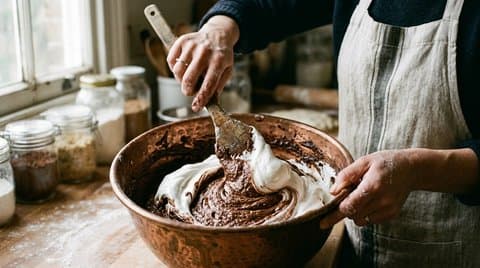 Folding whipped albumen meringue into dark chocolate and roasted almond paste
The Botanical Terroir: Sourcing Integrity Over Industrial Uniformity
A cake composed of five fundamental ingredients offers no place for mediocre produce to hide. Industrial baking conceals inferior raw materials behind vanillin, corn syrup, and excessive sucrose. In Torta Caprese, every ingredient must speak with its own agricultural dialect:
The Almonds: Supermarket pre-ground almond flour is unacceptable. It is typically stripped of its natural oils or oxidized from months of warehouse storage in clear plastic bags. You must begin with whole, raw, blanched almonds. Seek out almonds that smell fresh, sweet, and faintly woody. Toasting them at 150°C for precisely 12 minutes before grinding awakens pyrazines—the aroma compounds responsible for deep nutty complexities—and drives off residual moisture, preventing the ground meal from clumping into a greasy paste.
The Chocolate: A clean 70% dark chocolate with a minimum of 38% cocoa butter content. Avoid chocolates processed with alkali ("dutched" cocoa), as alkalinization destroys the natural fruit acidity and bright floral notes of the cacao bean. The subtle acidity of non-alkalized chocolate is vital: it interacts with the egg proteins to lower the coagulation threshold and cuts through the richness of the nut fats.
The Fat: While di Fiore’s original mid-century recipe utilized sweet unsalted butter from the Campania hills, our laboratory formulation embraces the ancient coastal tradition of substituting half the dairy fat with an unfiltered, early-harvest Extra Virgin Olive Oil from the olive groves of Cilento (cultivars such as Pisciottana or Frantoio). The polyphenolic bitterness and grassy pungency of early-harvest oil bind directly with the cocoa polyphenols, imparting an aristocratic depth that dairy butter alone can never achieve.
The Sugar and Salt: Granulated raw cane sugar provides clean sweetness without the molasses heaviness of muscovado. Fine sea salt harvested from solar salt pans—such as Trapani or Cervia—is mandatory. Salt is not an afterthought here; sodium ions suppress the perceived bitterness of the high-percentage cacao while uncoiling the coiled polypeptide chains of the egg whites, producing a tighter, more stable foam structure.
"A cake composed of five fundamental ingredients offers no place for mediocre produce to hide. Every ingredient must speak with its own agricultural dialect."
The Definitive Master Recipe: Torta Caprese Artigianale
This formulation is engineered for a standard 22 cm (9-inch) springform or fluted pastry pan. Precision is non-negotiable; weigh all ingredients with a calibrated digital gram balance. Do not rely on volume measurements.
The Baker's Formula & Component Ratios
Precision is non-negotiable in flourless baking. In this Mediterranean formulation, the toasted sweet almonds serve as the 100% baker's reference base. Every component is measured strictly by weight rather than volume:
Whole Sweet Almonds (Blanched) —
250 g(100% Baker's Base): Toasted at 150°C for 12 minutes, cooled completely, and ground to a coarse polenta grit.70% Single-Origin Dark Chocolate —
200 g(80%): High cocoa-butter content (minimum 38%), finely hand-chopped for uniform melting.Unsalted Sweet Grass-Fed Butter —
100 g(40%): Softened to room temperature (20°C) for clean thermal emulsification.Early-Harvest Extra Virgin Olive Oil —
50 g(20%): Cold-pressed, low-acidity monocultivar (Pisciottana or Frantoio) from Cilento.Whole Free-Range Eggs —
250 g(~5 large eggs, 100%): Separated at room temperature (21°C) to ensure peak albumen expansion.Fine Raw Cane Sugar —
170 g(68%): Divided into100 gfor the yolk sabayon and70 gfor the whipped albumen scaffolding.Unsweetened Cacao Powder —
15 g(6%): High-grade Dutch-process cacao, sifted to deepen color and moisture retention.Aged Dark Rum or Strega Liqueur —
15 g(6%): Traditional Campanian botanical herbal aromatic to lift the dark cocoa notes.Fine Mediterranean Sea Salt —
3 g(1.2%): Divided equally (1.5 gin the chocolate paste,1.5 gin the whipping whites to stabilize albumen).Pure Cane Confectioners' Sugar — For dusting: Sifted across the top after cooling for the traditional porcelain-white finish.
Step-by-Step Execution Protocol
1. The Thermal Prep and Dry Phase
Preheat an oven to 165°C (330°F) on static (convection fan off). If your oven has exposed lower heating elements, place an unglazed baking stone or heavy cast-iron pan on the lowest rack to act as a thermal buffer.
Butter a 22 cm round springform pan, line the base with unbleached parchment paper, and dust the interior surfaces lightly with sifted cacao powder, tapping out any excess.
Spread the whole blanched almonds on a baking sheet and toast at 150°C for 10 to 12 minutes until fragrant but pale golden. Allow to cool completely to room temperature.
Transfer the cooled almonds into a food processor with 20 grams of the weighed sugar (the sugar crystals prevent the blade friction from turning the nuts into almond butter). Pulse in brief, three-second intervals until you achieve a texture resembling coarse polenta. A few pebble-sized fragments are desirable; they provide textural delight in the finished crumb.
2. The Chocolate Emulsion
Place the finely chopped dark chocolate and softened butter in a heatproof glass or copper bowl suspended over a saucepan of barely simmering water (bain-marie). Ensure the bowl bottom does not touch the water.
Stir gently with a silicone spatula until completely melted and glossy (target temperature: 45°C–48°C). Remove from the heat.
Slowly pour in the extra virgin olive oil and the liqueur in a steady stream, whisking gently until fully incorporated into a shiny, silk-like emulsion. Set aside to cool to lukewarm (32°C–35°C).
3. The Yolk Sabayon
In a large ceramic mixing bowl, combine the egg yolks and 80 grams of the cane sugar.
Whisk vigorously for 4 to 5 minutes until the mixture turns pale, thickens significantly, and ribbons off the whisk.
Pour the cooled chocolate-lipid emulsion into the yolk mixture in three additions, folding smoothly from the bottom upward until homogeneous.
Fold in the coarse almond meal, sifted cocoa powder, and 1.5 grams of the sea salt until a thick, dark, fragrant paste forms.
4. The Albumen Scaffolding
In a thoroughly degreased copper or stainless-steel bowl, place the egg whites and the remaining 1.5 grams of fine sea salt.
Begin whipping at medium speed until frothy. Once soft peaks begin to form, gradually rain in the remaining 70 grams of sugar in a thin, continuous stream while continuing to whip.
Whip until the meringue achieves medium-firm peaks with a glossy, pliable sheen. Do not over-whip to dry, stiff peaks; brittle egg whites will clump upon folding, expelling trapped air and causing the cake to collapse unevenly.
5. The Gentle Union
Take one-third of the whipped meringue and fold it vigorously into the dense chocolate-almond paste. This sacrificial addition relaxes the viscosity of the base.
Add the remaining two-thirds of the meringue in two gentle additions. Using a flexible spatula or wooden spoon, slice down through the center, sweep along the bottom of the bowl, and fold up and over the side, rotating the bowl 45 degrees with each stroke. Stop the moment no white streaks remain.
Pour the batter into the prepared pan, smoothing the surface with an offset spatula. Do not tap the pan on the counter; you want to preserve every micro-bubble of suspended air.
6. The Bake and the Patience of Cooling
Bake at 165°C on the center rack for 38 to 42 minutes. The cake is done when the edges have set and pulled away from the tin by one millimeter, a thin, crinkled crust has formed across the top, and a wooden skewer inserted into the dead center comes out not wet with liquid batter, but coated with moist, tender crumbs.
Remove from the oven and set the pan on a wire cooling rack. Do not attempt to unmold the cake while warm. Hot cocoa butter and molten almond fats lack structural rigidity; unsealing the pan prematurely will cause the crumb to fracture.
Allow the cake to cool completely inside the tin for at least 3 hours. For the ultimate sensory experience, wrap the cooled pan in parchment and rest it overnight in a cool larder (16°C–18°C) before unmolding. The rest allows the cocoa butter to finish its polymorphic Form V crystallization and enables the almond oils to thoroughly hydrate the protein matrix.
Invert onto a serving platter, discard the parchment base, dust generously with powdered sugar through a fine-mesh sieve, and slice with a warm, thin-bladed knife wiped clean between cuts.
The Sensory Verdict: A Sanctuary in Every Bite
When you cut into a properly rested Torta Caprese, the resistance under the knife is unmistakable: a papery, audible fracture of the dry, meringue-like crust followed by a silent, velvety glide through the interior.
In the mouth, the cake behaves unlike any flour-based confection. It does not absorb saliva greedily like a sponge; rather, the body heat of the palate immediately begins melting the cocoa butter and almond lipids, releasing a progressive wave of sensory stimuli: first the crisp crunch of sugar and toasted almond shards, then the dark, fruit-acid intensity of the Trinitario cacao, followed by the grassy, peppery warmth of the olive oil, and finally the lingering botanical hum of the rum and roasted nuts.
In our frantic century, where recipes are optimized for viral ten-second video feeds and desserts are engineered for shelf-life longevity and hyper-palatability, Torta Caprese stands as a testament to the sovereign power of culinary restraint. It teaches us that omitting an ingredient—having the courage to remove the wheat, to bypass the chemical emulsifiers, to wait three hours for fat crystals to find their equilibrium—is often the highest form of artistic mastery.