
The Fermentation Clock
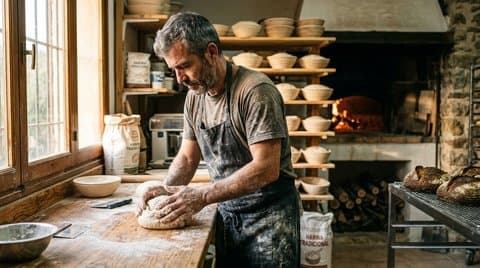
At four-thirty in the morning, before the streetlights of Valencia have flickered off, the obrador is as quiet as a crypt. The only sound is the deep, steady respiration of sixty kilos of dough resting inside rectangular cedar fermentation troughs.
If you lean your ear close to the surface of the flour-dusted linen, you can actually hear it: a faint, effervescent whispering. Millions of wild lactic acid bacteria—Lactobacillus sanfranciscensis, wild ambient yeasts harvested from the skins of local muscatel grapes, and ancient sourdough cultures nurtured through three generations—are consuming the complex starches of stone-ground heirloom wheat.
They do not follow an industrial production schedule. They obey only the immutable physics of temperature, moisture, and microbial ecology.
In the modern supermarket supply chain, bread is no longer an agricultural transformation; it is a chemical delivery system. Under the Chorleywood bread process invented in the nineteen-sixties, industrial factories use high-speed mechanical shear mixers, solid vegetable fats, chemical oxidizing agents, and massive doses of isolated commercial baker's yeast to force white flour into a spongy, sliced loaf in less than ninety minutes from sack to plastic bag.
That ninety-minute loaf is an abomination. By bypassing the biological fermentation clock, industrial bakeries flood the human gut with unhydrolyzed gluten proteins, undigested fructans, and intact phytic acid that locks away essential minerals like iron, zinc, and magnesium.
We did not develop an epidemic of gluten sensitivity because our bodies suddenly forgot how to digest wheat. We developed it because the food industry abolished the seventy-two hours of patient microbial labor required to make grain digestible.
The Industrial Elimination of Patience
To understand why modern bread makes people ill, one must examine the enzymatic biochemistry that unfolds when dough is allowed to rest at twelve degrees Celsius over three days.
When flour and water are mixed, endogenous enzymes called proteases and phytases are activated. In an industrial ninety-minute dough, these enzymes have zero time to operate. The dough is blasted with heat before a single complex gluten chain can be cleaved into digestible peptides.
In a long, cold sourdough fermentation, the lactic acid bacteria steadily drop the pH of the dough to approximately four point two. This gentle, acidic environment acts as a natural biochemical compiler.
Production Metric | The Industrial Chorleywood Process | The Seventy-Two-Hour Wild Fermentation |
|---|---|---|
Fermentation Window | 70 to 90 minutes (chemical and mechanical forcing) | 48 to 72 hours (temperature-staged natural rest) |
Microbial Population | Monoculture isolated brewer's yeast (S. cerevisiae) | Complex consortium of 50+ wild ambient yeasts & lactobacilli |
Gluten Proteolysis | Minimal (< 5% breakdown of immunogenic gluten peptides) | Deep enzymatic pre-digestion (> 70% breakdown of prolamin chains) |
Phytic Acid Neutralization | Intact phytic acid binds minerals (bioavailability < 15%) | Endogenous phytase activation unlocks minerals (> 85% absorption) |
Shelf-Life Mechanism | Calcium propionate and chemical mold inhibitors | Natural acetic and lactic acids provide mold resistance for weeks |
As the comparative table reveals, time is not an empty duration between mixing and baking; time is a primary ingredient.
When a loaf is allowed to ferment for three days, the wild bacteria do the digestive work that the human stomach was never designed to perform alone. The complex carbohydrates that cause systemic gastrointestinal inflammation are broken down into aromatic organic acids, simple digestible sugars, and bioavailable micronutrients.
The Alveolar Architecture of the Crumb
When you take a serrated bread knife and slice through a finished sourdough boule that was baked directly on stone hearth tiles at two hundred and thirty degrees Celsius, you are looking at a masterclass in thermal engineering.
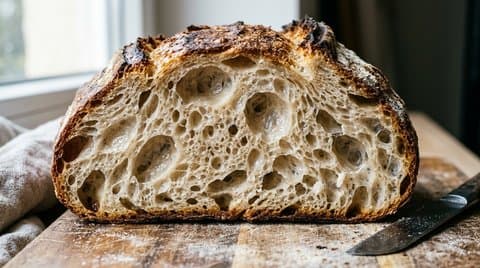 Cross-section of rustic sourdough boule with open alveolar crumb
Look at the open, glossy alveolar pockets of the crumb. Those irregular holes are not empty spaces; they are the physical footprints of carbon dioxide gas bubbles trapped within a delicate, translucent web of gelatinized starch and relaxed protein.
The Thermal Transformation Arc: Ambient Grape-Skin Wild Yeasts → 72-Hour Proteolytic Digestion → Cedar Trough Retardation → 230°C Hearth Stone Radiance → Living Alveolar Nourishment
A factory-produced sandwich bread has a tight, uniform, spongy crumb created by synthetic emulsifiers (mono- and diglycerides). When you press it with your thumb, it compresses into a gummy ball of unfermented starch that sits in your stomach like wet clay.
A true sourdough boule has an elastic, custardy interior wrapped inside a dark, caramelized, blistered crust smelling of toasted hazelnut, malt, and wood smoke. When you chew it, the acidity stimulates saliva, the complex sugars dissolve slowly across the palate, and your body recognizes that it is receiving genuine, ancestral fuel.
The Bread That Heals Alienation
We live in a culture that treats food as an inconvenience: something to be gulped down in three minutes between Zoom meetings, replaced by synthetic meal replacement shakes, or delivered in cardboard containers by underpaid gig-workers on motorbikes.
This alienation from the table is intimately linked to the mental malaise of our time. When you outsource every sensory, physical, and agricultural ritual of your life to industrial machines, your spirit dries up.
Bread is the foundational covenant of human civilization. When hunter-gatherers ceased wandering ten thousand years ago to cultivate wild emmer and einkorn in the Fertile Crescent, they did so because the loaf was the hearth around which community, family, and shared story were born.
To make bread by hand—to feel the cool hydration of stone-ground flour on your skin, to fold the dough every forty minutes as tension builds, to wait seventy-two hours without rushing the wild yeasts, and to bake it until the blistered crust sings as it cools on a wooden rack—is an act of profound psychological restitution.
It forces you to submit your frantic, impatient ego to the ancient rhythm of the earth.
The industrial machine promises speed, convenience, and uniformity. In exchange, it gives us chronic metabolic disease, digestive inflammation, and soulless plastic loaves that never decay because even bacteria refuse to eat them.
Step away from the supermarket shelf. Find a local baker who works with stone mills and wild sourdough starters, or buy a sack of unbleached heirloom flour and begin your own jar of starter on your kitchen counter.
Listen to the whispering in the jar. Respect the fermentation clock. Take back the staff of life.