
The Architecture of Friction: Why Independent Music Must Escape the Quantized Grid
Something sterile happened to the air inside recorded sound over the past fifteen years, and we have only recently begun to name the silence left in its wake. If you step into almost any contemporary digital audio workstation today, the default posture is one of relentless obedience. The transients are snapped instantaneously to an invisible sixteenth-note grid; vocal takes are corrected before the singer has even put down their headphones; and dynamic peaks are crushed beneath layered digital limiters until every track registers at the uniform, deafening loudness mandated by streaming distribution protocols.
The outcome is an uncanny auditory wallpaper. We inhabit an algorithmic landscape where millions of tracks are uploaded daily, yet a chilling proportion of them sound as though they were conceived inside the same climate-controlled server rack in northern Virginia. When rhythm possesses no micro-hesitations, when pitch contains zero doubt, and when the natural acoustic decay of a room is scrubbed away in favor of pristine algorithmic convolution, the human ear ceases to listen. It merely registers presence.
Music does not live in perfection. It breathes in friction.
The Great Quantization Trap
To understand why contemporary independent music feels like an embattled sanctuary, one must first confront the tyranny of the visual timeline. The modern DAW did not merely digitize multitrack tape; it transformed sound into graphic geometry. When a producer looks at a computer screen rather than closing their eyes, every micro-deviation from the tempo map looks like an error demanding correction. The snare drum that hits five milliseconds behind the beat—the very dragging inertia that gave J Dilla, Bernard Purdie, or Can their visceral swing—suddenly appears as a misplaced pixel.
With a single hotkey, the amateur and the weary professional alike execute the command: Quantize 100%. In that keystroke, the biological nervous system is extinguished. The subtle push-and-pull between a bassist leaning into the front edge of a bar and a drummer holding back in the pocket disappears into mathematical alignment.
What is lost is not merely rhythmic groove; it is temporal honesty. A drum pattern that never drifts cannot communicate fatigue, anticipation, or panic. It can only signal computation. When streaming platforms engineered automated playlists optimized for passive productivity—"Lo-Fi Beats to Study To," "Chill Instrumental Background," "Deep Focus"—they codified this computational stiffness into an economic imperative. Tracks designed to avoid startling the listener naturally had to purge all textural abrasiveness and unpredictable harmonic tension. The background had swallowed the art.
The Cassette Micro-Scenes and the Revolt of Analog Decay
Against this sedative monoculture, the most vital music of the current era is being forged in deliberate defiance of the grid. From the damp basement studios of South London to the nocturnal bedroom collectives of Osaka and Melbourne, a quiet counter-revolution has taken root. It does not look like traditional rock nostalgia, nor does it rely on expensive retro fetishism. Rather, it is a radical reclamation of physical limitation.
Consider the resurgence of underground tape labels operating through direct mail-order bandcamp distros and local exchange networks. For years, cultural commentators dismissed the cassette revival as hipster affectation. They missed the core material truth: magnetic tape is an active collaborator that talks back to the artist.
When you push an acoustic signal into a ferric tape formulation, the tape does not clip into harsh digital zeroes. It compresses naturally, saturating high frequencies and introducing harmonic warmth through magnetic hysteresis. More importantly, every analog mechanism wobbles. Wow and flutter—the minute pitch drift caused by irregular motor speeds and physical capstan friction—reintroduces microtonal instability into the harmonic architecture.
"A tape loop running through an altered four-track recorder is not just a recording medium; it is an unpredictable instrument that forces the musician to relinquish absolute control."
In the works of modern independent sound artists such as the ambient experiments emerging from the North of England or the off-kilter lo-fi polyrhythms coming out of Tokyo’s Koenji underground, tape hiss is not an aesthetic filter slapped on as an afterthought. It is the palpable grain of time passing through matter. It creates a physical floor upon which the music rests—an acoustic shadow that gives contrast to silence.
Reclaiming the Unquantized Pulse
Listen closely to the vanguard of contemporary independent jazz, experimental hip-hop, and exploratory folk. What unites artists like London’s unclassifiable rhythm architects or Chicago’s free-music improvisers is a militant refusal of mechanical tempo.
When an ensemble tracks live in a room without click tracks, the tempo breathes like a respiratory organ. During a crescendo of emotional intensity, the musicians accelerate together, not because they are sloppy, but because psychological gravity pulls them forward. When the harmonic resolution arrives, the measure elongates, suspending the listener over an open chasm before the downbeat finally falls.
This micro-timing is where empathy resides. Neurocognitive research into auditory perception has consistently demonstrated that the human brain responds with heightened dopamine release not to rigid periodicity, but to anticipated deviations from a pattern. We crave the tension between expectation and delivery. When an algorithm strips that deviation away, the music becomes frictionless, and because it is frictionless, it leaves no residue on the memory.
True independent music in 2026 is defined by its willingness to sound precarious. It is the willingness to leave the creak of the wooden piano bench in the recording; to allow the analog synth oscillator to drift out of pitch as the room temperature shifts; to let the vocal crack at the emotional apex rather than smoothing it over with Melodyne. These are not flaws; they are signatures of human presence in an automated landscape.
Modular Chaos and the Re-Wilding of Timbre
This rebellion against precision extends beyond percussion into the very synthesis of sound itself. For nearly two decades, digital virtual instruments offered musicians an infinite palette of flawless presets—hyper-sampled pianos captured with thirty velocity layers per key, pristine virtual analog synthesizers that never went out of tune, and modeled reverbs mimicking cathedral spaces with immaculate mathematical fidelity.
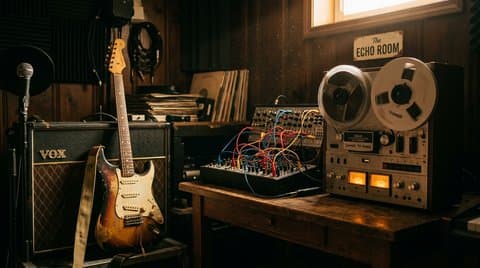
Yet infinite choice without resistance breeds sonic paralysis. In response, a generation of independent composers has turned to modular synthesizers, open-reel tape delays, and customized analog hardware where signal pathways are volatile and irreproducible. In modular synthesis, voltages wander. Heat alters the resistance of copper traces; ambient humidity subtly changes capacitance; components age and introduce idiosyncratic distortion curves.
When an artist patches a complex generative patch on a Serge or Buchla system, they are not programming a predetermined sequence; they are setting up a sonic ecosystem and listening to how it behaves. The synthesizer becomes an erratic dialogue partner rather than a passive typewriter. The composer must react in real time to unexpected sub-harmonic resonances, wild oscillations, and accidental overtones that no software designer consciously authored.
By introducing physical unpredictability back into the signal chain, independent electronic music re-wilds itself. It rejects the hyper-clean gloss of commercial EDM and corporate pop, offering instead a tactile, tactilely abrasive experience that resembles the unruly textures of nature rather than the sterile interiors of software suites.
The Dynamic Range Heresy
There is another silent war being waged in independent mastering suites: the battle for dynamic headroom. For decades, the so-called "Loudness Wars" persuaded artists that to compete on commercial radio and early digital platforms, every element of a mix had to be pushed to maximum perceptual volume. The result was acoustic fatigue—records where a whisper possessed the exact same decibel density as an explosive climax.
The finest contemporary independent engineers are actively sabotaging this convention. By deliberately mixing at lower peak levels and preserving vast dynamic range, they demand that the listener engage in an intentional act of attention.
If an album requires you to turn up your amplifier to hear the delicate resonance of an unamplified nylon-string guitar, and then shocks your ribcage with an uncompressed bass drum strike three minutes later, it has done something radical: it has broken the contract of passive consumption. It refuses to serve as audio furniture for your multitasking workday. It demands your physical room and your undivided ear.
The Economics of Tactile Attention
We cannot separate the aesthetic choices of independent musicians from the economic architecture of modern music distribution. Streaming economics are fundamentally predicated on volume, velocity, and non-intrusiveness. A play counts towards royalty payout after thirty seconds, incentivizing songwriters to front-load synthetic hooks and avoid slow, patient narrative development. Furthermore, algorithm-driven recommendation queues favor uniformity; any track featuring abrupt structural shifts or radical dynamic contrasts risks getting skipped, penalizing the artist within the algorithmic ranking matrix.
In contrast, independent music thrives within micro-economies of deliberate friction. When a listener purchases a limited-edition lathe-cut vinyl or a short-run cassette directly from a musician or an independent imprint, an entirely different psychological relationship is consecrated. The physical object demands ceremony. You must lift the dust cover, clean the groove, drop the stylus, and sit in proximity to the speakers to turn the record over when side A concludes.
This physical friction slows down the consumption cycle. It transforms music from disposable background stream to dedicated artistic event. The listener is no longer an algorithmic user skimming an infinite sea of homogenized data; they become a patron of living sound, participating in the preservation of an endangered human craft.
Toward a Critical Archaeology of Listening
Where does one find this music? You will not find it in curated corporate playlists whose primary client is not the listener, but the advertising network seeking background retention. The discovery of exceptional independent music today requires an ethic of sonic archaeology.
It requires seeking out independent artist-run cooperatives, community radio archives (from NTS, Dublab, and Worldwide FM to hyper-local college broadcasts), and physical record shops where curation is governed by passionate obsession rather than engagement telemetry. It means paying attention to the liner notes, tracing the lineage of guest drummers, uncredited tape manipulators, and mastering technicians who prioritize acoustic integrity over algorithmic compliance.
The stakes are far larger than mere audiophile connoisseurship. In a culture increasingly submerged in synthetic artifacts, deepfakes, and automated text generation, recorded sound remains one of our most intimate conduits to somatic reality. A voice singing across a genuine acoustic room, captured through a ribbon microphone into an unquantized rhythm track, is proof of life.
The future of independent music does not depend on out-competing the algorithms at their own game of hyper-optimized volume and hook-density. It depends on digging deeper into the mud of human irregularity. We must celebrate the wobble, the rustle of fingers on roundwound strings, the deliberate tempo collapse, and the raw harmonic friction that proves a beating heart was in the room.
When the grid is everywhere, true liberation is the courage to be out of time.