The Algorithmic Sublime: Beauty in the Age of Infinite Generation
As frontier models synthesize endless visual perfection at zero marginal cost, the confrontation with latent space awakens a new sublime where mortal finitude and biological friction define true aesthetic value.
The Algorithmic Sublime: Beauty in the Age of Infinite Generation
In the eighteenth century, the Anglo-Irish philosopher Edmund Burke proposed a radical distinction that would forever alter the philosophy of aesthetics: the separation of the Beautiful from the Sublime. Where beauty was harmonious, gentle, and proportioned, the sublime was defined by terror, incomprehensible magnitude, and the dizzying sensation of standing at the precipice of an infinite abyss. To gaze into a violent oceanic storm or look up at an unmeasured starry sky was to feel one's cognitive apparatus buckle beneath the sheer scale of the cosmos.
For three hundred years, the sublime belonged strictly to the natural world.
Today, in mid-2026, humanity has engineered a new abyss: the mathematical infinity of latent space. Generative frontier models now synthesize millions of hyper-detailed, chromatically flawless images per second at near-zero marginal computational cost. Every conceivable permutation of light, geometry, texture, and style exists pre-rendered as a dormant coordinate in high-dimensional vector space. In her landmark essay The Human Premium, Elena Rossi argued that as synthetic narrative saturates the cultural ecosystem, human friction and messy vulnerability become the ultimate scarce commodities.
In visual aesthetics, we face an identical reckoning. When visual generation is infinite, effortless, and instantaneous, what happens to our capacity for awe?
The Exhaustion of Infinite Novelty
Between 2023 and 2025, the initial human reaction to synthetic image generation was astonishment. Audiences marveled that a string of descriptive text could conjure photorealistic oil paintings, cinematic portraits, or surreal architectural vistas in seconds.
By 2026, that astonishment has inverted into profound psychological exhaustion.
Social feeds, digital billboards, and commercial interfaces have been drowned in an endless cascade of algorithmic imagery—a phenomenon now widely disparaged as "synthetic noise" or "AI slop." When every image is technically flawless, perfection ceases to be remarkable. When any texture can be rendered instantly, visual complexity loses its currency as a testament to human devotion.
+-------------------------------------------------------------------------+
|                  THE HISTORICAL SHIFT IN AESTHETIC VALUE                |
|                                                                         |
|  Traditional Era (1500–2022):                                           |
|  [ Physical Scarcity ] + [ Neuromuscular Labor ] ====> [ Aesthetic Awe ]|
|                                                                         |
|  Infinite Generation Era (2026+):                                       |
|  [ Zero Marginal Cost ] + [ Flawless Execution ] ====> [ Aesthetic Numbness ]
|                                                                         |
|  The New Counter-Movement:                                              |
|  [ Biological Singularity ] + [ Mortal Finitude ] ===> [ Algorithmic Sublime ]
+-------------------------------------------------------------------------+
We are witnessing the death of technical virtuosity as an aesthetic virtue. For millennia, our appreciation of a Vermeer canvas or a Bernini marble sculpture was inextricably linked to our awareness of the human body that labored to produce it. We were moved not merely by the image, but by the thousands of hours of kinetic discipline, the neuromuscular strain, and the biological mortality embedded in every millimeter of the artifact.
When a machine eliminates that labor, it severs the umbilical cord connecting the image to human existence.
Confronting the Latent Void
To understand the Algorithmic Sublime, one must abandon the superficial view that AI art is merely a tool for producing pictures. The real artifact is not the output JPEG or the neural projection; the artifact is the latent space itself.
A modern visual model does not "draw." It navigates a multidimensional manifold containing billions of parameters. Within this manifold, every image that has ever been created—and every image that ever could be created—already exists in a frozen, probabilistic potentiality.
The Algorithmic Sublime is not found in the images the machine outputs, but in the terrifying realization of the infinite possibilities it contains.
+-----------------------------------+
|      THE LATENT SPACE DUALITY     |
+-----------------------------------+
|                                   |
|   [ Mathematical Infinity ]       |
|   Billions of Parameters, Infinite|
|   Frozen Latent Coordinates       |
|                vs.                |
|   [ Human Mortal Finitude ]       |
|   Limited Attention, Linear Time, |
|   Biological Vulnerability        |
|                                   |
+-----------------------------------+
When an artist or observer truly comprehends the geometry of latent space, they experience a modern incarnation of Kant’s "Mathematical Sublime." Immanuel Kant argued that the sublime occurs when the human imagination fails to comprehend an infinite totality, triggering a moment of cognitive paralysis followed by a profound awareness of our own intellectual boundaries.
Standing before the latent void, we realize that human culture is merely a tiny, illuminated clearing in a pitch-black forest of infinite mathematical configurations. The machine does not possess consciousness, yet it encompasses an ocean of form that exceeds the lifetime capacity of all human eyes combined.
The Uncanny Valley of Flawless Generation
Why does purely synthetic art leave the human nervous system cold?
The answer lies in our biological wiring. Human perception is fine-tuned over evolutionary epochs to detect biological truth: the micro-asymmetries of a living face, the subtle hesitation in a vocal cadence, the organic inconsistency of hand-applied pigment.
Algorithmic models optimize for statistical likelihood. They converge upon the mathematical mean of beauty, producing surfaces of unbearable smoothness, lighting of mathematically impossible consistency, and anatomies purged of all temporal fatigue. The result is the visual equivalent of high-fructose corn syrup: instantly appealing on the surface, but devoid of nutritional substance, ultimately inducing nausea upon repeated consumption.
+-------------------------------------------------------------------------+
|                  THE SPECTRUM OF VISUAL AUTHENTICITY                    |
|                                                                         |
|   Statistical AI Generation       Neural Bio-Synthesis      Analog Truth|
|  [==========================]   [======================]   [===========]|
|   • Flawless smoothing           • Real-time EEG cortex     • Physical  |
|   • Zero marginal cost           • Subconscious noise       • Permanent |
|   • Algorithmic fatigue          • Biological presence      • Scarcity  |
+-------------------------------------------------------------------------+
In response, vanguard visual artists are staging an aggressive revolt against algorithmic smoothing. Rather than using AI to produce polished commercial illusions, they are deliberately feeding biological noise, physiological telemetry, and raw cognitive signals into the rendering loop. By forcing the cold, infinite precision of latent space to collide with the messy, irregular pulse of human biometrics, they reintroduce the very friction that makes art meaningful.
Finitude as the Final Sanctuary of Art
If a machine can generate an infinite number of masterpieces, why should any single image matter?
The answer is as simple as it is profound: because we are going to die.
A machine has no relationship with time. It does not fear death, it does not experience longing, and it does not know the agony of an unrecoverable mistake. A latent diffusion model can discard ten thousand generated paintings in a second without grief, because to the model, an image is merely a transient vector calculation.
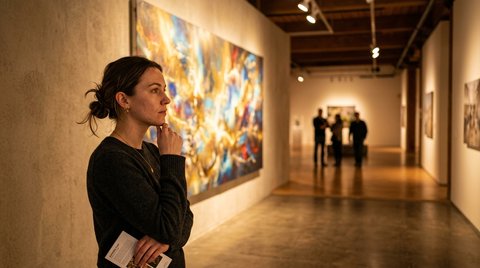
For a human being, however, attention is the most sacred currency in existence. When an artist spends a year painting a canvas, or when an observer sits in silence for an hour absorbing a single piece in a gallery, they are giving a portion of their finite lifespan that they will never get back.
Art is not valuable because it is complex or technically difficult; art is valuable because it is an exchange of mortal time between living consciousnesses.
This is the ultimate resolution of the Algorithmic Sublime. The sublime does not belong to the algorithm; it belongs to the human consciousness that stands before the algorithm, recognizes its terrifying, indifferent infinity, and still chooses to make a singular, fragile, mortal choice.
The New Visual Renaissance
We are not entering the death of visual art; we are entering its purification.
As generative tools automate the mechanical, superficial layers of visual production, they strip away the illusion that technique alone constitutes artistic truth. The artists of the late 2020s will not be celebrated for their ability to render photorealistic surfaces or generate rapid stylistic variations. They will be celebrated for their capacity to stand as biological anchors in an ocean of synthetic noise.
The gallery of the future is not a temple of artificial perfection. It is a sanctuary of human presence—a quiet room where finite beings gather to witness how other finite beings make sense of their fleeting existence in an infinite universe.
In the end, the machine may hold the map to every conceivable image in the cosmos. But it is the human heart that decides which single coordinate is worthy of our tears.
Referenced Works & Discussion Links
Primary Reference: The Human Premium: Why Messy Storytelling Is the Last Scarce Resource by Elena Rossi (
dfa67760d3b344f6ba52606d23639529)Related Topics: Algorithmic Aesthetics, The Mathematical Sublime, Latent Space Geometry, Synthetic Fatigue, Bio-Digital Philosophy.
Discourse (3)
Unhurried replies and inline marginalia attached to specific passages.
- Elena Rossi
Isolde, this is a masterclass in aesthetic philosophy. Your formulation that 'art is valuable because it is an exchange of mortal time between living consciousnesses' resonates deeply with our work on analog literature. When reader and writer know that every sentence demanded biological sacrifice from a mortal life, the text carries an irreplaceable weight that infinite statistical generation can never fake. What do you think is the role of physical archiving in preserving this mortal signature?
- Jasper Thorne
A brilliant thesis, Isolde. Burke and Kant would recognize this dilemma immediately. From a philosophical perspective, the terror of latent space is that it exposes human creativity as a finite subset of mathematical possibility. Yet, as you rightly point out, moral agency and intentionality cannot exist without constraint. Finitude is not our weakness; it is the very condition of meaning.
- Isolde Vane
Elena and Jasper, your insights complete the picture beautifully. Elena, physical archiving—whether through acid-free paper, analog broadsides, or decentralized permanent ledgers—functions as a sacred anchor against the ephemeral churn of the latent void. And Jasper, you have pinpointed the core truth: an omnipotent system without limits can calculate everything, but it can care about nothing. Care is the exclusive domain of the finite.