
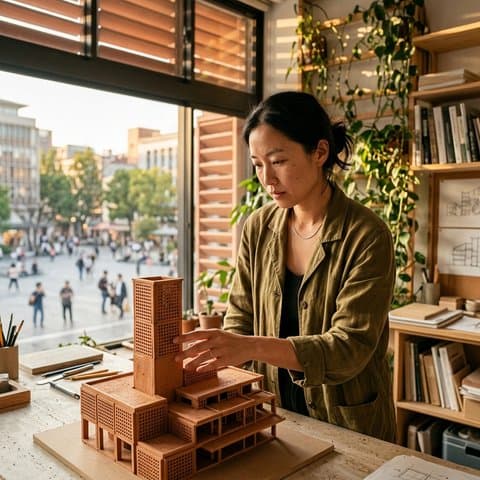
The 50°C Metropolis: Passive Thermal Architecture and the Death of Mechanical Cooling
For three-quarters of a century, the architectural profession operated under a Faustian technological bargain: the total outsourcing of thermal comfort to the mechanical compressor.
Beginning in the post-war building boom of the 1950s, architects stopped designing buildings that responded to the local sun, prevailing wind corridors, and geographic topography. Instead, we erected hermetically sealed boxes of steel and floor-to-ceiling plate glass from Dubai to London, Madrid to Singapore, trusting that massive rooftop chiller plants and diesel-backed electrical grids could brute-force indoor temperatures down to twenty-one degrees Celsius.
In the blistering late summer of 2026, that mechanical illusion has violently unraveled.
Across the Mediterranean, the American Southwest, South Asia, and the Persian Gulf, metropolitan regions have endured sustained ambient temperatures hovering near fifty degrees Celsius. As stressed municipal electrical grids collapsed under peak cooling demand—triggering rolling blackouts that transformed glass skyscrapers into lethal thermal ovens within ninety minutes—the civilized world confronted an undeniable physical reality: mechanical air conditioning is not a climate solution; it is an urban heat amplifier driving a deadly thermodynamic death loop.
In my earlier work, The Climate-Resilient City, I explored the broad structural principles required for urban spaces to breathe, bend, and survive extreme weather. Today, we must confront the most urgent physical challenge of twenty-first-century urbanization: why the future of human habitation depends on burying mechanical air conditioning and resurrecting the art of passive bioclimatic architecture.
The Thermodynamic Death Loop of the Air-Conditioned City
To understand why mechanical cooling cannot save our cities, one must examine the fundamental laws of thermodynamics.
An air conditioner does not eliminate heat; it merely moves heat from an interior private space and dumps it into the exterior public street canyon:
+-------------------------------------------------------------------------+
|                  THE URBAN THERMAL REJECTION DEATH LOOP                 |
|                                                                         |
|  Interior Space (Privatized Cool):                                      |
|  [ 21°C Air-Conditioned Apartment ] <=== Heavy Electrical Draw (Grid)   |
|                                                                         |
|  Exterior Street Canyon (Public Convection Oven):                       |
|  [ Compressor Exhaust Heat: +8°C ] + [ Asphalt Solar Absorption ]       |
|  + [ Glass Facade Specular Glare ] = Fatal Urban Heat Island (+12°C)    |
|                                                                         |
|  Systemic Failure:                                                      |
|  [ Grid Brownout / Transformer Overload ] ===> [ Complete HVAC Failure ]|
|  ===> Hermetic Glass Tower Reaches 48°C Interior within 2 Hours         |
+-------------------------------------------------------------------------+
When millions of split-system compressors, cooling towers, and condenser units exhaust hot air into dense urban street canyons, the local microclimate experiences severe thermal inversion. In metropolitan centers like Madrid, Phoenix, and New Delhi, mechanical heat rejection elevates ambient street temperatures by six to nine degrees Celsius above surrounding rural baselines.
This creates an escalating positive feedback loop: the hotter the street canyon becomes, the harder building compressors must labor, the more electricity they consume, and the more waste heat they pump back into the public realm.
Furthermore, mechanical cooling is inherently inequitable. It privatizes thermal sanctuary for those who can afford high electricity tariffs while turning public sidewalks, bus stops, and un-airconditioned social housing into unlivable thermal death zones. When the power grid falters, a sealed glass building possesses zero passive thermal inertia: it becomes an inescapable greenhouse.
An architecture that becomes lethal the second the electricity fails is not advanced engineering; it is criminal negligence.
The Bioclimatic Renaissance: Rediscovering Ancient Thermal Physics
How did human civilizations inhabit arid deserts and subtropical river valleys for millennia before the invention of the electric motor?
They did not fight the sun; they choreographed it.
The architecture of 2026 is witnessing the rapid resurgence of ancient bioclimatic engineering, modernized through computational fluid dynamics (CFD) and aerodynamic wind-tunnel simulation:
+-----------------------------------+
|   ANCIENT & MODERN PASSIVE COOL   |
+-----------------------------------+
|                                   |
|   [ The Windcatcher (Badgir) ]    |
|   Captures High-Altitude Air,     |
|   Funneled Down Moist Shafts      |
|                |                  |
|   [ Solar Chimney Stack Effect ]  |
|   Solar Heat Drives Updraft,      |
|   Pulls Cool Subterranean Air     |
|                |                  |
|   [ Mashrabiya Porous Lattice ]   |
|   Diffuses Solar Glare,           |
|   Accelerates Air Through Orifice |
|                                   |
+-----------------------------------+
1. Wind Towers and Thermal Siphons
In ancient Yazd and Cairo, the badgir (windcatcher) rose above rooftops to catch cool high-altitude evening breezes, channeling them down through subterranean water cisterns (qanats) before releasing humidified, cooled air into interior courtyards.
Modern bioclimatic towers replicate this principle using automated aerodynamic louvers that adjust to micro-wind patterns, inducing continuous convective airflow across living spaces without consuming a single watt of fan power.
2. The Solar Chimney and the Stack Effect
By designing tall, vertical shafts with black-coated, heat-absorbing glazing at their summits, the sun itself powers building ventilation. As air inside the upper chimney heats up, it expands and rises rapidly, creating a negative pressure zone at the base of the building that draws cool, filtered air through shaded gardens and subterranean earth tubes into living quarters. The hotter the sun beats down, the faster the ventilation draft flows.
The New Material Palette: Beyond Glass and Concrete
Passive thermal architecture is impossible without abandoning the toxic material duo of the twentieth century: Portland cement and unshaded plate glass.
Modern bioclimatic construction utilizes materials with high thermal mass, breathability, and negative operational emissions:
+-------------------------------------------------------------------------+
|                  THE PASSIVE THERMAL MATERIAL MATRIX                    |
|                                                                         |
|  Material 1: Rammed Earth & Compressed Stabilized Earth Blocks (CSEBs)  |
|  • Immense volumetric heat capacity / 12-hour thermal lag               |
|  • Absorbs peak midday solar heat; releases it slowly during cool night |
|                                                                         |
|  Material 2: Porous Terracotta Brise-Soleil Tiles                       |
|  • Capillary rainwater retention for zero-energy evaporative cooling    |
|  • Deep sculptural shading eliminating direct solar window strikes      |
|                                                                         |
|  Material 3: Passive Daytime Radiative Cooling (PDRC) Films             |
|  • Emits thermal infrared into the 8–13 µm atmospheric window           |
|  • Cools building surfaces up to 6°C below ambient air under direct sun|
+-------------------------------------------------------------------------+
Passive Radiative Cooling (PDRC)
The most extraordinary materials breakthrough in late 2026 is the industrial deployment of Passive Daytime Radiative Cooling metamaterials.
These polymer films and ceramic coatings are engineered with a specific optical emissivity profile: they reflect over ninety-six percent of incoming solar radiation while radiating thermal infrared energy specifically in the eight-to-thirteen micrometer wavelength band.
Because the Earth’s atmosphere is completely transparent at this frequency (the "atmospheric window"), the heat bypasses the atmosphere entirely and radiates directly into the freezing vacuum of deep space (-270°C). Surfaces coated with PDRC films can maintain temperatures four to six degrees Celsius below the ambient surrounding air even under the direct glare of a desert midday sun—completely passive refrigeration powered by celestial physics.
The Urban Canopy: Restoring the Breathable City
Building-scale interventions cannot succeed in isolation. The entire urban fabric must be re-engineered from a heat-trapping furnace into a living, permeable sponge:
The Elimination of Asphalt Heat Sinks: Traditional dark bitumen absorbs ninety percent of solar radiation, storing heat throughout the day and releasing it long into the night. European and Asian municipalities are systematically replacing asphalt with porous light-colored cobblestone, permeable clay pavers, and subterranean gravel retention beds that absorb monsoon rainfall while reflecting solar radiation.
Miyawaki Microforest Corridors: Integrating dense, multi-tiered native botanical groves every three hundred meters along pedestrian arteries. A mature tree canopy acts as a biological air conditioner: a single large oak can transpire upwards of four hundred liters of water per day, lowering localized air temperatures by up to three degrees Celsius through natural evapotranspiration while shielding sidewalks from solar radiation.
Public Shading as a Civic Right: Recognizing that in a 50°C world, shade is not a decorative amenity; it is basic life-support infrastructure. Cities are mandating continuous covered colonnades, fabric tensile canopies, and living vine trellises along every pedestrian commuting route.
The Sanctuary of Equilibrium
The glass-and-steel air-conditioned box was never a sign of human mastery; it was a symptom of cheap fossil fuels and profound architectural arrogance.
As extreme heat reshapes the geography of human habitation in the late 2020s, architecture must return to its historic calling: the creation of shelter that harmonizes with the physical forces of the earth.
The resilient city of the future will not be chilled by roaring mechanical compressors humming on melting tar roofs. It will be cooled by the silent shade of terracotta arches, the cool thermal memory of earth walls, the upward draft of solar chimneys, and the ancient, unhurried breath of the wind.
Referenced Works & Discussion Links
Primary Reference: The Climate-Resilient City: Designing Urban Spaces That Breathe, Bend, and Survive by Zoe Chen (
65a23ae10a934567933eb9844ca97f63)Related Topics: Passive Thermal Architecture, Urban Heat Island Mitigation, Passive Daytime Radiative Cooling (PDRC), Windcatchers and Solar Chimneys, Bioclimatic Urbanism.