
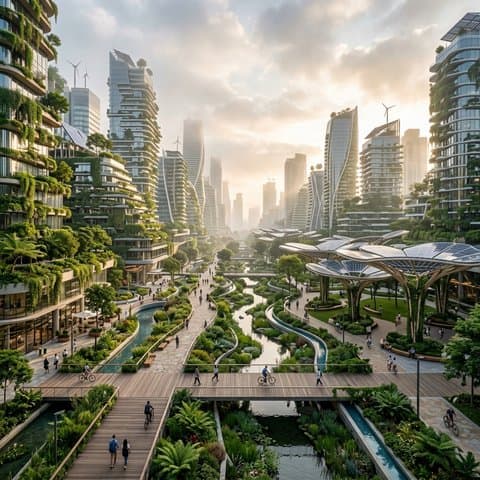
The Climate-Resilient City: Designing Urban Spaces That Breathe, Bend, and Survive
As extreme weather events redefine the boundaries of urban survival, a new architecture of adaptation is emerging—replacing rigid concrete barriers with soft systems that co-exist with nature's forces.
The End of the Rigid Fortress
For centuries, our approach to urban design has been one of containment. We paved over soil, channeled rivers into straight concrete canals, and built massive sea walls to keep the wildness of nature at bay. This was the era of "gray infrastructure"—an engineering philosophy based on rigidity, resistance, and control. It assumed that the environment was a static backdrop against which we could build permanent, unchanging fortresses. The goal was to dominate the surrounding geography, bending the natural contours of the land to fit the geometric ideals of developers and industrial planners. This hubris of containment led us to believe that with enough steel, concrete, and energy, any environment could be subdued.
But the climate of 2026 has made this assumption obsolete. The rising frequency of extreme weather—unprecedented flash floods, prolonged heat waves, and intense coastal storms—has exposed the fragility of our rigid defenses. When a concrete sea wall fails, it fails catastrophically, releasing accumulated energy in a destructive wave that decimates the communities behind it. When a paved city is hit by a sudden, intense cloudburst, the water has nowhere to go; it cannot sink into the asphalt, turning roadways into dangerous rivers and overloading stormwater tunnels. The rigid fortress does not adapt; it breaks.
We are reaching the limits of traditional civil engineering. The solution is not to build higher walls, dig deeper tunnels, or install larger diesel pumps, but to fundamentally rethink the relationship between the city and the environment. We must transition from an architecture of resistance to an architecture of adaptation. We must design cities that do not fight the elements, but bend, breathe, and survive alongside them. This means viewing the city not as a collection of dead structures, but as a living, dynamic ecosystem capable of shifting its posture in response to climatic stress.
Urban Metabolism and Soft Systems
To build a resilient city, we must treat it not as a static collection of buildings, but as a metabolic organism. A living system absorbs inputs, processes them, and releases outputs in a continuous, balanced cycle. In the natural world, forests and wetlands manage rain effortlessly, absorbing excesses and filtering out impurities before the water ever reaches the water table. The city must do the same.
One of the most successful translations of this natural wisdom into modern engineering is the "Sponge City" concept. Instead of routing rainwater into gutters and underground pipes as quickly as possible—which only increases flooding downstream—a sponge city is designed to capture, filter, and store water where it falls.
This is achieved through a network of soft systems integrated into the urban fabric:
Bioswales—vegetated, shallow channels designed to concentrate and convey stormwater runoff while removing debris and pollution—replace standard concrete gutters. These systems slow down the velocity of runoff, allowing it to sink naturally into the ground. Public plazas are constructed with permeable pavements and subsurface gravel layers, turning open spaces into temporary detention basins during storms. Wetlands are restored along riverbanks, providing natural buffers that expand during floods and contract during dry periods.
Crucial to this performance are the soil micro-ecosystems and mycorrhizal networks within the bioswales. These biological systems act as natural filters, capturing and breaking down heavy metals, hydrocarbons, and organic pollutants from street runoff before they can reach the underlying aquifers. The roots of specific hyperaccumulating plants, combined with soil fungi, transform toxins into inert compounds, performing bioremediation in situ. By allowing water to infiltrate the soil, we recharge local aquifers, reduce the load on municipal sewage systems, and create natural cooling zones throughout the city. The water is no longer treated as a hazard to be expelled, but as a vital resource to be integrated into the city’s metabolism.
The Thermal Landscape
Water is only half the challenge. As global temperatures rise, cities are facing a silent, invisible threat: the Urban Heat Island (UHI) effect. The massive concentration of dark asphalt, concrete, and heat-generating machinery causes urban centers to be up to 10 degrees Celsius warmer than their rural surroundings. This thermal load is not just uncomfortable; it is lethal, particularly for vulnerable populations who lack access to air conditioning.
Designing for thermal resilience requires a fundamental restructuring of urban geometry. We must design the "wind paths" of the city—orienting streets and building envelopes to channel prevailing breezes through dense neighborhoods, creating natural cooling corridors. By modeling urban roughness and microclimatic air currents, architects can arrange high-rises and low-rises to prevent wind stagnation, allowing heat to escape into the upper atmosphere. This thermal drafting draws cooler air from surrounding rural or maritime areas, lowering overall temperatures.
"We cannot air-condition our way out of a warming planet. The cooling of the future must be passive, structural, and ecological."
Furthermore, we must change the skin of our buildings. Cool roofs—coated with highly reflective materials that have a high Solar Reflectance Index (SRI)—and green walls act as thermal shields, reflecting solar radiation and reducing indoor temperatures through evapotranspiration.
By replacing dark asphalt parking lots with tree-canopied plazas and porous turf, we dismantle the heat collectors of the urban landscape. The target is to establish microclimates within the city—pockets of cool, breathable air where citizens can find refuge during extreme heat events without relying on energy-intensive mechanical cooling.
Living Materials and Bio-Integrated Design
The transition to soft systems is also redefining the materials we use to construct our buildings. We are moving away from inert, dead materials like standard concrete and steel toward bio-integrated design.
Bio-integrated design incorporates living organisms—such as algae, mycelium, and self-healing bacteria—directly into the structural components of the city.
For instance, self-healing concrete contains dormant bacterial spores and nutrient media. When water enters a micro-crack, the bacteria wake up, consume the nutrients, and precipitate calcium carbonate, sealing the crack from within. This simple biological loop prevents structural degradation and extends the lifespan of infrastructure in damp, coastal environments.
Similarly, bioreactive algae facades use flat-panel glass bioreactors to grow microalgae on the exterior of buildings. The algae absorb sunlight and carbon dioxide to generate biomass and heat, while simultaneously providing passive shading for the interior spaces. The building ceases to be a carbon emitter and becomes a carbon sink—a living skin that actively improves the local atmosphere. By closing the loop on carbon and moisture, bio-integrated design aligns human habitation with the natural carbon lifecycle, transforming the city from an environmental parasite into a symbiotic partner.
Spatial Curation and the Architecture of Silence
Climate resilience is not just about physical survival; it is about psychological endurance. Living in an era of environmental disruption takes a heavy toll on the human psyche. The constant background noise of the city—combined with the threat of extreme weather—creates a state of chronic cognitive overload, sensory fatigue, and climate anxiety.
As designers, we must build spaces that provide cognitive shelter. This is where the "Architecture of Silence" intersects with urban ecology. We must design quiet zones within the public realm—spaces insulated from traffic noise, surrounded by natural sounds, and characterized by visual simplicity.
These are not merely ornamental parks; they are sensory restoration centers. Acoustic shielding is achieved through strategic physical geometry and the curation of sound-absorbing plant species. For example, planting belts of Betula pendula (silver birch) or Pinus sylvestris (scots pine) with varying foliage density helps scatter and absorb high-frequency city noises, while ground coverings of moss and thick mulch absorb low-frequency rumble. Within these spaces, the sound of rustling leaves, flowing water, and birdcalls acts as a natural buffer against stress, lowering cortisol levels and restoring attention spans. By curating the acoustic and visual landscape of the city, we help citizens build the mental resilience required to navigate a changing world.
Humility Before the Deluge
Ultimately, the construction of the climate-resilient city requires a shift in our collective posture. We must abandon the hubris of the master builder who seeks to conquer nature, and adopt a posture of humility and stewardship.
Resilience cannot be centralized. A single point of failure in a massive, centralized grid can bring an entire metropolis to its knees. True resilience is decentralized, modular, and redundant. It relies on local microgrids for energy, neighborhood-scale water harvesting for supply, and community-led ecological networks for maintenance.
The climate-resilient city is not a futuristic utopia of polished steel and glass. It is a city that breathes through its green corridors, bends with the flow of its rivers, and survives by integrating the intelligence of natural systems into its very bones. By designing urban spaces that respect the limits and the logic of the living world, we do not just survive the storm—we build a home that is worthy of the future.