
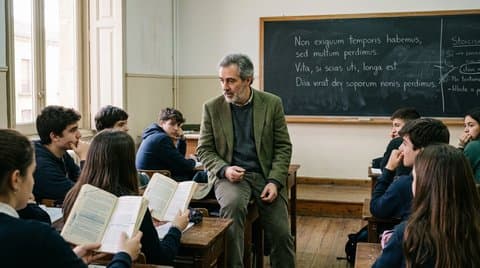
Teaching Seneca at Eight in the Morning
The slate blackboard in Room 204 still carries the faint white residue of yesterday's afternoon grammar class. At eight on a cold November morning in Salamanca, with the stone towers of the Clerecía shrouded in low Castilian fog, thirty seventeen-year-old Bachillerato students enter the room shivering in their coats. They have slept four or five hours. Their pockets buzz with automated push notifications from platforms that monetize their circadian distress. They are anxious about university entrance exams, about automated job elimination, and about whether anything they are currently being taught will matter by the time they turn twenty-five.
I pick up a piece of white chalk and write across the slate: Non exiguum temporis habemus, sed multum perdimus. Vita, si scias uti, longa est. "We do not have a short time to live, but we waste a lot of it. Life is long, if you know how to use it."
I do not turn on a digital projector. I do not display a slide deck summarizing the life of Lucius Annaeus Seneca in bullet points. I sit on the front edge of my desk, look directly at an exhausted boy in the third row, and ask: "Pablo, between midnight and this morning, how many hours did you actually own?"
The room falls completely silent. A nervous laugh ripples through the desks, then evaporates. For the next fifty minutes, these seventeen-year-olds do not touch a screen. They open their battered, yellowed paperback editions of Seneca's De Brevitate Vitae (On the Shortness of Life). They discover, with mounting disbelief, that an exiled Cordoban senator writing to his father-in-law Paulinus in forty-nine AD was diagnosing their exact contemporary neurosis: the tragic condition of being perpetually occupied in the service of others while remaining an absolute stranger to one's own soul.
The Technocratic Delusion of Prompt Literacy
Over the past four years, European educational ministries have been gripped by a technocratic panic. Confronted with the dizzying expansion of generative artificial intelligence, bureaucrats and policy consultants have converged on a singular, urgent recommendation: secondary curricula must be radically modernized. We are told that hours allocated to Greek, Latin, classical philosophy, and literary analysis must be trimmed to make room for "digital competencies," "AI literacy modules," and "natural language instruction engineering."
We must have the courage to identify this policy for what it is: an act of pedagogical fraud.
Training seventeen-year-olds to interact with the conversational interfaces of proprietary language models is not education; it is unpaid vendor onboarding. The syntax of software prompts changes every six months; the interface layers are redesigned on corporate whim; the specific tools being promoted in ministerial white papers today will be fully automated or abandoned before these adolescents graduate from university. By sacrificing classical humanities on the altar of immediate technological utility, we are not preparing our students for the future. We are training them to be low-cost clerical operators of machinery they neither own nor comprehend.
 A classical philosophy paperback edition open on a high school desk with handwritten margin notes
As Martha Nussbaum warned in her decisive 2010 work, Not for Profit: Why Democracy Needs the Humanities, an educational system oriented exclusively toward technical profitability produces "useful machines" rather than autonomous citizens. A human being trained solely to manipulate technical tools may be highly productive in the short term, but they remain intellectually helpless when confronted with demagoguery, ethical ambiguity, or sudden economic obsolescence.
Technocratic Utility vs. Classical Humanist Scaffolding
To defend classical philosophy in the high school classroom is not an elitist indulgence. It is a forensic triage of human capabilities in an age of automated cognition:
Educational Dimension | Technocratic Prompt Training | Classical Humanist Scaffolding |
|---|---|---|
Epistemic Foundation | Ephemeral, tool-specific interaction protocols dictated by private vendors | Timeless dialectical methods developed across twenty-four centuries |
Cognitive Autonomy | Dependent on external computational interfaces for synthesis and reasoning | Internalized capacity for independent logical deduction and moral judgment |
Handling of Ambiguity | Optimizes for immediate, statistically probable consensus answers | Wrestles with tragic irresolution, paradox, and conflicting duties |
Attentional Architecture | Fragmented, reactive prompt-and-check loops (<30 seconds) | Sustained, contemplative engagement with dense, resistant texts (45+ mins) |
Ethical Capacity | Compliance with algorithmic safety filters and corporate terms of service | Cultivation of conscience, civic duty, and the courage to refuse tyranny |
Half-Life of Skill | 12 to 24 months before next model generation renders technique obsolete | Lifelong psychological fortitude, rhetorical defense, and existential clarity |
Notice the contrast in the second row: cognitive autonomy. When a student relies on an algorithm to summarize a historical crisis or draft an essay, the intellectual labor of finding the narrative coherence is outsourced. The student becomes a consumer of pre-digested conclusions.
When that same student is forced to sit with Seneca's Epistles to Lucilius for an hour, tracing how the philosopher distinguishes between otium (fruitful philosophical leisure) and desidia (sluggish, distracted idling), they are performing an entirely different operation. They are building an internal mental architecture. They are discovering that their own emotional vulnerabilities—their fear of failure, their desperate craving for social validation, their terror of missing out—were analyzed with clinical precision two thousand years ago.
The Stoic Inoculation Against Synthetic Panic
Why does Seneca resonate so powerfully with teenagers who are supposedly hooked on fifteen-second video loops? Because adolescence is an acute, unceasing existential crisis, and Stoicism is not an abstract metaphysical theory; it is an emergency manual for living in an unhinged world:
The Stoic Dialectical Crucible: External Algorithmic Clamor → Radical Dichotomy of Control → Epistemic Self-Audit → Autonomous Moral Equanimity
Seneca's core pedagogical intervention begins with the ruthless separation between what is within our power (ta eph' hemin) and what lies outside our power (ta ouk eph' hemin).
In Room 204, I watch this principle detonate the quiet anxieties of my students. A girl named Sofia, who admits she checks her social media metrics every six minutes before going to sleep, suddenly stops when reading Seneca's fourth letter. Seneca points out that the man who ties his happiness to the opinion of the crowd is voluntarily putting his neck into a slave's collar: Non est pauper qui parum habet, sed qui plus cupit.
"Profe," she says, her fingers tracing the printed line on the paper, "the algorithm doesn't make me look at it because it's interesting. It makes me look at it because it wants me to feel that I am not enough."
That is not a lesson you can acquire from an AI literacy tutorial. It is the awakening of critical consciousness. It is the moment an adolescent realizes that their attention is not an empty bucket to be monetized by California software monopolies, but the sovereign territory of their own mortal existence.
The Humanities as the Only Permanent Shield
The ultimate irony of our current educational policy is that the disciplines technocrats label as "useless"—ancient Greek syntax, classical rhetoric, Latin etymology, and moral philosophy—are precisely the disciplines most resilient against machine automation.
An artificial intelligence can generate thousands of lines of syntactically valid code in seconds. It can draft legal boilerplates, produce marketing copy, and summarize financial disclosures with superhuman speed. But a language model cannot cultivate human virtue (arete). It cannot grieve a lost parent. It cannot feel the righteous anger of an injustice witnessed on the street. It cannot look into the eyes of a suffering peer and make a conscious, sacrificial commitment to accompany them in their pain.
If we transform our secondary schools into vocational digital coding bootcamps, we are marching our children straight into obsolescence. We are teaching them to do poorly what machines will do effortlessly.
By contrast, when we teach Seneca at eight in the morning, we are giving them an armor that no software update can rust. We are teaching them how to doubt, how to suffer without collapsing, how to recognize an imperial lie disguised as progress, and how to inhabit their own fleeting mortal lives with dignity. In an era of infinite synthetic noise, the quiet voice of an ancient Roman reminding thirty teenagers that their time belongs to them is the most radical lesson in the curriculum.