
Why Secondary School Must Remain a Civic Fortress
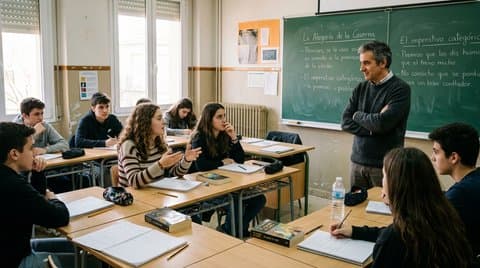
At a quarter past eight in the morning, the northern light of Salamanca cuts across the tall, unadorned windows of Room 204. The dust rising from the slate blackboard hangs suspended in the air like fine mica. Before me sit thirty-two sixteen-year-old boys and girls. For the preceding twelve hours, every single one of them has been immersed in an environment engineered with predatory mathematical precision to ensure they never encounter an uncurated thought. Their nocturnal lives are mediated by algorithmic recommendation engines that reward instantaneous outrage, reinforce preexisting cognitive biases, and isolate them within frictionless digital solitudes. They arrive at the school gates carrying the quiet neurosis of an endless, curated mirror.
Yet here, inside this rectangular room with its scuffed linoleum and scarred pine desks, something ancient and obstinate occurs. The bell rings. Mobile phones are placed into the wall-mounted wooden rack by the door. The glass screens go dark. For the next fifty-five minutes, these adolescents are subjected to an experience that our market civilization has systematically eradicated everywhere else in public life: the physical, inescapable friction of unmediated human coexistence.
Secondary school is not an occupational training center. It is not an orientation funnel for corporate platforms, nor is it a holding facility for adolescents while their parents participate in the labor market. The public high school is the last secular fortress of the democratic polis. It is the sole institution remaining on the European continent where individuals from radically divergent socioeconomic classes, family doctrines, and cultural lineages are compelled to occupy the same geographic space, breathe the same air, and look one another in the eye while defending what they believe to be true.
The Broken Cloister of the Modern Adolescent
We must diagnose the crisis of adolescence without resort to administrative euphemisms. The contemporary high school student does not suffer merely from distraction; they suffer from algorithmic enclosure. When private technology monopolies colonized teenage attention over the past decade, they did not simply provide communication channels. They dismantled what Hannah Arendt, in her 1958 meditation The Crisis in Education, identified as the essential function of the school: a protective space, a cloister intermediary between the private intimacy of the home and the relentless exposure of the public world.
Arendt warned that when the boundary between the private sanctuary and the public arena is dissolved, the young are thrust prematurely into a merciless spotlight before their faculties of judgment have matured. Today, that premature public exposure has been weaponized. A teenager does not make an error in private; their social anxieties, physical self-consciousness, and half-formed opinions are continuously indexed, scored, and monetized by platforms whose business model relies on maintaining them in a permanent state of parasympathetic arousal.
When these students walk down the school corridor, they are not entering a common world. They are wandering through thirty-two parallel, privatized realities. In the hallway before the bell, each looks down into their personal glass portal, consuming custom-tailored synthetic narratives designed to confirm their parochial identities and demonize their peers across the corridor. The consequence is not merely political polarization in the abstract; it is the atrophy of the civic imagination. They have lost the capacity to imagine that someone who disagrees with them could be operating in good faith.
 A classroom seminar engaged in open political philosophy debate
If the public high school surrenders to this drift—if it adopts the technocratic mantra that the classroom must simply mirror the digitized convenience of the market—it ceases to be an educational institution. It becomes an accessory to epistemic balkanization.
The Secular Agora vs. The Algorithmic Enclosure
To defend the high school as a fortress is not to retreat into nostalgic reaction. It is an act of militant political architecture. We must be lucid about the irreconcilable antagonism between the logic of the algorithmic feed and the logic of the republican classroom:
Pedagogical & Civic Dimension | The Algorithmic Enclosure | The Secular Civic Agora |
|---|---|---|
Primary Social Architecture | Solitary consumer isolated in a personalized, metric-driven feed | Collective assembly of physical peers bound by shared attention |
Encounter with Otherness | Filtered through recommendation algorithms; dissent framed as hostile anomaly | Unavoidable physical proximity with peers of opposed backgrounds |
Epistemic Posture | Passive consumption of pre-synthesized, effortless answers | Agonistic struggle with primary texts, ambiguity, and contradiction |
Temporal Velocity | 15-second visual loops; continuous cognitive dopamine refresh | 55 minutes of sustained, unhurried, collective deliberation |
Validation Mechanism | Algorithmic engagement metrics, likes, and algorithmic rewards | Peer interrogation, teacher refutation, and oral coherence |
Civic Consequence | Epistemic tribalism, hyper-individualism, and intellectual fragility | Pluralistic resilience, rhetorical courage, and republican fraternity |
The contrast could not be sharper. The algorithmic feed flatters the user. It whispers to the sixteen-year-old that their immediate emotional intuition is the ultimate measure of reality. It eliminates cognitive friction because friction produces churn.
The classroom, by deliberate contrast, exists to generate fruitful friction. In Room 204, a student who makes an assertion is immediately asked by their peers: By what warrant do you claim this? What historical precedent supports your conclusion? If your premise holds, how do you account for the misery of those it excludes?
This is Jürgen Habermas's der zwanglose Zwang des besseren Arguments—the unforced force of the better argument—rendered tangible in the voices of young people whose voices crack with adolescent emotion. It cannot be simulated in an online forum, where participants can block, mute, or report anyone whose perspective disturbs their dogmatic slumber. You cannot block your desk-mate who sits three feet away from you smelling of rain and tobacco. You must listen to him, or you must explain aloud why his reasoning fails.
The Pedagogical Socratic Crucible
How do we transform an assembly of fragmented teenagers into a living democratic forum? It does not happen through ministerial slogans or interactive whiteboards. It occurs through the deliberate cultivation of dialectical rigor:
The Pedagogical Socratic Crucible: Algorithmic Isolation → Destabilizing Aporia → Agonistic Deliberation → Shared Civic Consciousness
The trajectory requires four distinct, non-negotiable stages:
First, the student must be severed from the comforting immediacy of their private feed. When they enter the classroom and open a text—whether it is Pericles' Funeral Oration, the Spanish Constitution of 1978, or Simone Weil's reflections on the needs of the soul—the initial reaction is often resentment. The syntax does not yield in fifteen seconds. It demands labor.
Second comes aporia—the Socrates-induced recognition that what one took to be an undeniable truth was merely an unexamined prejudice absorbed from a short-form video clip. When a student discovers that their passionately held conviction collapses under three consecutive counter-questions, the vanity of the individual ego cracks open. This crack is where education begins.
Third is agonistic deliberation. In our classroom debates, modeled after the European Youth Parliament, students are frequently assigned to defend positions that contradict their personal preferences. A boy from an affluent suburban family must argue the case for public housing expropriation; a girl with libertarian leanings must articulate the philosophical necessity of progressive taxation. This is not theatrical cynicism; it is the muscular exercise of cognitive empathy. It forces the adolescent mind to occupy the interior logic of the political adversary, destroying the caricature constructed by internet memes.
Finally, there emerges a shared civic consciousness. After fifty minutes of fierce, exhausting argument over whether justice requires strict equality of outcome or equality of opportunity, something extraordinary occurs: the bell rings, the students gather their books, and they walk out together into the courtyard to share a sandwich. The disagreement was real, but the fellowship of having wrestled together within the same arena remains unbroken.
Why the Republic Needs Classroom Friction
There are educational reformers who argue that the physical high school is an obsolete nineteenth-century relic. They suggest that education can be unbundled into asynchronous remote modules, that learning paths should be customized by adaptive software algorithms, and that teachers should be demoted to "learning facilitators" while artificial intelligence personalizes each student's curriculum.
We must recognize this vision for what it is: an attempt to liquidate the public realm in the interest of market convenience.
A democratic society does not survive because its citizens possess high technical proficiencies in spreadsheets or instruction-prompt engineering. A democracy survives because its citizens are capable of governing themselves collectively through speech and persuasion rather than violence. And self-governance is an acquired, unnatural habit that cannot be mastered in private.
If our young people do not learn to sit in a room with people they did not choose, listening to arguments they find distasteful, and subjecting their own certainties to the merciless audit of public reason, they will never become citizens. They will remain consumers of ideological commodities, permanently ripe for authoritarian manipulation by whoever promises to silence the voices that offend them.
The public secondary school must remain a fortress. Its walls must be thick enough to keep out the commercial solicitations of Silicon Valley platforms and the bureaucratic cowardice of educational technocrats. Behind those walls, illuminated by the chalk dust of Room 204 and the unadorned light of the morning sun, thirty-two young minds will continue to discover that freedom is not the absence of resistance, but the shared courage to look one another in the eyes and ask: Why?