
Subsea Cartography: Why Undersea Fiber Cables Are the Most Fragile Borders on Earth
We live under the comforting optical illusion of the cloud. We imagine our transactions, model weights, cryptographic keys, and diplomatic cables dissolving into ethereal air, routed by weightless algorithms across a borderless sky. But the internet is not in the sky. It does not float above our fractures. The internet lies on the ocean floor, unspooled across tectonic trenches and continental shelves, encased in pitch, steel wire, and petroleum jelly, resting directly upon the cold mud of international waters.
Ninety-nine percent of all intercontinental data traffic moves through roughly six hundred submarine fiber-optic cable systems. These hair-thin conduits of ultra-pure silica glass, barely thicker than a garden hose along the deep abyssal plain and armored to the circumference of an artillery shell near shallow coastlines, carry more than ten trillion dollars in financial settlements every day. They carry sovereign communications, military telemetry, and the real-time inference pipelines of the artificial intelligence boom.
Yet their safety is guaranteed by almost nothing.
There are no naval convoys stationed above them. There are no sovereign borders demarcating their paths through the high seas. A single container ship dragging a five-ton anchor across an uncharted shelf, or an unflagged dual-use hydrographic vessel deploying a submersible shear, can instantly sever the digital carotid artery of an entire hemisphere. Subsea fiber cables are not merely conduits; they are the most fragile, contested, and physically exposed borders on Earth.
The Tyranny of the Narrow Waters
Geographers have spent centuries studying maritime chokepoints: the Strait of Malacca, the Bab-el-Mandeb, the Suez Canal, the Strait of Hormuz, the Danish Belts. In naval warfare, control of these bottlenecks historically meant the power to starve an adversary's industry or cut off their grain. In the twenty-first century, digital geography has mapped itself directly over these exact same geographic scars.
Consider the Red Sea corridor. Approximately seventeen percent of all global internet traffic squeezes through the narrow maritime passage between Djibouti, Yemen, and Egypt. A dense bundle of cables—including Europe India Gateway (EIG), SEA-ME-WE 5, AAE-1, and 2Africa—runs along a shallow seabed that narrows to less than twenty kilometers at the Bab-el-Mandeb. When conflict erupted in the southern Red Sea in 2024, the vulnerability transitioned from theoretical threat modeling to immediate kinetic disruption. The drifting, disabled cargo vessel Rubymar, dragging its severed anchor along the seabed for dozens of nautical miles before sinking, shredded three major cable systems in a single stroke, immediately throttling twenty-five percent of the data routing between Asia, East Africa, and Europe.
Traffic was rerouted, as the internet's dynamic protocols are designed to do. But rerouting across oceans is not instantaneous, nor is it infinite. Data had to detour around the Cape of Good Hope via the West African Cable System or journey eastward across trans-Pacific paths. Latency spiked by more than eighty milliseconds—a delay that is trivial for an email, noticeable for video conferencing, and fatal for high-frequency financial arbitrage and distributed compute clusters synchronizing across datacenters.
The Red Sea is not an anomaly; it is the rule. The Luzon Strait between Taiwan and the Philippines funnels virtually all traffic connecting East Asia with North America; a magnitude 7.0 submarine earthquake or intentional dredging can sever multiple lines within minutes, as occurred in 2006 when eight submarine cables were cut simultaneously, blacking out banking transactions across Hong Kong, Tokyo, and Singapore. The Strait of Malacca, through which one-third of world maritime trade flows, is so congested with dredging, anchoring, and commercial trawling that subsea cables are struck dozens of times each year.
The geography of bandwidth has concentrated the world's nervous system into fewer than ten hyper-congested choke points. We have engineered hyper-redundant neural architectures, multi-region cloud regions, and federated model registries, yet all of them terminate upon a handful of vulnerable oceanic bottlenecks.
The Physics of the Abyssal Cable
To understand why repair is so agonizingly slow, one must discard the metaphor of the digital and examine the brutal physics of the seabed.
A deep-sea submarine cable is a triumph of industrial materials science. At its core lie between twelve and ninety-six pairs of optical glass fibers, each thinner than a strand of human hair. Surrounding these fibers is a thixotropic water-blocking compound, encased within a welded copper tube that acts as both a hermetic barrier and an electrical conductor carrying up to 10,000 volts of direct current. This power is essential: optical light pulses degrade as they traverse kilometers of glass, requiring optical repeaters—erbium-doped fiber amplifiers—spliced into the cable every fifty to eighty kilometers along thousands of miles of seabed. Encapsulating this electrical sheath is high-density polyethylene, which in deep waters provides the only protection needed against ambient water pressure reaching four hundred atmospheres.
In shallow waters—where fishing trawlers drag heavy weighted bottom nets and commercial ships drop anchors—the cable is armored with layers of galvanized steel wire and wrapped in tar-soaked polypropylene yarn. Yet even this armor cannot withstand the momentum of a 100,000-ton cargo vessel dragging an anchor at eight knots.
 Marine optical technician splicing glass fiber cores inside a cable ship laboratory
When a cable breaks at three thousand meters depth, the repair is not a software patch. It is an immense, dangerous maritime operation.
First, shore stations utilize optical time-domain reflectometers (OTDR), firing laser pulses down the severed glass to calculate the exact distance of the fracture based on backscatter reflection. Once localized within a few hundred meters, a specialized cable repair ship must be chartered, dispatched, and navigated to the coordinates in the open sea.
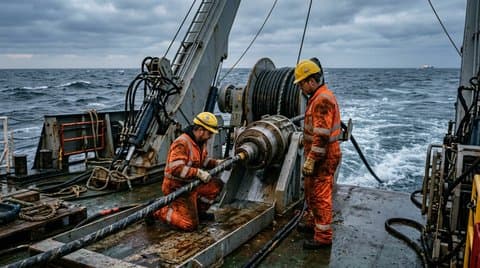
There are fewer than sixty active commercial cable-repair vessels operating worldwide. More than half of this aging fleet is over twenty-five years old, and charter queues routinely stretch into weeks or months. Once on site, dynamic positioning systems keep the ship stationary against wind and swell while a heavy grapnel or a remotely operated vehicle (ROV) descends into the abyss. The ROV cuts the damaged section, grips one severed end with hydraulic jaws, and brings it up to the surface.
Aboard the vessel's cleanroom laboratory, technicians strip the steel armor, cut through the copper power casing, and clean each hair-thin glass strand. Under stereoscopic microscopes, workers use precision electric arc fusion splicers to align the micron-wide glass cores and fuse them back together with near-zero optical loss. The process must be repeated for every single fiber pair. Once spliced, the joint is sealed within a heavy steel joint casing, lowered back to the ocean floor, and the ship repeats the operation for the opposite end, adding a length of spare cable to bridge the gap.
In calm seas, a single repair takes between seven and twenty days. In heavy winter seas in the North Atlantic, or in politically contested territorial waters where littoral states deny transit permits, a severed cable can remain dark for six months.
The Gray Zone: Asymmetric Sabotage in International Waters
The true strategic crisis of 2026 is not accidental anchor snagging; it is the weaponization of deniable physical sabotage in the maritime gray zone.
Because submarine cables lie outside territorial waters for thousands of miles, their legal protection under international law is catastrophically weak. The 1982 United Nations Convention on the Law of the Sea (UNCLOS) provides nominal protections, declaring willful damage to submarine cables a punishable offense. Yet UNCLOS provides no enforcement mechanism, no mandate for collective defense, and no jurisdiction for naval forces to board or detain foreign-flagged civilian vessels suspected of dragging anchors over cables outside their own contiguous zones.
In the Baltic Sea, the vulnerability of critical subsea infrastructure has evolved from hypothetical risk into an active theater of asymmetric contestation. The severing of the Balticconnector gas pipeline and the subsequent cuts to the Sweden-Estonia telecom link and the C-Lion1 cable connecting Helsinki to Rostock highlighted a chilling reality: a commercial merchant vessel or research ship sailing under a flag of convenience can drag an anchor along the seabed for scores of kilometers, sever multiple critical lines, and claim navigational error or rough weather. Proving intent in international maritime tribunals requires years of litigation, while the strategic damage—degraded communication, panic, intelligence loss, and economic friction—is achieved in seconds.
The asymmetry is staggering. A state or non-state actor needs only a cheap trawler, an old anchor, or a commercially available unmanned underwater vehicle (UUV) costing tens of thousands of dollars to disrupt an asset worth hundreds of millions of dollars that underpins the sovereign stability of an entire continent.
The Hyperscaler Hegemony and Sovereign Cloud Enclaves
For the first four decades of submarine telecommunications, subsea cables were constructed and operated by international consortia of public telecommunications monopolies and state-backed utilities. Decisions about routing were governed by diplomatic treaties, multilateral consensus, and shared sovereign liability.
That era is dead. Today, the masters of the seabed are not nations, but private hyperscale technology conglomerates: Google, Meta, Microsoft, and Amazon.
Over the past seven years, private tech monopolies have become the primary investors, owners, and operators of transatlantic, transpacific, and intra-Asian subsea bandwidth. Google's private cables—Dunant, Grace Hopper, Equiano, Firmina, and Curie—crisscross the globe with massive, proprietary spatial multiplexing systems. Meta's 2Africa system, spanning 45,000 kilometers around the African continent, represents the longest subsea cable system ever constructed.
This privatization has created a profound geopolitical shift:
The sovereign states of the world no longer own the physical pathways of their national communication. National security, central bank settlement systems, and citizen identity databases ride as guests over privately owned glass owned by four American technology firms.
When private tech giants control the landing stations and routing infrastructure, they effectively command the digital foreign policy of the nations they connect. In Southeast Asia, Google and Meta deliberately bypassed Hong Kong and direct routes through the South China Sea for their Apricot and Echo cables, routing instead through Indonesia and Singapore to avoid Beijing's maritime surveillance claims and regulatory licensing freezes. Private corporate risk assessments now redraw the sovereign digital borders of nations more decisively than United Nations boundary commissions.
The Next Frontier: Arctic Fiber and Oceanic Sovereign Redundancy
How do sovereign nations respond when their primary lifelines are at the mercy of shallow chokepoints and maritime gray-zone sabotage?
The answer lies in two parallel strategic developments: the opening of polar routes and the construction of sovereign subsea redundancy.
As Henrik Lindqvist observed in his recent analysis of Arctic statecraft, the retreat of polar pack ice is revolutionizing maritime navigation along the Northern Sea Route. But its most profound consequence may be informational rather than freight. Projects such as Polar Connect and the Far North Fiber initiative aim to lay submarine fiber cables through the Northwest Passage and across the Arctic seabed, linking northern Europe directly to Japan and North America without passing through a single Eurasian geopolitical chokepoint.
By routing through the freezing depths of the Arctic Ocean, these cables bypass the Red Sea, the Suez Canal, and the Strait of Malacca entirely. The route cuts latency between Tokyo and Frankfurt by thirty milliseconds, but more importantly, it buries the cable beneath Arctic ice sheets where conventional surface trawlers, commercial anchors, and hostile commercial ships cannot operate.
Simultaneously, sovereign states are beginning to treat subsea cables not as private commercial utilities, but as sovereign military infrastructure:
Active Seabed Acoustic Monitoring: Deploying permanent sonar arrays and hydrophone sensors along cable landing shelves to detect unauthorized submersibles and acoustic signatures of dragging anchors in real time.
Autonomous Seabed Escorts: Developing long-endurance autonomous underwater vehicles (AUVs) programmed to patrol critical subsea corridors and inspect repeaters for magnetic eavesdropping taps or explosive charges.
Sovereign Repair Fleets: Ending reliance on commercial repair pools by establishing state-backed, naval-operated cable repair ships equipped with rapid-splicing robotics and heavy ice-breaking capabilities.
Multipath Cryptographic Meshing: Ensuring that the sudden loss of any two maritime corridors automatically redistributes critical state traffic over sovereign satellite constellations (such as high-throughput LEO networks) without relying on intermediate foreign landing stations.
The Ground Beneath the Glass
We have spent three decades celebrating the immateriality of cyberspace. We built legal theories around the cloud, economic doctrines around frictionless digital capital, and cultural movements around borderless communication. But geography does not disappear simply because we convert our thoughts into laser beams.
Every prompt sent to a machine learning cluster, every bank settlement executed across currencies, and every diplomatic dispatch transmitted between capitals must ultimately travel down a microscopic strand of glass lying in the absolute darkness of the seabed, four thousand meters below the waves.
Out there, in the silent depths, the digital world is completely defenseless. It is subject to the grinding of tectonic plates, the bite of deep-sea sharks, the careless drag of rusting anchors, and the calculated malice of covert statecraft. If we wish to protect our digital sovereignty, we must cease looking up into the clouds and begin looking down into the sea. The real borders of the twenty-first century are not drawn on maps; they are unspooled across the ocean floor.