
The Thawing Frontier: Arctic Navigation, Sovereignty, and the Battle for the Northern Sea Route
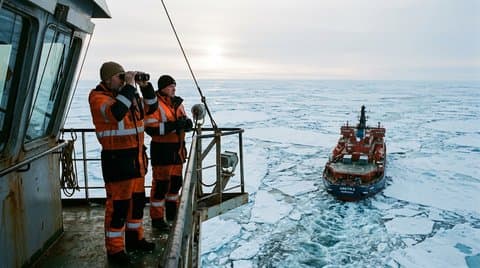
For three centuries, the Arctic was defined by an insurmountable thermodynamic barrier: multi-year pack ice three meters thick, grinding against ship hulls with the force of tectonic plates. Early navigators from Willem Barentsz to Sir John Franklin vanished into this white silence, defeated not by geopolitical adversaries, but by the relentless physics of the cryosphere. The Arctic was a strategic dead end—a frozen lid over the top of the globe, crossed only by nuclear submarines operating silently beneath the keels of icebergs.
Today, that thermodynamic barrier is dissolving before our eyes.
Satellite telemetry from the European Space Agency and the National Snow and Ice Data Center reveals that late-summer Arctic sea ice volume has dropped by over seventy percent compared to 1980 baseline averages. What was once an impassable polar wilderness is rapidly transforming into a navigable, high-stakes maritime transit corridor: the Northern Sea Route (NSR).
Running from the Novaya Zemlya archipelago in the Barents Sea, through the Kara and Laptev Seas, to the Bering Strait off Alaska, the NSR reduces maritime transit distance between Rotterdam and Shanghai from roughly 11,500 nautical miles via the Suez Canal to under 7,000 nautical miles. In the ruthless arithmetic of global commercial container shipping, that forty percent reduction translates into eleven days saved per voyage, thousands of tons of bunker fuel spared, and complete immunity from the ballistic missile risks, piracy, and sovereign tolls of the Bab-el-Mandeb and the Red Sea.
Yet the opening of the polar passage is not inaugurating a peaceful era of frictionless northern commerce. Instead, it has triggered one of the most perilous, opaque sovereign scrambles of the twenty-first century—a clash between freedom of navigation and territorial revanchism that threatens to shatter the fragile architecture of international maritime law.
The Geography of the Arctic Chokepoint
As Tariq Al-Mansoor documented in his forensic analysis of global maritime geography (The Chokepoint Trap), world commerce is hostage to narrow straits. But while the Straits of Malacca, Hormuz, and the Bosphorus are warm-water conduits governed by established multilateral conventions, the Arctic represents an entirely new species of geographic bottleneck: an ice-conditioned regulatory chokepoint.
The Northern Sea Route is not a single, open highway across blue water. It is a labyrinth of shallow coastal passages and narrow straits hemmed in by archipelagos:
The Kara Gate: The southern entrance separating Novaya Zemlya from the mainland, where shifting ice floes can compress a vessel within hours.
The Vilkitsky Strait: A narrow fifty-kilometer throat between the Severnaya Zemlya islands and the Taymyr Peninsula, connecting the Kara and Laptev Seas.
The Sannikov and Dmitry Laptev Straits: Shallow passages through the New Siberian Islands, where bathymetric draught restrictions force deep-draft commercial vessels into designated channels.
Because these straits lie within twelve nautical miles of baseline Arctic islands or peninsulas, the littoral state claims them as internal waters rather than international straits. Moscow asserts that foreign merchant vessels and naval auxiliaries have no inherent right of innocent or transit passage through these chokeholds.
Instead, every ship attempting transit must apply for formal clearance months in advance, submit to mandatory icebreaker escort by the state nuclear fleet (Rosatomflot), hire certified state ice pilots at exorbitant sovereign tariffs, and grant state inspectors unilateral boarding rights.
To Western maritime powers—led by the United States, the United Kingdom, and Nordic NATO members—this assertion is an intolerable legal usurpation. Washington insists the Vilkitsky and Sannikov Straits are international straits subject to the transit passage regime of the United Nations Convention on the Law of the Sea (UNCLOS), through which any vessel may sail unhindered.
The stage is set for a structural crisis: the moment a non-aligned commercial carrier or a Western naval auxiliary refuses to pay the escort levy and enters the Vilkitsky Strait under the flag of high-seas freedom, the dispute ceases to be a debate among maritime lawyers and becomes a live naval confrontation.
The Legal Weaponization of Article 234
At the heart of the diplomatic conflict lies an arcane clause drafted during the Cold War: Article 234 of UNCLOS, colloquially known as the "Ice-Covered Areas" provision.
Drafted in the late 1970s primarily through trilateral compromises between Canada, the Soviet Union, and the United States, Article 234 grants coastal states exceptional regulatory and enforcement powers within their Exclusive Economic Zones (EEZs) up to 200 nautical miles. The rationale was purely ecological: in regions where severe climatic conditions and the presence of ice create exceptional hazards to navigation, an oil spill or chemical disaster would be irreversible. Therefore, the coastal state was permitted to enforce non-discriminatory laws for the prevention and control of marine pollution.
Today, this environmental safeguard has been weaponized into an instrument of sovereign monopolization.
Under the banner of Article 234, the littoral state has constructed a comprehensive regulatory fortress. Navigational decrees require foreign vessels to meet strict ice-class hull specifications, carry proprietary satellite communications gear compatible with sovereign domestic ground stations, and pay mandatory tariffs for emergency preparedness.
"Article 234 was conceived as an ecological shield to protect fragile polar biomes; in practice, it has been forged into an administrative sword to extract geopolitical rent from international commerce."
Crucially, climate change is actively eroding the factual premise of the statute itself. Article 234 applies explicitly only where ice conditions create hazards "for the major part of the year."
As seasonal ice-free windows widen from six weeks to four continuous months, the legal foundation for coastal exceptionalism dissolves. If the Vilkitsky Strait is open, temperate water during late summer, customary law cannot justify requiring an independent commercial vessel to hire a sovereign atomic icebreaker to cross an empty sea. Yet sovereign powers rarely surrender administrative monopolies simply because the ice melts. When physical ice disappears, states erect regulatory ice to replace it.
The Atomic Escort Monopoly and the Polar Silk Road
While Western maritime nations debate UNCLOS jurisprudence in London and Hamburg, reality on the water is dictated by industrial physics: nuclear-powered icebreakers.
No state approaches the polar fleet deployed by Rosatomflot. While the United States Coast Guard relies on a single aging heavy icebreaker (Polar Star, launched in 1976) amidst protracted procurement delays, the Russian northern fleet operates eight nuclear-powered leviathans, including Project 22220 Arktika-class vessels capable of smashing through three meters of solid sea ice at continuous speed.
This atomic fleet grants an unassailable sovereign monopoly. Arctic weather is notoriously volatile; sudden wind shifts can herd pack ice into designated lanes within hours, trapping unreinforced commercial hulls. Without an escort agreement with the atomic fleet, international maritime insurers refuse to underwrite transits. Sovereign control is thus enforced not by coastal batteries, but by the actuarial verdict of the global insurance cartel.
Simultaneously, this transit monopoly finds its capital counterweight in Beijing's Polar Silk Road doctrine. Seeking alternatives to the vulnerable Strait of Malacca, China has invested heavily in polar maritime infrastructure—financing deep-water hubs at Sabetta and deploying ice-strengthened Arc7 LNG carriers. The strategic symbiosis is clear: Moscow provides nuclear icebreaker escorts and territorial sovereignty, while Beijing supplies cargo volume, capital, and commercial demand.
The Svalbard Dilemma and the Remilitarization of the High North
The consequences of this commercial-sovereign realignment ripple far beyond commercial shipping lanes into the broader architecture of European and Nordic security.
For over a century, the Svalbard Treaty of 1920 stood as a monument to diplomatic ingenuity. It recognized Norwegian sovereignty over the remote Arctic archipelago while granting all signatory nations equal rights to economic activity and explicitly establishing Svalbard as a demilitarized zone where no naval bases or military fortifications may be constructed.
Today, Svalbard is surrounded by friction:
Strategic Telemetry and Fiber Infrastructure: SvalSat, the world’s largest commercial ground station for polar-orbiting satellites, downloads vital meteorological and earth-observation telemetry. Strategic rivals allege dual-use military intelligence transmission, while the subsea fiber cables connecting Svalbard to Norway have suffered mysterious acoustic anomalies and physical severances.
The GIUK Gap Revival: As polar sea lanes activate, the Greenland-Iceland-United Kingdom (GIUK) gap re-emerges as the operational barrier for NATO anti-submarine warfare, monitoring submarine deployments from Kola Peninsula naval bastions into the North Atlantic.
Nordic states—Norway, Sweden, and Finland, united within NATO—now confront an Arctic stripped of its historical insulation. For three decades, the Arctic Council operated under the doctrine of "High North, Low Tension," preserving scientific and search-and-rescue cooperation above geopolitical rivalry. That sanctuary is fractured; multilateral dialogue has yielded to hardened patrol frigates, radar arrays, and sub-zero combat deployments.
Constructing an Arctic Protocol of Silence
How does the international community prevent the thawing Arctic from igniting a kinetic crisis?
The illusion of a grand, universal treaty must be abandoned. Neither Moscow nor Beijing will surrender their sovereign leverage to a newly minted Western legal convention; nor will Washington or London ever formally concede that the Vilkitsky Strait is an internal Russian lake.
Instead, regional stability requires the pragmatic, quiet statecraft that historically preserved peace during the tensest intervals of the Cold War. Three realistic, unglamorous protocols must be established:
1. Dual-Track Incidents at Sea Accords
We must revive and modernize bilateral Incidents at Sea (INCSEA) agreements tailored specifically to polar maritime operations. Sovereign coast guards and naval commands must possess unmonitored, direct tactical frequencies to coordinate navigation clearances, ice telemetry sharing, and distress responses without requiring heads of state to posture before domestic television cameras.
2. Commercial Neutrality via Independent Escort Tariffs
To avoid political boycott, NSR transit fees must be depoliticized through technical arbitration. Tariffs for Rosatomflot icebreaker assistance should be indexed to transparent fuel, maintenance, and insurance costs verified by neutral maritime bodies (such as the International Maritime Organization), ensuring that fees are not used as an arbitrary political embargo against specific national flags.
3. Separation of Science from Strategic Chokepoints
The international community must strictly partition Arctic climate and cryosphere research from sovereignty disputes. The monitoring of thawing permafrost, methane clathrate releases, and polar ice extent is a civilizational necessity that cannot be held hostage to naval posturing.
The Cost of the Shorter Voyage
The economic allure of the Northern Sea Route is undeniable. In an era of fractured global supply chains and geopolitical volatility, shaving eleven days off the maritime journey between East Asia and Western Europe represents tens of billions of dollars in commercial efficiency.
Yet we must not deceive ourselves about what is being traded.
The ice that is disappearing from the Arctic was not merely frozen water; it was a natural buffer that kept the great empires of the northern hemisphere apart for centuries. In melting that ice, we are removing the insulation that protected international statecraft from direct friction.
The Northern Sea Route will indeed open. Giant Arc7 tankers will plow through the summer swells of the Kara Sea, their bridge officers sipping black coffee as they navigate waters where Franklin's men starved. But those ships will be sailing across the most militarized, legally contested, and fragile body of water on earth. The Arctic is no longer at the edge of the world; it has become its epicenter.