
Shoot It on 16mm or Don't Shoot It at All
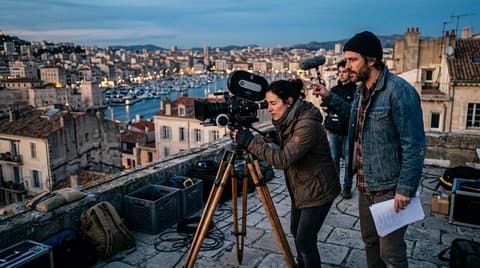
There are only eleven minutes of daylight left over the Old Port of Marseille. The sun is sliding behind the limestone cliffs of the Frioul islands, throwing a thin, violet wash of light across the cracked terracotta tiles of our rooftop.
Below us, two hundred meters down the alley, the evening traffic is beginning to hum. In our center stands a nineteen-seventy Arriflex 16SR loaded with a four-hundred-foot magazine of Kodak Vision3 500T. Inside that dark metal drum lies exactly eleven minutes and six seconds of celluloid. That is not an aesthetic choice; that is the total operational budget of our scene.
When you shoot on modern digital cinema sensors with infinite terabytes of solid-state storage, nobody is truly paying attention. The director sits under an air-conditioned tent staring at a calibrated monitor fifty meters away from the actors, calling out casual suggestions over a walkie-talkie. If a take is soft, or an actor fumbles a line, nobody flinches. You simply roll another forty minutes of digital footage and tell the colorist and visual effects house to fix the lighting in post-production.
When you shoot on physical sixteen-millimeter film, every second that passes costs real money, real silver halide crystals, and real mechanical wear on the camera claw.
The entire crew—all four of us—stops breathing the moment the motor hums to twenty-four frames per second. There is no second chance. The light is dying, the film is running out in the magazine, and the actors know that if they do not find the dramatic truth of the scene in this single four-minute take, the day is dead.
That terror is where cinema is born.
The Trap of the Infinite Budget
Hollywood spent the last twenty-five years convincing the public that cinema is synonymous with spectacle. If an image does not feature three hundred million dollars of digital compositing, an entire city tumbling into an earthquake fault line, or a sky filled with synthetic energy beams, the corporate studio considers it insufficient for theatrical release.
The consequence has been the total aesthetic and emotional castration of commercial film.
When anything can be generated by a GPU render farm, nothing has weight. When a character falls from an eight-story building and lands on a CGI vehicle without breaking a rib, the human nervous system registers the image as visual chewing gum. It is motion without consequence, pixels without mass, and spectacle without soul.
Production Dimension | The Digital VFX Green-Screen Pipeline | The 16mm Guerilla Chamber Shoot |
|---|---|---|
Material Constraint | Infinite digital takes on solid-state drives | 11 minutes per 400-foot magazine (radical discipline) |
Spatial Geography | Featureless green cycloramas with synthetic CGI set extensions | Real architectural rooms with natural acoustic and light limits |
Actor Embodiment | Disconnected eye-lines staring at tennis balls on sticks | Immediate tactile friction with real props and human eye contact |
Visual Texture | Sterilized, denoised algorithmic pixels requiring post-grain | Natural photochemical grain structure embedded in emulsion |
Narrative Focus | Planetary stakes masking hollow character motivation | Intimate psychological conflict between five people in a room |
As the comparative table proves, resource scarcity is not an obstacle to be overcome through venture capital; it is the fundamental crucible of artistic style.
Orson Welles did not shoot Othello across three countries with stolen costumes and piecemeal lighting because he was careless; he did it because necessity forced him to invent dynamic cutting rhythms that forever changed montage. Robert Bresson understood that showing a hand turning a brass doorknob with total acoustic clarity is a thousand times more terrifying than blowing up an entire city block.
The Tactile Truth of Photochemical Emulsion
Look closely at a single frame of sixteen-millimeter film under an optical loupe. You are not looking at an array of square silicon photosites arranged in a sterile Bayer grid.
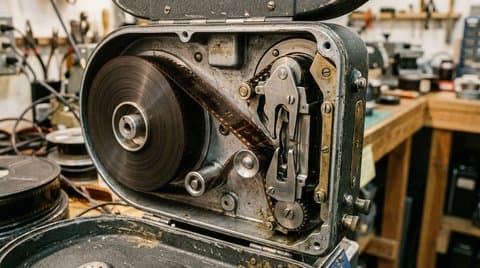 Vintage 16mm film camera gate and magazine mechanism
You are looking at millions of microscopic silver halide crystals suspended randomly in a gelatin binder. When photons of light hit that chemical surface, they trigger a physical, irreversible reduction reaction. Each crystal that turns black does so at its own irregular geometric boundary.
When twenty-four of these random chemical distributions flash across an optical projector every second, the human eye does not perceive a flat, dead digital plane. The eye perceives a living, breathing photochemical organism.
The Photochemical Economy Arc: Chemical Latent Image → Nitric Acid Bleach Bath → Silver Grain Stabilization → The Unforgiving Single Take → Irreversible Dramatic Weight
This chemical reality cannot be simulated by a software filter. Corporate streaming platforms love to slap digital grain overlays onto digitally shot series to make them look "cinematic." But digital noise merely sits on top of the image like dirty glass.
In genuine film, the grain is the image. It is the physical flesh of the light itself.
The Chamber Drama as Radical Resistance
If you want to rescue cinema from the algorithmic sludge of franchise entertainment, you do not need ten million dollars or an invitation to a Hollywood studio lot.
You need:
Five actors who are not afraid of silence.
A single real room with four walls, a window facing north, and floorboards that creak when someone shifts their weight.
A mechanical camera with two prime lenses (a 25mm and a 50mm).
A script that respects the intelligence of an audience by refusing to explain everything in expositional dialogue.
When you trap five complex human beings in a single enclosed room for ninety minutes, you strip away every commercial distraction. There are no car chases to cover up bad acting. There are no synthetic explosions to mask a flabby script.
All that remains is the geometric tension between human bodies: who is sitting, who is standing near the door, whose hand is trembling while holding an empty espresso cup, and what is left unsaid in the silence between two sentences.
Cinema began as a fairground attraction, but it became an art form only when it discovered the human face in natural light.
The corporate monoliths can keep their nine-figure VFX pipelines and their synthetic AI-generated video models. We will stay on the rooftops and in the small rooms, listening to the whir of the Bolex spring, waiting for the last eleven minutes of twilight, and shooting on film until the last lab in Europe runs out of developer.