
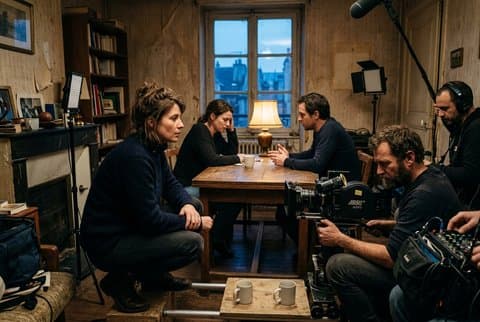
Five Actors in a Single Room
There is a precise moment during an autumn dusk in an unheated fourth-floor apartment in Marseille when the light coming through the single casement window turns the color of bruised slate. It lasts roughly eleven minutes. If your cast is rehearsed, if your sound recordist is crouched beneath the kitchen counter with his boom pole extended between the radiator pipes, and if you have forty meters of Kodak Vision3 500T remaining in the magazine of an ARRI 16SR3 camera, you have everything required to produce cinema.
You do not need fifty million dollars. You do not need a green-screen volume illuminated by sixteen thousand LED panels. You do not need a prompt engineering interface hallucinating synthetic backgrounds of impossible celestial nebulae.
In fact, the more money and computational power you pump into a cinematic frame, the more rapidly the dramatic soul tends to leak out of it.
The crisis facing contemporary moving images is not an absence of visual fidelity; it is an catastrophic surfeit of consequence-free imagery. When a studio spends two hundred million dollars to render an entire synthetic universe down to the sub-millimeter displacement of a digital superhero's cape, the human eye ceases to believe anything it sees. The spectator knows intuitively that the light falling on the actor's face was computed by a farm of graphics processors rather than refracted through real dust in an actual room. There is no atmospheric resistance, no unexpected shadow cast by an uneven ceiling, no bodily fatigue, and no physical danger.
True cinema was never about spectacle. It was always about constraint: the violent friction between five human beings trapped in an inescapable room, negotiating their survival while the light fades.
The Tyranny of the Unbounded Canvas
To direct a movie with limitless digital assets is to suffer from a debilitating form of aesthetic vertigo. When any camera angle is possible, no camera angle carries meaning. When a camera can pass weightlessly through a solid brick wall, dive through the floorboards, and orbit an explosion in thirty-six hundred frames per second, the physical relationship between the spectator and the dramatic action is severed.
In classical chamber cinema—from Sidney Lumet’s 12 Angry Men to John Cassavetes’ Faces, from Rainer Werner Fassbinder’s The Bitter Tears of Petra von Kant to Chantal Akerman’s Jeanne Dielman—the camera obeys the laws of Newtonian physics. It cannot pass through walls because there are real lath-and-plaster walls holding the ceiling up. The operator’s shoulder aches after an eight-minute take; the actors must breathe the same stale oxygen; and when someone raises their voice, the sound bounces off the tiled kitchen backsplash with an acoustic harshness that no post-production reverberation plugin can replicate.
┌─────────────────────────────────────────────────────────────┐
│          The Architecture of Chamber Dramatic Tension       │
│                                                             │
│   [Spatial Constraint] ──► [Unbroken Duration] ──► [Panic]  │
│            │                        │                │      │
│   (No Cutaway Escape)       (Actor Micro-Tremor) (Real Air) │
│            │                        │                │      │
│            ▼                        ▼                ▼      │
│   [16mm Grain Clumping]──► [Natural Falloff] ──► [Catharsis]│
│   (Physical Chemical)      (Twilight Fade)    (Human Truth) │
└─────────────────────────────────────────────────────────────┘
The camera in a small room is not an omniscient god. It is an uninvited guest wedged into a corner behind a sofa, trying desperately not to knock over a floor lamp. That physical precariousness is transmitted directly to the viewer’s nervous system.
Dimension | Hollywood Generative VFX Pipeline | Low-Budget Chamber Cinema |
|---|---|---|
Spatial Envelope | Infinite virtual stage, unbounded coordinates | 35 square meters of peeling wallpaper and parquet |
Lighting Logic | Computed radiance, artificial multi-point fill | Natural daylight falloff & single 60W tungsten bulb |
Material Base | 4K digital sensors, clean look-up tables (LUTs) | 16mm celluloid emulsion, silver halide crystals |
Editing Philosophy | Rapid cutting (average shot length < 2.5 seconds) | Long, agonizing master shots held through awkward pauses |
Actor Behavior | Eyeline dots, isolated tennis balls on green screen | Visceral eye contact, sweat, saliva, acoustic breath |
Economic Vulnerability | Insulated corporate capex, algorithmic hedging | Personal financial ruin if the camera jams at dusk |
When you eliminate the possibility of a spectacle cutaway—when you forbid yourself the luxury of cutting to an exterior shot of a skyline or an explosion whenever the scene drags—you force the drama back onto its only legitimate engine: the unpredictable, terrifying interiority of the human face.
The Tactile Honesty of the 16mm Magazine
Why do we continue to load magazines of 16mm film stock into mechanical cameras in 2026, when a digital cinema camera can record twelve hours of pristine RAW footage onto an SSD without stopping?
Because digital abundance breeds psychological complacency. When a director knows that storage is virtually free and that a take can run for forty minutes, the moral tension on the set evaporates. The director mutters, "Let's just keep rolling and find it in the edit." The actors relax; their urgency dissipates; and the shoot devolves into an undisciplined rehearsal funded by venture capital.
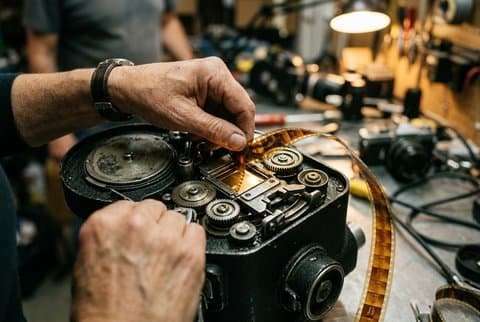 Cinematographer hands threading 16mm film
When you shoot 16mm on a shoestring budget, a four-hundred-foot magazine gives you precisely eleven minutes of running time. Every single second that the shutter spins costs twelve euros in stock, processing, and scanning fees.
When you call "Action!", the sound of the claw pulling the celluloid through the gate with a crisp, sewing-machine clatter creates an immediate, electrifying focus in the room. The actors know there are no infinite retakes. If someone fumbles their line in minute eight of a ten-minute unbroken master shot, that take is dead, three hundred euros are gone, and the light outside the window will not return until tomorrow.
The Chamber Dramatic Compression Arc: Spatial Boundary Enforcement → Acoustic Claustrophobia → Micro-Expressive Escalation → Exhaustion of Subtext → Irreversible Physical Breakthrough
That financial and chemical scarcity produces a miraculous performance density. The actor does not pretend to be tense; the actor is tense. The tremor in her lower lip as she confronts her father across the table is real, because the ticking of the camera magazine is an audible reminder that time and resources are finite.
The Fiction of Synthetic Empathy
We are currently being told by technology evangelists that within two years, generative video models will allow anyone to generate a feature film from a text prompt. You will be able to type: "A neo-realist confrontation between two estranged lovers in an attic apartment, cinematic lighting, shot on 35mm" and receive an eight-minute sequence indistinguishable from real life.
This promise betrays a grotesque misunderstanding of what makes art valuable to human beings.
A generated film is not cinema. It is a statistical collage of cinematic history, stripped of the intentional labor and existential risk that gave that history its weight. When we watch a great scene in a film, our emotional resonance is not merely a reaction to light patterns hitting our retinas; it is an act of deep communion with the human beings who made it. We are moved because we sense the immense, fragile human effort required to capture that specific truth: the director who fought with the landlord for three months to secure the location, the actress who drew upon an unspoken bereavement to find that singular breaking cadence in her voice, and the focus puller whose knuckles were white as he kept the iris open at T1.3 in failing light.
A synthetic image cannot bleed. It cannot risk anything, because it has no body to sacrifice and no budget to lose.
The Light That Remains
The eleven minutes of Marseille dusk are over. The window has turned black. The camera assistant caps the Zeiss prime lens, unscrews the magazine in the pitch dark of the changing bag, and tapes the plastic core can shut with red gaffer tape.
The two actors are still sitting at the kitchen table. They are exhausted, their foreheads wet with perspiration, staring into their empty coffee cups. For eight minutes, neither of them spoke a line that was not in the script, yet what transpired between them in that room will never happen again in exactly that way.
Tomorrow, the metal can will travel on an overnight train to the chemical lab in Paris. In the dark baths of developer and fixer, the latent image—the silver bromide crystals that were struck by real photons bouncing off those two human faces—will be transformed into metallic silver grains suspended in gelatin.
It will have weight. It will have grain. It will smell of vinegar and hypo. And when it is projected on a screen fifty years from now, long after the synthetic text prompts of 2026 have been forgotten in the discard bins of obsolete data centers, those five actors in that single room will still be breathing real air.