
Classrooms in the Quiet
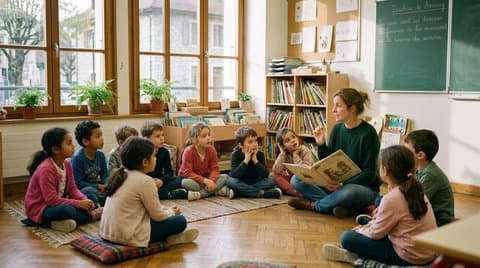
At two in the afternoon in Annecy, when the alpine sun slants low across the schoolyard gravel, the silence inside our building possesses an almost physical weight. It is not the frozen silence of an exam hall, nor is it the sullen quiet of disciplinary reprimand. It is the rhythmic, humming quiet of twenty-six seven-year-olds gathered on an oak floor around an open storybook, listening to human breath articulate human language.
You can hear the wooden floorboards creak as a child shifts their weight. You can hear the dry turn of a paper page, the faint tick of the mechanical brass clock above the coat pegs, and the distant sigh of the wind in the pine trees outside.
If you had walked into this same room four years ago, the acoustic reality was unrecognizable. Back then, following the municipal "Smart Classroom" grant of 2021, each child sat isolated behind a tablet encased in shockproof rubber. The room hummed with a thin, metallic vibration: the ping of digital reward tokens, the cheerful synthetic chime of gamified spelling exercises, and the irritable tap of twenty-six index fingers striking capacitive glass. The children’s postures were folded inward, their chins pressed against their sternums, their pupils dilated by the high-frequency flicker of backlit LEDs. They were physically present in Haute-Savoie, but their sensorimotor consciousness was dispersed across server clusters thousands of miles away.
Today, those rubber-clad tablets are locked behind the oiled pine doors of a wall cabinet. The small brass key hangs on my keyring. The return to quiet was not an administrative accident; it was an act of civic self-defense. Across Europe, from the public primary schools of France and the Netherlands to the radical curricular reversals of Sweden and Italy, a profound epistemic realization has taken hold: the human child does not need more digital connectivity. The child needs a sanctuary where thought is allowed to breathe.
The UNESCO Alarm and the Swedish Reversal
For two decades, the global educational establishment operated under an article of unexamined faith: that inserting digital screens into early childhood education was inherently progressive. School boards took on substantial municipal debt to purchase proprietary hardware, install interactive whiteboards, and subscribe to cloud-hosted adaptive learning platforms whose sales representatives promised miraculous leaps in scholastic autonomy.
The empirical reckoning has been devastating. In its landmark 2023 Global Education Monitoring (GEM) report, pointedly subtitled Technology in education: A tool on whose terms?, UNESCO reviewed comprehensive longitudinal datasets across dozens of nations. The conclusion was unequivocal: the indiscriminate presence of digital screens in primary classrooms consistently depresses reading comprehension, disrupts sustained attention spans, and exacerbates social inequality. Far from democratizing learning, screen-based pedagogy widens the developmental gap between children whose parents can afford to shield them from digital saturation at home and those whose entire domestic lives are already colonized by algorithms.
 A primary school classroom in France where devices are locked away in favor of paper books
Nowhere was this awakening more dramatic than in Sweden. Having spent fifteen years positioning itself as the undisputed world vanguard of classroom digitalization, the Swedish government executed an abrupt, historic about-face. Prompted by declining scores in the international PIRLS reading assessments and stern warnings from the Royal Swedish Academy of Sciences, Minister of Education Lotta Edholm halted the national digital strategy and redirected over 685 million Swedish kronor toward the emergency re-purchase of physical clothbound textbooks, paper exercise notebooks, and school library collections. The diagnostic verdict of Swedish pediatricians was simple and unanswerable: Children must learn to read, write, and think in physical matter before they are asked to operate a machine.
The Connected Classroom vs. The Attentional Sanctuary
The debate over educational technology is often framed by industry lobbyists as a dispute between innovation and obsolete nostalgia. But when we examine the empirical reality of classroom ecology, the distinction is between neurological overstimulation and biological development:
Pedagogical Dimension | The Screen-Saturated Connected Classroom | The Attentional Ecological Sanctuary |
|---|---|---|
Primary Attentional Regime | Hypervigilant, fragmented scanning driven by micro-rewards | Sustained, unhurried immersion in continuous linear narrative |
Motivational Driver | Extrinsic gamification (badges, audio pings, streak counters) | Intrinsic curiosity, physical mastery, and shared group discovery |
Sensory Atmosphere | Acoustic reverberation, screen flicker, postural constriction | Natural daylight, acoustic absorption, tactile material contact |
Social Dynamics | Atomized learners isolated in private interactive silos | Collective assembly with sustained eye contact and vocal dialogue |
Error Architecture | Instantaneous software rollback ("undo"); zero somatic cost | Physical irreversibility of paper and ink; encourages self-regulation |
Memory Consolidation | Ephemeral, screen-bound recognition prone to rapid decay | Deep somatosensory spatial mapping anchored in three dimensions |
Look at the third row: the motivational driver. When an educational application rewards a seven-year-old for spelling a word correctly with an animated explosion of golden stars and a celebratory sound effect, it is not cultivating a love for language. It is training a behavioral response using Skinnerian variable-ratio schedules.
The child does not read to understand; they read to trigger the next dopamine burst. When you subsequently present that same child with a printed page of unadorned text—a page that does not blink, sparkle, or chime—the brain experiences immediate, painful sensory withdrawal. The book feels "boring" not because the story lacks wonder, but because the child’s baseline dopamine receptors have been artificially up-regulated by predatory interface design.
The Attentional Sanctuary Cycle
How does a primary classroom recover its cognitive equilibrium once the screens have been banished? In our Annecy school, we observe a consistent four-phase restorative cycle that unfolds over the first six weeks of an analog semester:
The Attentional Sanctuary Cycle: Sensorimotor Decoupling → Baseline Dopamine Stabilization → Shared Narrative Immersion → Deep Cognitive Synthesis
The first stage is sensorimotor decoupling. During the initial fortnight without tablets, children frequently display irritability, physical restlessness, and short temper. They complain that their hands feel empty; they reach involuntarily toward the edges of paper books as if attempting to swipe to the next screen. This is the legitimate withdrawal phase of behavioral habituation.
The second stage is dopamine stabilization. As the ambient noise floor drops and visual stimuli return to natural frequencies—chalk on slate, daylight through glass, watercolors drying on paper—the nervous system settles. Heart rates synchronize during group activities. Children begin to sustain eye contact for several uninterrupted sentences without looking down for a notification badge.
The third stage is shared narrative immersion. When a teacher reads aloud to twenty-six children who are not glancing at private screens, a collective mental space is forged. The children construct mental images using their own interior imagination rather than consuming pre-rendered digital graphics. You can watch their faces mirror the tension of the narrative: thirty pairs of eyes widening simultaneously at a plot twist, thirty voices sighing in collective relief. This is the genesis of empathy—the lived experience of feeling another’s emotion in common physical space.
The fourth stage is deep synthesis. When these children return to their desks to write or draw what they have heard, their attention is grounded. They work for forty minutes without demanding entertainment. The drawing is not an interactive asset to be exported; it is a physical artifact created with wax and pencil, smelling of cedar and paper, that will be pinned to a corkboard for their parents to touch at the end of the day.
A Policy Imperative for European Public Education
The preservation of the primary classroom as an attentional sanctuary cannot be left to the idiosyncratic courage of individual teachers. It requires legislative sovereignty.
France took the first decisive step in 2018 with Article L. 511-5 of the Education Code, outlawing mobile phones and connected devices in all nursery and primary schools (écoles maternelles et élémentaires). The Netherlands followed in 2024 with a comprehensive national directive extending screen bans across primary education, citing irreversible cognitive costs. Similar measures are advancing through parliaments in Rome, Helsinki, and regional authorities across Spain.
These policies must be defended against the continuous commercial pressure of corporate EdTech cartels. Technology companies understand that if they capture the attentional loyalty of a child at age six, they secure an uncritical consumer for life. When they lobby ministers to digitize preschools under the banner of "modernization," they are not defending pedagogy. They are executing an industrial resource extraction strategy, where the resource being strip-mined is the developing attentional capacity of the human child.
We do not teach children to swim by throwing them into a typhoon. We teach them to swim in calm, protected waters where they can master the stroke, build lung capacity, and feel the buoyancy of their own bodies.
The primary school must remain that protected water. Behind its heavy wooden doors, insulated from the algorithmic clamor of the commercial world, our children have the democratic right to a slow, physical, and unhurried childhood. We owe them the gift of the quiet. We owe them a world where a bird singing outside the window can still be heard.