

When Six-Year-Olds Forget How to Grip
The sound in the classroom at nine in the morning used to be the crisp, scratchy rhythm of thirty graphite points biting into fibrous paper. Today in Annecy, when I distribute ordinary triangular cedar pencils to a new cohort of six-year-olds, the dominant sound is the hollow clatter of wooden shafts slipping from limp fingers and rolling across the floorboards.
Watch a child who has grown up swiping glossy capacitive glass attempt to write their own name. They do not hold the pencil with the dynamic tripod grasp that humans evolved across centuries of artisanal literacy—the delicate stabilization between the thumb, the index finger, and the radial side of the middle finger. Instead, they clutch it in a fisted, palmar grasp, or pinch it awkwardly between rigid, hyperextended knuckles as though trying to pierce the sheet. Within ninety seconds, their shoulders tense, their breath turns shallow, and their small fingers begin to tremble with acute physical exhaustion. "Madame," they whisper with genuine distress, "my hand hurts. It won't move."
This is not a failure of character, nor is it a temporary developmental delay that can be cured with an interactive tablet app. It is pediatric motor dysgraphia—an escalating neurodevelopmental crisis unfolding across European primary schools. We are witnessing the physical atrophy of the human hand before the child has even learned to articulate their first complex thought.
The Atrophy of the Thenar Eminence
To understand why a pencil feels like an instrument of torture to a contemporary six-year-old, one must look at the functional anatomy of the infant hand. The human thumb is an evolutionary masterpiece, anchored by the thenar eminence—a dense triad of intrinsic muscles (the abductor pollicis brevis, the flexor pollicis brevis, and the opponens pollicis) capable of modulating fine isometric counter-pressure down to millinewtons of force.
When a child manipulates physical matter—kneading dense modeling clay, twisting wooden nuts onto threaded bolts, buttoning heavy wool coats, or peeling orange rinds—these intrinsic muscles are subjected to variable mechanical resistance. Every micro-adjustment of resistance stimulates mechanoreceptors in the skin and Golgi tendon organs, sending a continuous stream of proprioceptive feedback through the median and radial nerves straight into the motor homunculus of the prefrontal cortex.
A capacitive touchscreen provides precisely zero mechanical resistance. A swipe across gorilla glass requires a coefficient of friction of less than 0.15. The finger glides across a uniform, frictionless plane where the underlying musculature never contracts against density, never stabilizes against torque, and never calibrates isometric balance.
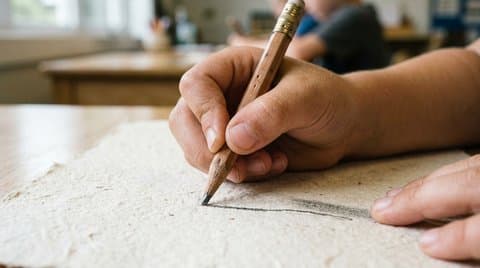 A six-year-old child practicing handwriting with an occupational therapist
When pediatric occupational therapists in Geneva and Lyon conduct electromyographic audits of seven-year-olds referred for severe dysgraphia, the findings are chilling: the thenar musculature exhibits the tone and endurance of a cohort three years younger. The muscles are hypotonic. The connective tissue of the wrist has not developed the tensile stability required to isolate finger movements from the forearm. When these children attempt to draw a simple diagonal line, they are forced to recruit the entire shoulder girdle, locking their elbows and fatiguing their spinal erectors within two minutes of pencil work.
Kinematics of Resistance: Paper vs. Capacitive Glass
The physical difference between writing by hand and tracing on a screen is not merely aesthetic. It is a fundamental divergence in neuromuscular architecture:
Biomechanical Dimension | Graphite Pencil on Heavy Paper | Stylus / Finger on Capacitive Glass |
|---|---|---|
Mechanical Resistance | Dynamic, tactile tooth varying with paper grain (0.4–0.7 friction coefficient) | Negligible, frictionless slide across glass surface (<0.15 friction coefficient) |
Proprioceptive Load | High isometric engagement of intrinsic hand muscles (thenar/hypothenar) | Low-load kinematic gliding dominated by shoulder and wrist compensation |
Sensorimotor Feedback | Micro-vibrations transmitted through bone conduction to somatosensory cortex | Visual feedback delayed by frame refresh rates; zero haptic counter-force |
Spatial Mapping | Absolute coordinates bound to three-dimensional physical margins | Ephemeral, relative coordinates disrupted by pinch-to-zoom and infinite scrolling |
Cognitive Fatigue Point | Gradual muscular calibration; promotes sustained attentional endurance | Rapid neuromuscular frustration; triggers premature task abandonment |
Syntactic Retention | Deep neural encoding via fine-motor stroke sequencing (orthographic motor memory) | Surface recognition; motor pattern dissociated from symbolic meaning |
As the comparative data demonstrates, writing with a pencil is an act of high-dimensional physical engineering. The child must modulate vertical downward pressure while simultaneously directing horizontal translation. If they press too hard, the graphite point snaps with an audible crack—an immediate, non-punitive physical consequence that teaches self-regulation. If they press too lightly, the mark remains faint and illegible.
On a touchscreen, by contrast, the software normalizes the input. The algorithm smooths the jittery line with Bezier curve interpolation. The child never experiences the reality of their own motor clumsiness, and therefore never develops the neurological feedback loops necessary to overcome it.
The Cortical Thenar Feedback Loop
Neurologists know that the hand and the brain mature in strict developmental reciprocity. The motor and somatosensory cortices do not pre-exist in their final adult architecture; they are sculpted, dendritic branch by dendritic branch, through physical friction against the material world:
The Cortical Thenar Feedback Loop: Mechanical Resistance of Material → High-Density Proprioceptive Inflow → Thenar Cortical Representation → Orthographic Motor Memory → Structured Syntactic Processing
When a child traces a letter with a pencil, their brain activates a distributed neural network that encompasses the left superior frontal gyrus (Exner's area), the primary motor cortex, the parietal lobule, and Broca's area. This physical motor pathway is the biological scaffolding upon which reading comprehension is built.
Neuroimaging studies led by Dr. Karin James at Indiana University have demonstrated that when children write letters by hand, their brains exhibit functional activation in the reading circuit that is completely absent when they merely press a key or trace a shape on an interactive screen. The physical struggle of producing the variable stroke creates an invariant mental representation of the letter.
By stripping children of the physical friction of pencil and paper during their formative neuroplastic window between ages three and seven, we are not modernizing their literacy. We are performing an accidental, population-wide neurological pruning. We are raising a generation whose fingers cannot grasp, whose wrists cannot stabilize, and whose cognitive architecture lacks the spatial grounding that only physical resistance can bestow.
Field Notes from the Pediatric Hand Clinic
In an outpatient pediatric clinic just outside Geneva, Dr. Christine Morel has spent three decades evaluating developmental motor disorders. Over the past five years, she has documented a fundamental shift in the clinical profile of children referred for scholastic evaluation. A decade ago, referrals for fine motor dysgraphia were predominantly correlated with specific neurological diagnoses—mild cerebral palsy, congenital hypotonia, or acute sensory integration disorders. Today, over seventy percent of referrals present with what clinicians term "acquired functional hypoplasia": structurally intact hands that simply lack the muscular endurance and proprioceptive calibration to sustain a pencil grip for more than ninety seconds.
"When we place a simple dynamometer in the palm of a six-year-old whose primary pre-school interface has been an interactive screen," Dr. Morel notes in her 2025 regional report, "we observe a devastating deficit in static palmar pinch force. A healthy six-year-old child should generate between 2.5 and 3.5 kilograms of sustained isometric pinch. In children whose daily recreational and educational screen time exceeds four hours, pinch force routinely registers below 1.2 kilograms. The intrinsic lumbrical muscles, which should stabilize the metacarpophalangeal joints while the fingers articulate, are literally dormant. The hand collapses inward under its own weight."
This physical collapse has direct behavioral consequences in the primary classroom. A child whose hand is in physical pain after writing two lines of text does not experience handwriting as a medium for thought; they experience it as a punishment. They become irritable, restless, and demonstratively disobedient. They drop their pencils, break their leads intentionally, or ask to visit the washroom to escape the physical torment of the notebook. All too often, this acute biomechanical distress is misdiagnosed as attention deficit hyperactivity disorder (ADHD), prompting clinical interventions when the true remedy is the patient reconstruction of thenar musculature through heavy physical matter.
Reclaiming the Tools of the Earth
What must be done? The response cannot be more adaptive educational software, nor can it be the surrender of handwriting in favor of classroom keyboards, as some technocratic ministers in Northern Europe have disastrously proposed.
We must return to a pedagogy of physical matter. In my classroom, the tablets remain locked in metal cabinets. Before we touch a pencil, we work with our hands:
First, we rebuild intrinsic hand strength. We knead cold, stiff baker's dough and unyielding terracotta clay. We pull dense wax crayons that require genuine forearm force to deposit color onto rough butcher paper. We use brass hand-cranked pencil sharpeners that force the non-dominant hand to stabilize the housing while the dominant hand drives the rotating cutter.
Second, we restore the dignity of the physical pencil. We teach the child to hold the wooden barrel gently, like a sleeping sparrow—firm enough that it does not slip, but loose enough that it does not suffocate. We let them feel the grain of the wood, the cedar smell of fresh shavings, and the subtle friction of the graphite sliding across heavy, unbleached cotton paper.
When a seven-year-old who spent three years swiping glass finally writes their own name in a steady, unbroken cursive line, you can see the transformation in their eyes. It is not the superficial excitement of a video game badge. It is the quiet, serene pride of a human animal that has mastered physical matter through the patient discipline of its own hands. That pride cannot be downloaded. It must be carved into the world, one millimeter of graphite at a time.