
Beyond the Copper Grid
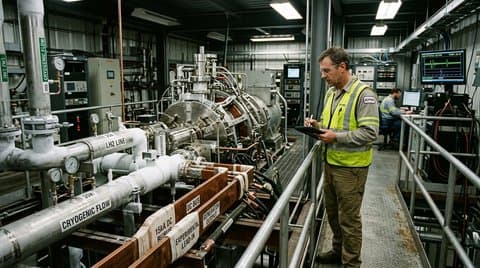
From the high metal catwalk of the experimental power testing bay at Cadarache, the geometry of contemporary energy infrastructure reveals its absolute physical limit. Down on the concrete apron, insulated cryogenic lines frosted with crystalline white condensation snake toward the vacuum flanges of the high-field magnet assemblies. When fifteen kiloamperes of direct current course through those busbars to stabilize a burning deuterium-tritium plasma at over one hundred million degrees Celsius, there is an audible, low-frequency hum that vibrates through the soles of your work boots.
That vibration is thermodynamics speaking in its native tongue. It does not speak in terms of venture capital multiples, software scaling laws, or clean energy certificates bought and sold on digital carbon exchanges. It speaks in megawatts of resistive heat dissipation, magnetic shear stress measured in megapascal pressures, and the brutal reality of thermal neutron flux eroding stainless steel vacuum vessels.
The tech-industrial sector in 2026 finds itself in the grip of a monumental delusion: the belief that the exponential power demands of hyperscale artificial intelligence can be satisfied by merely stringing more high-voltage AC copper wires across continents and patching them into legacy electrical grids. This is an engineering fantasy. The legacy grid cannot bend to the load of planet-scale compute without collapsing under its own physical inertia.
The Parasitic Nature of the Hyperscale Load
To understand why the centralized power grid cannot survive the current expansion of compute clusters, one must examine the fundamental electrical physics of data center consumption. A conventional municipal electrical grid is engineered for diversity of demand: factories operate by day, residential heating cycles in the evening, and nighttime baseload drops predictably, allowing thermal turbines to throttle down and maintenance windows to open.
An AI inference and training cluster behaves completely differently. It is a flat, unyielding, non-coincident parasitic load. It demands four hundred to eight hundred megawatts of continuous, uninterruptible power, twenty-four hours a day, 365 days a year, with zero tolerance for frequency droop or voltage sags.
Grid Architecture Parameter | Legacy High-Voltage AC Grid (Centralized) | Island-Mode Dedicated SMR / Fusion Co-Location |
|---|---|---|
Transmission Impedance | 8–12% line losses over hundreds of kilometers | < 0.5% direct DC/short-busbar coupling |
Interconnection Queue | 5 to 9 years for high-voltage substation permits | Zero public grid queue; sovereign site boundary |
Grid Stability Vulnerability | Cascading frequency trips from sudden step-load transients | Dedicated dampening dump resistors and captive thermal mass |
Public Infrastructure Strain | Forces municipal tariffs up and strains local transformers | Decoupled from public residential ratepayer pools |
Thermodynamic Efficiency | Separate cooling towers and remote generation cycles | Co-located district heating and waste-heat thermodynamic recovery |
As the comparative table reveals, attempting to power thousands of hyperscale data centers through public transmission lines produces a catastrophic conflict of interest. Either public utilities are forced to delay fossil plant retirements and burn coal to maintain baseload stability, or private hyperscalers securitize the grid capacity, driving residential tariffs to unsustainable heights.
The Physics of Island-Mode Power
The only thermodynamic solution that does not bankrupt public grids or accelerate the fossil backslide is island-mode co-location.
In island-mode architecture, the compute facility is constructed directly at the generation source—adjacent to small modular fission reactors (SMRs) or early commercial magnetic confinement fusion prototypes. The transmission grid of copper lines, long-distance transformers, and high-voltage switchyards is eliminated entirely.
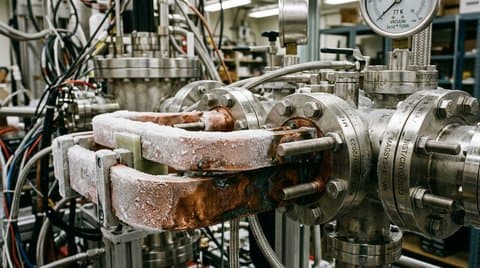 Heavy copper cryogenic busbars frosted with condensation on high-field magnet assembly
Power is delivered across mere meters of heavy copper busbars directly into high-density liquid-cooled server racks.
The Sovereign Energy Architecture: Core Fusion/Fission Thermal Output → Supercritical $CO_2$ Turbine → Direct Solid-State DC Transformation → High-Density Liquid Compute Cluster → Low-Grade Thermal District Heating Loop
By removing hundreds of kilometers of AC transmission lines, line losses are cut from ten percent to near zero. More critically, the massive waste heat generated by millions of silicon chips (typically exhausted uselessly into the atmosphere via evaporative cooling towers) can be captured and routed into industrial district heating networks, water desalination, or secondary thermochemical processes.
Reclaiming the Thermodynamic Ground
The transition to island-mode sovereign power requires an intellectual revolution among systems engineers and political leaders alike. We must abandon three dangerous illusions:
The Greenwashing of Virtual Power Purchase Agreements (VPPAs): Buying solar certificates in Spain does not power an 800-megawatt data center in Ireland that runs on natural gas at two in the morning. Baseload must match instantaneous demand in the physical world, not on a financial balance sheet.
The Myth of Infinite Copper: Global copper production cannot support the simultaneous electrification of domestic vehicles, heat pumps, and a tripling of high-voltage transmission lines. We must generate power where it is consumed.
Energy as a Corporate Monopoly: Island-mode nuclear facilities must not become autonomous corporate fiefdoms operating outside public safety standards and democratic environmental oversight.
What the Catwalk Reveals
Looking down from the catwalk at Cadarache as the vacuum pumps maintain their steady rhythm against the stillness of the Provencal night, one is reminded of the profound humility that physics imposes upon human ambition.
You can write software that imagines infinite worlds. You can train neural networks on every text ever recorded by civilization. But when the current flows and the magnets pull, you are bound by the immovable laws of mass and heat.
If our civilization is to build a future of planetary intelligence without poisoning the earth that feeds it, we must leave the decaying copper grid behind. We must have the courage to tame the fire of the atom at the very site where our thought is born.