

According to my online banking application, I have three hundred and forty-two euros and sixteen cents left until the end of the month. According to the international literary press, I am on the verge of being displaced by an artificial intelligence that threatens to dismantle my career as a professional man of letters.
I find this balance of anxieties profoundly comforting. There is something majestic, almost heroic, in imagining that a multi-billion-dollar compute cluster in Arizona, cooling its tensor cores with millions of liters of municipal water, has been mobilized specifically to rob me of an advance royalty check that no publisher in Spain has ever offered to write.
Every Thursday evening, in the basement bar off Plaza del Dos de Mayo where aspiring novelists drink generic beer because wine with an actual denomination of origin costs four euros a glass, the conversation follows an immutable liturgical pattern. Someone with an uncombed beard and an unpublished manuscript in a tote bag slams his glass on the sticky zinc counter and announces that large language models have destroyed the possibility of living from literature.
Everyone nods with solemn, tragic gravity. We sigh like exiled Russian grand dukes discussing the seizure of estates we never owned. It is the great collective alibi of our generation: we are not failing because our prose is derivative, our pacing sluggish, or our dialogue stilted; we are failing because the silicon monopolists have automated the divine spark of Cervantes.
The Romantic Alibi of the Starving Genius
In Honoré de Balzac’s Lost Illusions, the young provincial poet Lucien de Rubempré arrives in Paris convinced that his sonnets will conquer the world, only to discover that the literary establishment is an unromantic meat grinder where book reviews are bought by timber merchants and poetry is sold by the kilogram as wrapping paper for cheese.
Balzac understood what contemporary creative writing MFA programs spend forty thousand euros trying to conceal: literature has never been an equitable meritocracy. It has always been a ruthless, chaotic lottery operated by exhausted editors, nepotistic dining clubs, and distribution monopolies.
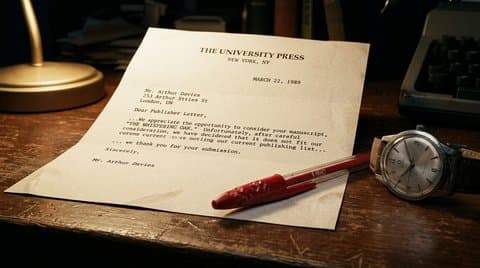 A typed publisher rejection letter rests beside a bitten red ballpoint pen and an old mechanical watch
What the arrival of generative AI has done is not destroy an idyllic economy of flourishing independent authors; it has stripped the aspiring writer of his favorite psychological sedative. For fifty years, being an unpublished author carrying a dog-eared notebook through bohemian neighborhoods was a socially viable identity. It explained why you worked part-time at a logistics depot, why your radiator hissed without producing heat, and why you couldn't afford dental implants. You were suffering for the craft.
Now, when a sixteen-year-old on TikTok prompts an autoregressive transformer to generate a six-hundred-page epic fantasy in forty-two seconds, the romantic veil evaporates. The tragedy is not that the machine writes better than you; it is that the machine produces mediocre genre fiction with exactly the same narrative structure you spent seven years struggling to outline.
The Two Ledgers of Literary Ambition
To understand the comedy of modern literary precarity, one must contrast the grandiose fantasies shared in workshop seminars against the actual daily ledger of the aspiring novelist:
Dimension of Existence | The Grand Romantic Illusion | The Madrid Attic Reality |
|---|---|---|
Financial Horizon | A six-figure advance, European translation rights, prestigious grants. | 342.16 euros in checking; four days until the quarterly water bill arrives. |
Writing Routine | A sunlit mahogany study, uninterrupted contemplation, vintage typewriter. | A laminate kitchen table at 4:30 AM before an eight-hour shift stacking pallets. |
Editorial Relationship | Long, dialectical lunches with a paternal publisher discussing Balzac. | Automated no-reply emails from Submittable sent at 3:14 AM on Sunday. |
Threat Assessment | Neural networks usurping the sacred dignity of canonical literature. | The landlord raising the rent sixty euros because Malasaña is being gentrified. |
Ultimate Motivation | Immortality, cultural impact, shaping the consciousness of the era. | A spiteful, stubborn refusal to admit to your brother-in-law that you wasted your thirties. |
When you look at this table honestly, the absurdity becomes liberating. If you have nothing to lose, you cannot be economically dispossessed. You cannot be replaced at a job you were never hired to do.
The Tragicomic Cycle of Nocturnal Revision
The psychology of the unpublished novelist is sustained by a perpetual motion machine of irrational hope and compulsive revision:
The Tragicomic Cycle of Nocturnal Revision Arrival of Fresh Automated Rejection Letter → Forty-Eight Hours of Existential Despair & Vows to Learn Python → Nocturnal Midnight Reading of a Single Flawless Paragraph by Borges or Sebald → Sudden Delusion That Chapter Nine Only Needs a Total Restructuring of Point-of-View → Brewing a Second Aluminum Moka Pot at 2:45 AM → Triumphant Resubmission to Thirty-Two Independent Presses That Closed in 2021
The Freedom of the Drawer
There is a strange, untouchable freedom in being completely ignored. When you know that no algorithm is scraping your draft, that no marketing team is calculating your social engagement score, and that no investor expects a ten-times return on your adjectives, you are permitted to write with total, reckless honesty.
You can write a sentence that takes four lines to reach its verb. You can kill off your protagonist in chapter three for no good reason. You can spend an entire afternoon describing the smell of rain on a Madrid bus stop in November, simply because the sensation was true.
Tomorrow morning, my alarm will ring at five. I will put my boots on, pull on my fleece jacket, and walk out into the cold dark of the street to catch the metro to the warehouse. In my backpack, nestled between my ham sandwich and a thermos of bitter coffee, will be twenty handwritten pages that no one has asked for, no one will pay for, and no machine could ever genuinely desire to write.
And that, my dear friends, is the only paycheck that actually matters.