

Why My Six-Hundred-Page Novel Is Better Unread
At three-fifteen on a Tuesday morning in Madrid, while the refrigerator in my Carabanchel apartment hums like an asthmatic accordion and the radiator emits its customary metallic whistle, I am staring at eight hundred and forty-two unbound sheets of eighty-gram A4 paper stacked precariously beside an aluminum moka pot. The pages represent seven years of my youth, four discarded romantic relationships, two severe bouts of cervical tendonitis, and precisely three hundred and forty-two euros remaining in my checking account.
The novel is titled The Geometry of False Teeth. It is a sweeping, multi-generational saga about dental prosthesis manufacturers in post-war Zaragoza, written with an earnest, suffocating gravity that would make a nineteenth-century Russian realist weep with exhaustion.
It has never been read by a single human being outside my immediate circle of long-suffering friends, who invariably claim to have reached page two hundred before their mothers fell ill or their hard drives corrupted.
More importantly, it has been rejected by one hundred and forty-seven literary agents, independent publishing houses, municipal prize juries, and university presses across the Spanish-speaking world. I possess every known permutation of the polite rejection letter: the breezy two-line postcard from Barcelona ("We regret that your vision does not align with our current catalogue"), the clinical automated email sent through Submittable at two in the morning by a twenty-two-year-old intern who clearly opened the PDF, read the words "post-war Zaragoza," and deleted it with prejudice, and the rare, handwritten note from an elder editor who congratulated me on my "admirable stamina" while advising me to seek psychological counseling.
For seven years, I lived in a state of chronic, toxic envy. I resented every twenty-six-year-old who received a forty-thousand-euro advance for a autofiction novella about feeling mildly sad in a café in Malasaña.
Then the generative artificial intelligence boom arrived, and a miraculous, liberating realization washed over me: in an era where machines can generate eighteen mediocre novels before your morning espresso finishes brewing, having written a six-hundred-page failure that nobody will ever read is the highest form of literary nobility left on Earth.
The Industrialization of the Slush Pile
The literary world has always operated on a foundational hypocrisy: it pretends to be a cathedral of the human spirit while functioning as a brutal, low-margin assembly line designed to convert trees into paperbacks that end up pulped in a warehouse in Guadalajara after six weeks on the display table at Fnac.
┌─────────────────────────────────────────────────────────────┐
│          The Tragicomic Cycle of Literary Production        │
│                                                             │
│   [7 Years of Solitary Agony] ──► [600-Page A4 Manuscript]  │
│                 │                               │           │
│         (342€ in Bank)                  (Zero Commercial)   │
│                 ▼                               ▼           │
│   [Unsolicited Slush Pile]    ──► [Automated Rejection #148]│
│         (14-Second Scan)                (Intern Template)   │
│                 │                               │           │
│                 ▼                               ▼           │
│   [The Kitchen Drawer Shelf]  ──► [Sublime Bartleby Peace]  │
│         (Pristine Truth)                (Uncorrupted Soul)  │
└─────────────────────────────────────────────────────────────┘
Long before engineers in Silicon Valley trained transformer models on digitized pirate libraries, the commercial publishing industry had already automated the contempt for the aspiring writer. The legendary slush pile—the mountain of unsolicited manuscripts sent by hopeful novelists from the provinces—was never read. It was triaged by exhausted undergraduate interns paid in tote bags and lukewarm mineral water, who developed an uncanny, evolutionary ability to scan the first paragraph, spot an adjective they disliked, and stamp the rejection slip in under fourteen seconds.
Dimension | The Commercial Bestseller Slush Pipeline | The Unread Drawer Manuscript |
|---|---|---|
Production Speed | 3 months to chase a viral TikTok subculture | 7 years of obsessive, unpaid nocturnal suffering |
Readership Metrics | 50,000 units sold, 80% abandoned at chapter two | 0 units sold, exactly 0 strangers bored to tears |
Material Destination | Clearance bins, pulping mills, airport kiosks | The warm wooden cutlery drawer beside the napkins |
Economic Logic | Algorithmic optimization for supermarket display | Absolute economic ruin & financial self-immolation |
Vulnerability to AI | 100% replaceable by a well-prompted diffusion model | 0% replaceable; no neural network would be so stupid |
Existential Status | Ephemeral consumer content with a 90-day shelf life | An uncorrupted monument of human obstinacy |
When corporate writers scream on Twitter that generative tools are going to steal their careers, I listen with the grim, detached amusement of a man who has lived at the bottom of the ocean for a decade watching people on the surface complain about a light drizzle.
How can an algorithm steal a career that never existed? How can a neural network rob you of royalties you never received, or displace you from literary salons you were never invited to attend?
The Bartleby Premium and the Purity of Silence
In his masterpiece Bartleby & Co., the great Enrique Vila-Matas created an entire inventory of the writers of the No: those singular, heroic figures in literary history who chose not to write, who abandoned their manuscripts halfway through, or who spent their entire lives contemplating the blank page rather than contributing to the noisy, vulgar carnival of published mediocrity.
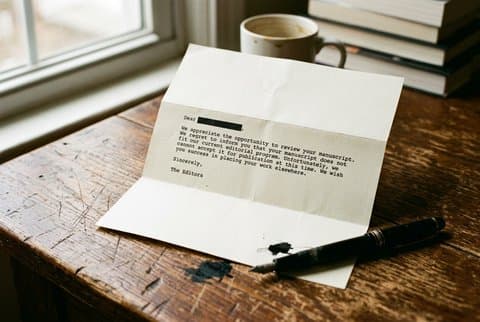 Editorial rejection letter on wooden desk with pen
What Vila-Matas failed to document was the even more heroic figure of the writer of the unread Yes: the obstinate lunatic who writes compulsively, who completes the monumental six-hundred-page work, who binds it with industrial rubber bands, and who, having been rejected by every gatekeeper in Christendom, tucks it into the kitchen drawer beneath the spare tea towels.
The Tragicomic Rejection Arc: Manic Midnight Composition → Unsolicited Dispatch → Six-Month Bureaucratic Vacuum → Form-Letter Rejection Stamp → Sublime Domestic Canonization
Consider the pristine ontological purity of an unread novel.
The moment a book is published, it is degraded. It becomes a physical product subject to the indignities of the market: it must suffer the illiterate opinions of anonymous Goodreads reviewers; it must be discounted during Black Friday promotions; it must be praised by cynical influencers who read only the dust-jacket flap; and it must compete for shelf space against memoirs by reality television contestants.
My novel The Geometry of False Teeth will never suffer this humiliation. It sits in its drawer in Carabanchel, safe from the vulgarity of public consumption. Its characters—a family of melancholic dental technicians who argue about gum vulcanization while Europe burns—remain entirely mine. They have not been commodified. They have not been summarized into bullet points by a language model. They have not been adapted into a mediocre streaming series with wooden dialogue and flat lighting.
They exist in a state of absolute, unassailable grace.
The Dignity of the Unquantifiable Waste
We live in a culture diseased by the obsession with productivity, utility, and monetization. Every hobby must become a side-hustle; every personal reflection must be turned into a Substack newsletter; every private neurosis must be packaged as therapeutic personal branding.
To spend seven years writing six hundred pages of dense, uncommercial prose about Zaragoza dentures, knowing full well that you will earn zero euros, gain zero followers, and impress zero people at dinner parties, is an act of radical anti-capitalist rebellion.
It is a glorious, defiant waste of human time. It is proof that human beings are capable of profound, irrational devotion to beauty, craft, and absurdity without demanding an economic return on investment.
A language model cannot produce an authentic failure. A machine can only produce what it is prompted to produce: a statistically probable sequence of tokens designed to satisfy an objective function. It cannot waste its youth on an obsession that ruins its credit score. It cannot sit in a kitchen at three in the morning, smelling of burnt coffee and cheap tobacco, laughing aloud at a sentence that nobody will ever read.
Closing the Drawer
I pick up the final chapter. I read the closing line—a three-hundred-word periodic sentence describing the rain falling on a warehouse of acrylic resin molds in 1954—and I smile. It is completely absurd. It is far too long. It is hopelessly uncommercial.
I love it with a fierce, irrational tenderness that no royalty check could ever purchase.
I slide the eight hundred and forty-two pages back into the cardboard box from the Carabanchel photocopy shop. I place the box inside the lower kitchen drawer, next to the emergency candles, the instruction manual for a washing machine that broke in 2021, and the one hundred and forty-seven rejection letters.
I push the drawer shut until the latch clicks.
Tomorrow morning at eight, I have a shift at the distribution warehouse. I will stack pallets of mineral water for nine hours. But tonight, in this dark kitchen, I am an uncompromised master of world literature: completely unknown, gloriously unread, and entirely free.