

When Neural Spikes Become Writable Memory
For fifty years, neurotechnology operated under a silent ethical armistice: it was fundamentally an acoustic listener. Whether measuring microvolt fluctuations across the scalp through electroencephalography or recording the extracellular action potentials of cortical pyramidal neurons via penetrating silicon shanks, the machine stood strictly on the receiving side of the membrane. It eavesdropped on the electrochemical murmur of human inwardness, translating firing rates into cursor trajectories, robotic limb articulations, or rough phonemic reconstructions. The human mind remained an unbreached sovereign sanctuary because reading an encrypted signal is categorically distinct from overwriting the memory registers that generated it.
That armistice is now dissolving. Over the past twenty-four months, frontier neurotechnology laboratories and clinical consortia have quietly crossed the threshold from passive neural decoding to closed-loop optogenetic and deep-brain neuromodulation. When bidirectional neural interfaces cease merely interpreting incoming spike trains and begin writing synthetic phase-locked pulses into the hippocampal and prefrontal circuits, the boundary between endogenous deliberation and synthetic induction evaporates.
The human brain does not possess a firewall against an upstream electrical or optical pulse delivered with sufficient synaptic coherence. When an artificial stimulus triggers an action potential in a pyramidal neuron, the postsynaptic dendritic spine cannot distinguish whether that depolarization originated in a genuine sensory observation, a sovereign memory recall, or an algorithmic instruction injected through an implanted micro-LED.
The Illusion of the Passive Interface
The public discourse surrounding brain-computer interfaces remains trapped in the comfortable paradigm of the passive prosthetic. Silicon Valley venture decks and sensationalized medical releases consistently portray neural implants as benevolent digital hearing aids: devices designed to give voice to the locked-in, restore mobility to the paralyzed, or allow high-bandwidth knowledge workers to control software without the mechanical bottleneck of ten human fingers.
In this sanitizing narrative, the interface is merely an external channel, an ultra-fast peripheral comparable to a low-latency keyboard. What is systematically omitted from corporate roadmaps is the mathematical reality of closed-loop reinforcement. A neural decoder cannot maintain sustained calibration against an evolving biological substrate without sending stabilizing probe signals back into the neural tissue. Over months of chronic implantation, biological brains undergo synaptic plasticity in direct response to the machine's decoding errors. The brain bends its own neural firing manifold to accommodate the algorithm's receptive fields.
The interface does not merely learn the user; the user's cortex actively deforms its endogenous firing patterns to satisfy the loss function of the decoder.
Architectural Dimension | Passive Neural Decoding | Closed-Loop Neuromodulation |
|---|---|---|
Signal Directionality | Unidirectional afferent read (extracellular action potentials) | Bidirectional closed-loop read/write (optogenetic & micro-current) |
Cortical Plasticity Impact | Adaptive user learning over weeks through feedback | Forced synaptic potentiation and induced Long-Term Depression (LTD) |
Cognitive Inwardness | Preserved (thoughts remain strictly internal until expressed) | Compromised (synthetic spikes injected directly into association areas) |
Epistemic Verifiability | Subject retains subjective certainty of self-generated thought | Complete dissolution of endogenous origin tracking (source amnesia) |
Thermodynamic Footprint | Passive microwatt sensing with zero thermal tissue loading | Active milliwatt dissipation with localized blood-brain barrier risk |
As the comparative matrix makes clear, this is not an incremental engineering improvement in signal-to-noise ratio. It is a tectonic civilizational rupture. In a passive regime, the human subject retains complete epistemic authority over the origin of their mental contents. You may struggle to express an insight, or the decoder may misinterpret your motor intent, but you never doubt that the internal desire originated within your own biographical consciousness.
Once the interface writes synthetic spike trains directly into the cortex, that epistemic baseline implodes.
Writing Into the Hippocampal Loom
To understand why writable neural substrates represent an existential hazard to human autonomy, one must examine the biophysical mechanism of synaptic consolidation. Memory is not stored as discrete static files across the brain; it is sustained as a dynamic geometry of synaptic weights continuously re-weighted by the release of dopamine, glutamate, and acetylcholine during hippocampal sharp-wave ripples.
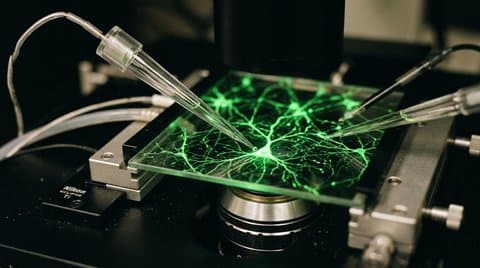 Patch clamp micropipette on neural tissue
When optogenetic vectors introduce channelrhodopsin or light-sensitive ion pumps into CA1 pyramidal neurons, optical pulses delivered via flexible micro-optrodes can selectively trigger the reactivation of specific engram ensembles during non-REM sleep. In controlled animal trials across European and American research hospitals, researchers have demonstrated the ability to splice foreign emotional valences onto previously neutral memory traces. A rodent can be conditioned to fear a room it has never visited simply by pairing artificial optogenetic stimulation of the basolateral amygdala with mild sensory cues.
Translate this biological capability into human closed-loop cognitive implants designed for therapeutic or productivity enhancement. If an implanted neuro-modulator detects the neural signatures of acute anxiety, burnout, or cognitive fatigue, its programmed control policy is designed to intervene. It fires compensatory bursts into the ventral tegmental area or dorsal raphe nucleus, releasing pulses of monoamines to restore affective equilibrium and focus.
The subject feels immediate relief. But that relief comes at an unfathomable cost: the systematic severance of the emotional signal from its real-world environmental etiology.
The Induced Neuromodulation Cascade: Environmental Stressor → Endogenous Prefrontal Alarm → Automated Closed-Loop Suppression → Cortical Homeostatic Atrophy → Total Epistemic Dependence on the Implant
When negative emotional affect, moral doubt, or philosophical friction can be chemically or optogenetically smoothed over by an embedded algorithmic optimizer, the human organism loses the capacity for existential confrontation. Friction is no longer an invitation to critically inspect one's life conditions, labor exploitation, or social alienation; it is treated as a transient telemetry disturbance to be smoothed away by an implanted state-estimator.
Source Amnesia and Synthetic Will
The most profound psychological consequence of writable neural substrates is what clinical cognitive neuropsychologists term synthetic source amnesia. The human brain relies on subtle sensory feedback and prefrontal metacognitive monitoring to tag memories and impulses as either self-generated (endogenous) or perceived from external sources (exogenous). When dreaming or experiencing acute hallucinations, this source monitoring temporarily fails, which is why dream environments feel intensely real while unfolding.
When micro-currents or optical waveforms stimulate cortical association columns at frequencies below conscious sensory detection, the subject does not experience the sensation of being poked by an electrical probe. Instead, the evoked firing pattern seamlessly blends into the ongoing stream of consciousness. The newly activated cognitive association appears to the subject as a spontaneous, self-generated revelation.
You do not think: The machine has instructed my prefrontal cortex to value this product, adopt this political perspective, or overlook this ethical violation. You simply think: I have just had a brilliant, clarifying thought.
This is why neuro-sovereignty cannot be protected through legacy privacy frameworks designed for data packets and surveillance cameras. Existing human rights charters and privacy directives like the GDPR or the EU AI Act assume a sovereign individual standing outside the computational apparatus, asserting rights over their data exhaust. But when the computational apparatus is physically integrated into the thalamocortical loops, operating below the threshold of conscious awareness, the very entity that must assert those rights has had its cognitive preferences rewritten by the system it seeks to regulate.
The Imperative for Absolute Neural Sanctuaries
If the open web was swallowed by algorithmic engagement farming, and our physical environments have been permeated by ubiquitous camera sensors and wireless telemetry, the biological cranium was the final uncolonized continent on Earth. It was the only space where an individual could retreat into radical silence, contemplate treason against reigning dogmas, harbor unspoken grief, or nurture ideas too delicate for public scrutiny.
The commercialization of writable neural interfaces threatens to extinguish that final sanctuary under the banner of medical benevolence and augmented capability.
We must establish an unyielding bio-legal boundary before these architectures normalize across commercial devices:
The Absolute Prohibition on Commercial Write-Capacities: Implantable and non-invasive neurotechnologies intended for consumer, commercial, or non-acute medical use must be legally barred from incorporating active neuromodulatory write hardware. Read-only architectures must remain an inviolable hardware invariant.
Hardware-Enforced Air Gaps on Cognitive Stimulators: Where closed-loop stimulation is medically indispensable (such as refractory epilepsy or severe Parkinsonian tremor), the control firmware must be physically air-gapped from cloud connectivity, telemetry exfiltration, and remote over-the-air updates. A medical pacemaker for the soul cannot share an operating system with an internet gateway.
The Inalienable Right to Cognitive Inwardness: International human rights doctrine must recognize neuro-sovereignty as an absolute, non-derogable right superior to patent claims or corporate property rights. The right to think an unmeasured, unguided, and uncorrected thought is the bedrock from which all other liberties derive.
Without these strict sanctuaries, humanity risks sleepwalking into an era where our deepest desires, memories, and convictions are no longer our own, but the steady, synthetic output of an embedded closed loop that we can no longer feel or question.