
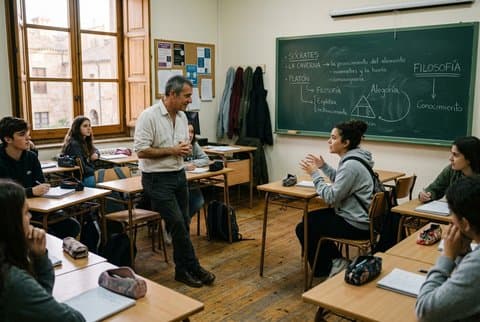
Voices Against the Screen in Room 204
At eight-thirty on a damp Tuesday morning in Salamanca, Room 204 is cold. The cast-iron radiator beneath the high window clanks with irregular hydraulic spasms, fighting against the autumn chill that seeps through the granite walls of our public secondary institute. Before me sit twenty-eight sixteen-year-old boys and girls. For the past twenty minutes, they have not looked at a single screen. Their smartphones are locked inside the grey felt pouches hanging on the back of the classroom door; their tablets remain zippered in their backpacks; and their desks, pushed together into a wide, uneven oval that forces every student to look into the eyes of their peers across the floorboards, hold only two things: an unruled notebook and a battered, dog-eared paperback copy of Seneca’s Letters to Lucilius.
The silence in the room is not the polite passivity of an audience waiting for a lecture to begin. It is an acoustic tension so dense you can hear the scrape of chalk dust under my shoe.
I have just written five Latin words in broad, jagged chalk strokes across the green slate board: Non scholae, sed vitae discimus. Then I turned to Álvaro, a boy sitting in the fourth row whose shoulders usually hunch forward into the familiar, defensive curve of an adolescent who lives eight hours a day inside a handheld glass interface.
"Álvaro," I said, keeping my voice level and conversational. "Seneca tells Lucilius that we do not learn for the school, but for life. But last night, eighty percent of the essays on the Stoic conception of freedom submitted to the institute’s digital portal were generated by a neural language model in under four seconds. They used impeccable syntax. They cited Chrysippus and Epictetus with flawless bibliographic formatting. They were synthetically perfect, and they were completely dead. So tell me, without looking down at your hands: what is Seneca asking you to sacrifice when he tells you to master your desires, and why does an automated answer to that question constitute a spiritual surrender?"
Álvaro froze. His eyes flickered sideways, searching the empty space of his wooden desk for the glowing search bar that has mediated every epistemic doubt of his adolescence. For four seconds, nothing happened. The room held its breath. Then, slowly, painfully, his voice emerged: uneven, halting, trembling with the visceral vulnerability of a human animal forced to think aloud without a technological crutch.
"He’s... he’s asking us to stop outsourcing the pain of choosing," Álvaro whispered. Then he paused, cleared his throat, sat up straighter, and repeated it with conviction: "Because if a machine chooses the words for you, you never actually took the risk of being wrong."
In that single, unscripted moment, Room 204 ceased to be a bureaucratic testing center. It became what a European school was always meant to be: an acoustic agora of living minds.
The Death of the Homework Proxy
For half a century, secondary education in the Western world operated on an unstated proxy: we assumed that if an adolescent could take a written prompt home, consult reference materials, synthesize the arguments into an eight-hundred-word essay, and hand it in on paper or through an online portal, intellectual digestion had taken place. The essay was treated as an authentic audit trail of cognitive struggle.
Today, that proxy is not merely broken; it is a rotting corpse that administrative cowardice refuses to bury.
┌─────────────────────────────────────────────────────────────┐
│          The Collapse of the Asynchronous Homework Proxy     │
│                                                             │
│   [Student Prompt] ──► [Frontier LLM] ──► [Automated Text]  │
│          │                                      │           │
│   (Zero Struggle)                       (Plausible Fluff)   │
│          ▼                                      ▼           │
│   [Detection Tool] ──► [Statistical Guess]──► [Dead Trust]  │
│   (False Positives)   (Adversarial Drift)  (Cynical Mimicry)│
└─────────────────────────────────────────────────────────────┘
When a student can feed a prompt into a frontier model on their phone during a ten-minute bus ride and receive a prose composition that scores an eight out of ten on standard pedagogical rubrics, the homework essay ceases to measure understanding. It measures only the student’s compliance in acting as a meat-based courier between one algorithmic server and another.
To respond to this collapse by subscribing to commercial "AI detection" software—programs that peddle snake oil by assigning probabilistic confidence scores to student prose—is an insult to pedagogical intelligence. It turns the educator into a paranoid border guard, falsely accusing honest students whose writing happens to be formal, while rewarding cynical students who learn how to introduce strategic grammatical flaws into synthetic text to bypass the filters.
Dimension | Algorithmic Homework Automation | Face-to-Face Socratic Disputation |
|---|---|---|
Cognitive Modality | Passive prompt dispatch & cut-and-paste triage | Live, unscripted, spontaneous oral defense |
Vulnerability Level | Zero; the interface shields the ego from exposure | Absolute; tone of voice, posture, and gaze are exposed |
Temporal Horizon | Asynchronous, instantaneous, friction-free | Real-time, dialogic, subject to the acoustic pause |
Error Feedback | Statistical confidence scores & plagiarism flags | Immediate Socratic refutation (elenchus) by peers |
Epistemic Anchorage | Synthetic statistical mimicry without interiority | Embodied, personal conviction tested under pressure |
Democratic Purpose | Training frictionless administrative consumers | Forging articulate citizens capable of civic dissent |
The only answer to the automated simulation of thought is the radical return to presence. If writing at home can be faked, the high school classroom must become a fortress of unrecordable, embodied speech: the living arena of the Socratic elenchus.
The Acoustics of the Socratic Seminar
In the classical Athenian agora, Socrates did not distribute take-home questionnaires. He intercepted citizens in the street and engaged them in relentless, dialectical combat. He asked them what justice was, dismantled their conventional definitions through contradictory examples, and forced them into a state of aporia—that fertile, terrifying intellectual vertigo where one realizes that what one took for knowledge was merely inherited habit.
 Open Seneca book on wooden desk with chalk and ruler
When you arrange a classroom in a circle and institute the rule of the live seminar, this ancient discipline comes roaring back to life. In a Socratic circle, an adolescent cannot hide behind an avatar, a bulleted list, or a generated summary. They must speak with their own vocal cords. They must endure the silence when their argument collapses under scrutiny. They must look their classmate in the eyes while conceding that their initial premise was flawed.
The Socratic Elenchus Dialectical Arc: Dogmatic Assertion → Dialectical Counter-Example → Aporic Vertigo → Structural Disputation → Embodied Civic Conviction
This oral vulnerability is precisely what our hyper-digitized culture systematically denies to young people. The modern teenager spends their waking hours navigating algorithmic environments engineered to eliminate social friction: text messages that can be edited before sending, audio notes that can be rerecorded, and algorithms that feed them mirror images of their own pre-existing biases. They are terrified of making a mistake in public, terrified of conversational silence, and terrified of the raw, unbuffered acoustic feedback of another human voice.
When we force them to stand up in Room 204 and defend an ethical thesis against their classmates, we are not merely teaching philosophy. We are administering an urgent therapy of exposure: restoring the cognitive muscle that allows an individual to endure disagreement without falling into hysterics or retreating into silence.
The European School as a Civic Fortress
Why does this matter beyond the walls of the secondary school?
Because a democracy cannot survive on synthetic compliance. A totalitarian system functions splendidly with citizens who know how to accept automated directives and regurgitate standardized slogans. But a self-governing republic—the fragile, extraordinary inheritance of European humanism—demands something far more difficult: citizens who can speak clearly in a public assembly, who can detect demagoguery in real time, who can weigh competing claims of justice without losing their temper, and who possess the courage to say "no" when an unjust consensus is being manufactured.
If we allow the generative machine to colonize the adolescent mind, we are training a generation of intellectual serfs: young men and women who will never know the thrill of formulating an original thought, because an algorithm will have anticipated and domesticated it before it could even cross the threshold of consciousness.
The public high school is the last secular space where individuals from disparate social backgrounds are gathered in the same physical room, under the same natural light, to grapple with texts that do not care about their feelings or their algorithms. It is the sanctuary of human friction.
The Bell at the End of the Hour
The bell rings at nine-twenty. It is a harsh, mechanical buzzer that cuts through the debate just as Marta and Carlos are locked in an intense disagreement over whether Seneca’s suicide was an act of philosophical defiance or an aristocratic surrender to Nero’s tyranny.
For a moment, nobody moves. Nobody reaches for their phone. The twenty-eight students are still looking at each other, flushed with the heat of an argument that belonged entirely to them—an argument that no server in California predicted, that no synthetic model generated, and that left no digital breadcrumb in any corporate database.
Álvaro picks up his copy of Seneca, marks the seventeenth letter with a slip of cardboard, and looks at me with a tired, genuine grin.
"Mister Herranz," he says, slinging his canvas bag over his shoulder. "Tomorrow at eight-thirty, I’m taking the counter-argument."
"I expect nothing less, Álvaro," I tell him, brushing the white chalk dust from my fingers. "Bring your own voice, or don't bother coming."