

The Smell of Damp Rag Paper
There is an acoustic threshold in my Turin workshop that I have come to recognize as the exact boundary where the digital noise of the city ceases to exist. It happens when the heavy oak door clicks shut against the Via Po, leaving the hum of electric scooters and traffic vibrations behind. What replaces it is not silence, but an older, slower cadence of physical sounds: the rhythmic clink of cast-lead sorts settling into the slots of a brass composing stick, the faint suction sound of a roller spreading dense linseed oil ink across an iron ink stone, and the peculiar, earthy scent of damp rag paper resting under weighted felt blankets.
To someone accustomed to the instantaneous latency of glowing glass screens, a sheet of handmade cotton rag paper is an baffling object. It has weight, tooth, and an irregular, feathered deckle edge formed as the wet cellulose fibers settle across the wire mesh of the papermaking mould. It does not load; it exists. It cannot be refreshed, updated, or purged by a cache invalidation script. Every page produced on a hand-operated letterpress carries within its microscopic fibers a permanent physical memory of the pressure that forged it: an impression pressed deep into the damp cotton weave that you can feel with your fingertips in the dark.
For the past twenty years, the priests of digital disruption have assured us that paper was merely a temporary, inefficient vessel for the transmission of disembodied informational tokens. Text, they argued, wanted to be free: weightless, fluid, infinite, and decoupled from the expensive friction of cellulose and ink. Yet in 2026, as the public internet drowns beneath a daily tsunami of automated synthetic text—billions of machine-generated words written by nobody, read by nobody, and hallucinated for the sole purpose of capturing programmatic ad spend—the physical page has returned not as an obsolete relic, but as an impregnable cognitive sanctuary.
When information becomes infinite and virtually free, it loses its gravitas. It is the friction of the material world that restores meaning to the written word.
The Geometry of the California Job Case
To write on a computer is to generate ephemeral electrical states that mimic typography without understanding its physical anatomy. When you press a key on a backlit keyboard, a character is rendered on a matrix of liquid crystals; if you change your mind, a backspace key erases it into non-existence with zero energetic penalty.
In letterpress printing, however, every letter is a three-dimensional block of lead, antimony, and tin cast in a steel matrix. The lead sort has physical dimensions: point size, em-quad spacing, nick, shoulder, and bevel. You do not type a sentence; you compose it with your fingers, drawing one metal sort at a time from the compartments of a California job case.
┌─────────────────────────────────────────────────────────────┐
│          The Typography of Hand-Set Mechanical Friction     │
│                                                             │
│   [Lead Sort] ──► [Brass Composing Stick] ──► [Iron Chase]  │
│        │                      │                     │       │
│   (Tactile Weight)    (Right-Justified)      (Quoins Lock)  │
│        │                      │                     │       │
│        ▼                      ▼                     ▼       │
│   [Linseed Ink] ──► [Damp Rag Paper] ──► [Embossed Folio]   │
│   (Mineral Pigment) (Cotton Pulp Tooth)   (Permanent Depth) │
└─────────────────────────────────────────────────────────────┘
The compositor must hold the brass stick in her left hand while her right hand dances across the compartments: picking up an uppercase 'T', checking the orientation of the nick with her thumb, inserting a thin brass hair-space, selecting the lowercase 'h', followed by the 'e'. You feel the cold density of the metal, the slight oily sheen that prevents the sorts from oxidizing, and the physical resistance as a line approaches justification. If a line is too loose, the type will fall through the press when locked into the chase. If it is too tight, the delicate zinc quoins will buckle under the pressure of the wrench.
Dimension | The Ephemeral Algorithmic Feed | The Hand-Set Letterpress Book |
|---|---|---|
Material Base | Transient capacitive glass & backlit liquid crystals | 100% cotton rag paper, lead alloy & linseed ink |
Cognitive Pace | Hyper-accelerated scanning, dopamine flickers, skimming | Deliberate, linear, sensory, haptic immersion |
Durability Horizon | Sub-second cache invalidation; ephemeral server states | Centuries of archival stability without power |
Tactile Resistance | Zero friction, frictionless infinite vertical scroll | High friction: tooth of paper, indentation depth |
Authorship Scarcity | Synthetic infinite abundance, negligible cost of generation | Costly physical labor, deliberate composition |
Spatial Ecology | Infinite notification intrusions & surveillance beacons | Self-contained, quiet, unmonitored sanctuary |
This mechanical resistance imposes a profound moral discipline upon the writer. You do not set trivialities in lead. When setting a single paragraph of text requires forty minutes of manual assembly, you weigh every adjective, cut every redundant clause, and question whether the thought you are preparing to imprint is truly worthy of the metal that will bear it.
The Living Pulp and the Watermark
Paper is not an inert substrate; it is a living, hygroscopic fabric. The sheets we pull in the workshop are made from discarded linen rags and unbleached cotton linters, beaten for seven hours in a Hollander beater until the long cellulose fibrils hydrate and open like miniature sea anemones. When the vat is stirred and the mould is dipped into the milky slurry, the vatman lifts the wooden deckle with a slow, decisive shaking motion known as the stroke—a subtle diagonal ripple that interlaces the fibers in both directions, giving the finished sheet equal tensile strength across its width and length.
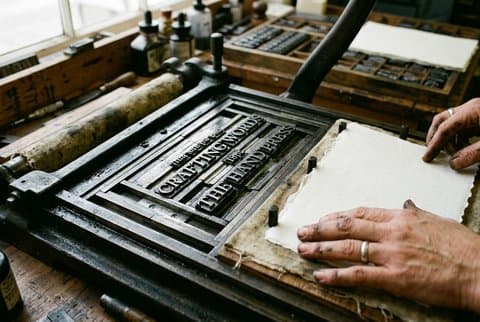 Platen of letterpress printing press on cotton paper
As the sheet is couched onto damp wool felts, squeezed under thirty tons of hydraulic pressure, and hung to dry on horsehair ropes in the attic, it retains the subtle texture of the wire screen and the translucent shadow of the paper-maker’s wire watermark. When held up to the afternoon sun, you can see the cloudy, irregular distribution of the pulp. It is imperfect, individual, and unrepeatable.
The Tactile Cognitive Sanctuary Pathway: Rag Cellulose Hydration → Hand Mould Interlacing → Platen Mechanical Indentation → Tactile Bilateral Encoding → Deep Epistemic Retention
Compare this to the smooth, dead surface of plasticized digital paper or the uniform glare of a smartphone screen. The human brain evolved over hundreds of thousands of years to navigate physical geography: to read spatial cues, to remember where an landmark sits in relation to a ridge, to feel the texture of bark or stone under the fingers. When we read a printed book, our cognitive architecture maps the narrative across the physical topography of the bound volume. We remember that a certain argument appeared on the upper-left verso of a thick, creamy page three-quarters of the way through the volume, anchored by the faint indentation of an initial capital.
On a digital screen, this spatial orientation is obliterated. The text flows endlessly through an invariant glass frame. Top and bottom cease to exist; page numbers are replaced by progress percentages; and the mind, stripped of its sensory moorings, floats in a state of frictionless amnesia. We read more words than our ancestors ever did, but we retain less of their substance, because the medium through which we consume them offers no traction for memory.
The Secession from the Synthetic Torrent
What we are witnessing today is not merely a nostalgic boutique revival of vintage printing techniques. It is an intentional, political secession from the epistemic contamination of the web.
Across Europe, from small letterpress workshops in Turin, Lyon, and Leipzig to independent publishing cooperatives in Dublin and Edinburgh, writers, readers, and printers are coming together to create an alternative information ecosystem. They recognize that as artificial intelligence models are trained on the recursive slop of other artificial intelligence models, the digital sphere is entering an irreversible epistemic death spiral: a self-referential loop where nuance, historical accuracy, and genuine human experience are smoothed away into homogenized statistical probabilities.
In this climate, the physical book becomes a cryptographic proof of work. You cannot mass-produce three hundred copies of a hand-set, letterpress-printed monograph on handmade paper with a command-line script. It requires hundreds of hours of focused human presence: someone had to mix the carbon black into the varnish, someone had to examine every lead sort with a magnifying loupe, someone had to pull the heavy iron lever of the Albion press with the full weight of their torso, and someone had to fold and sew the gatherings with needle and unbleached linen thread.
The result is an object that cannot be hacked, intercepted, updated retroactively, or erased by a remote cloud provider when a subscription expires. It sits on a wooden shelf in an ordinary room, quiet and self-sufficient, waiting for a human hand to open its cover.
The Weight of What Remains
As evening falls over the rooftops of Turin, the light in the atelier softens into amber. The freshly printed sheets are stacked on the drying racks, their black letters still releasing the sweet, pungent aroma of boiled linseed oil and rosin. I pick up a single folio, feeling the cool, slightly damp weight of the cotton paper against the palms of my hands.
Run your thumb across the page, and you feel the slight hollow where the metal type has bitten into the fiber: a tactile relief map of thought made manifest in matter.
The digital world promises us that we will never be bored, that we will never have to wait, that we will never run out of things to consume. But it achieves this by draining reality of its gravity, reducing human culture to a stream of disposable electrical pulses that evaporate the moment the battery dies.
Here, in the smell of damp rag paper and ink, we remember what we almost surrendered: the luxury of patience, the dignity of the physical artifact, and the quiet, unassailable truth that some things are worth doing slowly, by hand, for as long as there are eyes to read and minds to remember.