
The Sacred Void: Light, Shadow, and Spatial Silence in Northern Renaissance Painting
We inhabit a visual culture terrorized by the horror vacui. Our digital interfaces, generative feeds, and commercial spectacles are engineered to abhor emptiness. Every square millimeter of the screen must vibrate with saturation; every millisecond of attention must be ambushed by hyper-stimulated pixels, flickering notifications, and frictionless synthetic graphics. We have forgotten what it feels like to stand before a space that demands nothing from us except the courage to be quiet.
Five centuries ago, in the mist-shrouded cities of the Low Countries—Bruges, Ghent, Delft, and Antwerp—a guild of painters confronted an inverse spiritual crisis. Emerging from the theatrical grandiosity of the Italian High Renaissance and the claustrophobic dogmas of medieval icon painting, masters like Jan van Eyck, Rogier van der Weyden, Pieter de Hooch, and Johannes Vermeer engineered something unprecedented in human visual history.
They did not paint spectacle. They painted stillness.
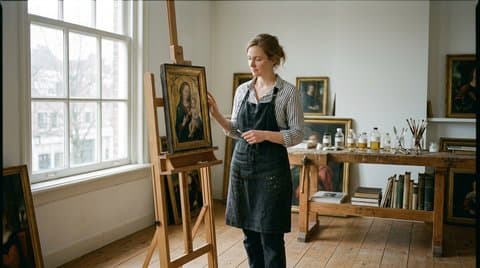
They constructed an architecture of spatial silence—a pictorial realm where cool, indirect northern daylight pours through leaded casement windows across whitewashed plaster, illuminating dusty floorboards, unfinished letters, and quiet courtyards. In their hands, the void was not an absence of meaning; it was the sacred vessel through which human presence could finally breathe.
The Geometry of the Quiet Interior
To understand the radical nature of Northern Renaissance and Dutch Golden Age space, one must contrast it with the heroic Italian perspective championed by Leon Battista Alberti.
In Florence and Rome, perspective was rhetorical, theatrical, and human-centric. Italian linear perspective (costruzione legittima) was engineered like a proscenium stage: all vanishing orthogonals converged relentlessly toward a single focal point, pulling the viewer into a dramatic narrative—a martyrdom, an apotheosis, or a mythological triumph. The Italian canvas was loud; it demanded public veneration.
The Northern masters inverted this geometry entirely.
When you gaze into Jan van Eyck's Arnolfini Portrait (1434) or Petrus Christus's A Goldsmith in His Shop (1449), the vanishing point does not hit you like a theatrical spotlight. It recedes into the quiet domestic shadows. Van Eyck does not compress the room to dramatize the couple; he allows the wooden ceiling beams, the polished brass chandelier, and the convex amber mirror on the far wall to exist with equal ontological dignity. The objects do not perform for the spectator; they dwell in silence.
Two centuries later, in seventeenth-century Delft, Johannes Vermeer refined this domestic stillness into an absolute spiritual discipline.
Consider The Milkmaid (De Melkmeid, c. 1658) or Woman Holding a Balance (c. 1664). Vermeer deliberately drains the room of narrative frenzy. The woman holding the balance does not move. Her fingers hover in microscopic equilibrium. The gold weights rest untouched. Behind her hangs a dark painting of the Last Judgment, yet there is no apocalyptic thunder, no weeping saints, no writhing sinners. There is only a pale rectangle of diffuse northern morning light gliding down an unevenly plastered wall, illuminating tiny nail holes, hair-thin cracks, and the soft down on her cheek.
Vermeer understands that the greatest drama of existence does not occur during catastrophic battle, but in the private, unrecorded second when a human being pauses to weigh an invisible thought.
The Physics of Northern Raking Light
Why does northern light possess this peculiar, meditative quietude?
In Mediterranean painting, sunlight is direct, fierce, and searing. It creates razor-sharp contrasts—the brutal, theatrical chiaroscuro of Caravaggio, where pitch-black shadows are torn open by violent raking beams. Mediterranean light is muscular; it forces the eye to take sides.
Northern daylight, however, is filtered through hundreds of kilometers of North Sea cloud cover and low-lying coastal moisture. It has no harsh center. It is ambient, cool, and isotropic. When this light enters through a casement window, it does not scorch the room; it grazes it. It wraps around objects with infinite gentleness, revealing their tactile materiality rather than dissolving them in glare.
The Northern masters did not merely observe this light; they engineered chemical substrates capable of trapping its slow gradations.
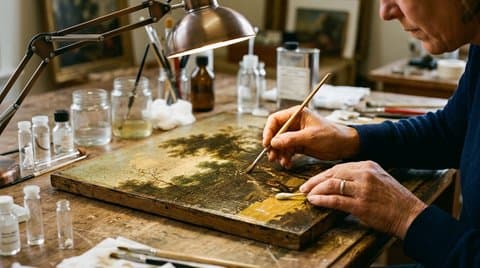 Art conservator cleaning a 17th-century Dutch oil painting on panel
Unlike the fast-drying egg tempera of the Italian Trecento, which forced artists into flat, opaque cross-hatching, the Flemish invention of oil glazing using linseed and walnut oils allowed artists to build up translucent, glassy layers over radiant white chalk grounds (gesso).
As optical microscopy reveals in modern conservation laboratories, a single patch of shadow in a Vermeer or a Ter Borch is not painted with opaque gray or black pigment. It is built from five to eight micro-layers of semi-transparent glaze: raw umber, yellow ochre, crushed smalt, and lead white. Light penetrates through these amber-tinted resinous layers, strikes the reflective white gesso ground beneath, and bounces back through the pigments into the viewer's retina.
The painting does not merely reflect ambient gallery illumination; it glows from within its own physical depths. The light feels trapped inside the room because it literally is trapped inside the microscopic optical matrix of dried linseed film.
The Doorkijkje and the Threshold of Longing
In the domestic compositions of Pieter de Hooch and Samuel van Hoogstraten, the spatial silence is given architectural form through the device of the doorkijkje—the view through an open doorway into an adjacent room, a sunlit vestibule, or a brick-paved interior courtyard.
In De Hooch's A Woman with a Child in a Pantry (c. 1658) or Courtyard of a House in Delft (1658), the primary human action is relegated to the perimeter. What occupies the psychological center of the composition is an empty threshold: a checkered marble corridor, an open half-door, a broom leaning quietly against a whitewashed brick wall, a patch of sunlit flagstones where nobody is standing.
Why does the empty doorway exert such a haunting emotional pull?
Because an open threshold is the visual symbol of possibility without coercion. It invites the mind to wander without demanding that it arrive. In modern synthetic media, every image is a destination: an aggressive, algorithmically optimized punchline designed to harvest an instantaneous reaction. There are no side corridors; there are no ambiguous thresholds; there is no unscripted space.
The doorkijkje provides cognitive shelter. It reminds the viewer that life continues beyond the frame of the immediate moment, that quiet rooms exist where no camera is watching, and that human consciousness thrives most deeply when it is permitted to linger in the margins between rooms.
The Erasure of Noise: Spatial Silence as Resistance
It is easy to dismiss the stillness of Northern Renaissance art as mere bourgeois domesticity—the quiet comforts of wealthy seventeenth-century Dutch merchant families enjoying their herring, Delftware, and imported Turkish rugs.
To view these works through the lens of bourgeois complacency is to misunderstand their profound spiritual radicalism.
The Dutch Republic in the seventeenth century was not a peaceful retreat; it was a society traumatized by eighty years of savage religious warfare against the Spanish Empire, threatened by catastrophic sea floods that breached dikes overnight, and embroiled in hyper-capitalist colonial trade routes that spanned across violent oceans. The world outside the studio was roaring with noise, religious fanaticism, and speculative mania (such as the Tulip Bubble).
The quiet interior was not a passive depiction of daily reality; it was an intentional act of resistance.
By excluding the clamor of the marketplace, the soldiers in the streets, and the religious zealots shouting from pulpits, painters like Vermeer, Fabritius, and De Hooch carved out sovereign cognitive sanctuaries on thirty-centimeter oak panels.
They asserted that the sacred was not confined to golden basilicas or imperial thrones. The sacred resided in the corner of a kitchen where a servant girl poured milk from an earthenware jug. It resided in the dust motes hanging motionless in a diagonal shaft of light. It resided in the profound, impenetrable dignity of ordinary, unheralded human life.
Reclaiming the Contemplative Gaze
We live today in an era of unprecedented visual inflation. Generative models flood the digital commons with billions of synthetic canvases every month—infinite, frictionless variations of neon-lit cybernetic cities, hyper-detailed fantasy landscapes, and flawless digital portraits.
Yet despite their technical virtuosities, these synthetic floods leave us spiritually starved. They suffer from a fatal aesthetic pathology: they possess no silence. They contain no negative space; they have no patience for dust; they cannot bear the weight of an unlit corner. Because they are generated through statistical token prediction, every pixel is packed with probable information, resulting in a manic visual density that suffocates the human eye.
The Northern Renaissance offers us the ultimate antidote to this digital exhaustion.
To look at a Vermeer or a Van Eyck is to undergo a visual detox. It demands that we decelerate our pulse. It requires us to stand before a painted wall for five uninterrupted minutes and watch how lead-white pigment slowly transforms into morning light. It asks us to surrender the modern addiction to constant stimulation and rediscover the restorative power of the sacred void.
The room is empty, the door stands ajar, and the light is falling. Nothing more needs to be said.