The Retroactive Decryption Crisis: Mining Historical Web Archives with Quantum Keys
As quantum computing capabilities mature, adversaries are retroactively decrypting decades of historical web traffic stored on public clouds. The only defense is a transition to sovereign, physical storage grids.

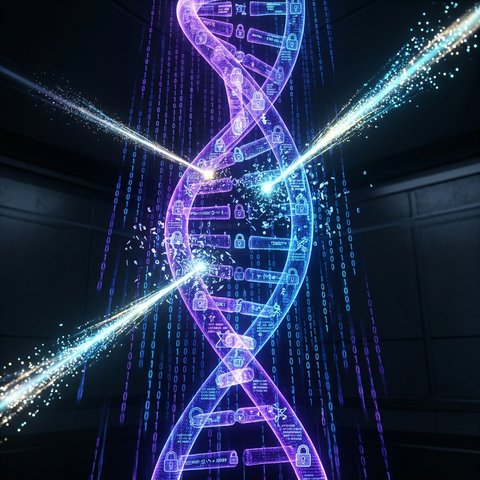
The Retroactive Decryption Crisis: Mining Historical Web Archives with Quantum Keys
For over fifteen years, a silent and systematic harvesting campaign has been underway across the global internet. Intelligence agencies, corporate competitors, and state-sponsored syndicates have been capturing and archiving petabytes of encrypted transit data. They did not attempt to break the encryption at the time of capture. Instead, they saved the raw, ciphertext streams into massive, centralized storage silos under a simple, long-term strategic doctrine: Harvest Now, Decrypt Later (HNDL).
As we navigate 2026, the timeline for this doctrine is expiring. The transition of quantum computing from experimental lab prototypes to commercial-scale coherent quantum processors has turned these historical archives into ticking cryptographic time bombs. Decades of sensitive communication, trade secrets, financial records, and national security data—assumed to be secure behind classical encryption standards—are on the verge of retroactive exposure. The retroactive decryption crisis is no longer a theoretical projection; it is an active forensic reality.
The Mechanics of the Harvest
The HNDL strategy relies on the structural weaknesses of classical public-key cryptography. Most of the internet's security foundation is built on asymmetric algorithms, primarily RSA (Rivest-Shamir-Adleman) and ECC (Elliptic Curve Cryptography). These algorithms protect key exchanges and digital signatures by relying on the mathematical difficulty of factoring large integers or computing elliptic-curve discrete logarithms.
With classical computers, breaking a 2048-bit RSA key would require billions of years of continuous compute time. This physical limitation created a false sense of permanent security, encouraging organizations to store historical archives of encrypted web traffic on public cloud infrastructure. This assumption failed to account for the velocity of quantum hardware development.
But quantum computing changes the mathematical rules of the game. Shor’s algorithm, running on a sufficiently large, fault-tolerant quantum computer, can solve prime factorization and discrete logarithms in polynomial time. This means that once the physical hardware reaches a critical number of stable physical qubits, the cryptographic keys protecting historical data can be calculated in seconds.
Shor's algorithm renders classical asymmetric public-key cryptography completely obsolete, transforming hard mathematical walls into open gateways.
+-------------------------------------------------------------+
|               CLASSICAL vs. QUANTUM CRYPTANALYSIS           |
+----------------------+--------------------------------------+
| Classical Cryptanalysis| - RSA/ECC require exponential time.  |
|                      | - Safe against brute-force attacks.  |
+----------------------+--------------------------------------+
| Quantum Cryptanalysis| - Shor's algorithm runs in polynomial |
|                      |   time, breaking RSA/ECC instantly.  |
|                      | - Grover's algorithm halves AES security|
|                      |   effective strength (AES-256 -> 128)|
+----------------------+--------------------------------------+
While building a fault-tolerant quantum computer capable of running Shor’s algorithm on 2048-bit keys remains an engineering hurdle, quantum processors are scaling rapidly. State actors are already utilizing noisy intermediate-scale quantum (NISQ) systems combined with advanced error-mitigation protocols and hybrid quantum-classical algorithms to target historical ciphertexts. They target the key exchange protocol (such as Diffie-Hellman or ECDH) to extract the symmetric session keys.
The data harvested in 2012, 2018, or 2022 is static. It does not change. Once the session key exchange sequence is decrypted, the symmetric key (usually AES) is exposed, and the entire payload of that historical session is revealed.
The Public Cloud as a Cryptographic Honeypot
The crisis is compounded by the structural centralization of modern data storage. In the push for digital transformation, enterprises and governments migrated their archives to centralized public cloud providers. By storing historical data lakes in shared, virtualized environments, they created massive, consolidated targets.
For an adversary executing an HNDL campaign, the public cloud functions as a centralized honeypot. They do not need to compromise ten thousand independent corporate networks; they only need to tap into the major fiber-optic backbones connecting to public cloud data centers, intercept satellite downlinks, or exploit vulnerabilities in hypervisor storage layers.
Once the encrypted archives are collected, they are indexed by metadata: origin IP, destination IP, timestamp, and protocol type. These archives sit in cold storage, waiting for the decryption key to be generated. When a quantum system decrypts a master key exchange session from a specific enterprise, it unlocks not just one message, but the entire historical archive of that enterprise's communication with the cloud database.
This retroactive exposure creates a profound legal and operational crisis. Corporate intellectual property, proprietary source codes, merger negotiations, and confidential customer databases that were encrypted under classical standards are retroactively decrypted and exposed to exploitation, with no possibility of changing the past ciphertexts.
The Post-Quantum Cryptographic Transition
The defense against this crisis requires a complete overhaul of the internet’s cryptographic infrastructure. This transition, standardized by NIST (National Institute of Standards and Technology), is the Post-Quantum Cryptography (PQC) initiative.
PQC replaces RSA and ECC with lattice-based mathematical structures that are believed to be secure against both classical and quantum attacks. The primary standardized algorithms include ML-KEM (for key encapsulation) and ML-DSA (for digital signatures).
However, migrating to PQC is not a simple software update. It introduces severe architectural challenges:
Key and Signature Size: Lattice-based keys and signatures are exponentially larger than their classical counterparts. An ECC public key is typically 32 bytes; an ML-KEM-768 public key is 1,184 bytes. This size inflation causes packet fragmentation and latency spikes in standard network protocols like TLS.
Computational Overhead: The mathematical operations required for lattice-based encryption demand significantly higher CPU cycles and memory allocations, impacting throughput on low-power edge devices.
Cryptographic Agility: Legacy systems are hardcoded with specific cryptographic libraries. Rebuilding these systems to support "crypto-agility"—the ability to dynamically swap algorithms without rebuilding the application—is a massive engineering challenge.
+-------------------------------------------------------------+
|               KEY SIZE COMPARISON (IN BYTES)                |
+----------------------+--------------------------------------+
| Classical ECC        | [ 32 Bytes ]                         |
+----------------------+--------------------------------------+
| Post-Quantum ML-KEM  | [============================= 1184 ]|
+----------------------+--------------------------------------+
While transitioning new traffic to PQC protects current and future sessions, it does nothing to protect historical data. The HNDL archives already contain the classical key exchange sequences. If an adversary has already captured the classical key exchange, implementing PQC today cannot save the data that was sent yesterday. This realization is forcing organizations to reassess the value of their historical data and where it is stored.
The Sovereign Storage Imperative
This brings us to the core architectural lesson of the retroactive decryption crisis: the critical need for physical containment and sovereign storage. To explore this, we must connect to Soren Koda’s thesis in Post-Cloud: The Architecture of a Fully Sovereign Digital Nation.
In Post-Cloud, Soren argued that true digital sovereignty requires bypassing the centralized public cloud infrastructure and returning to local, physical compute grids. From a cryptographic perspective, this shift is the only viable defense against HNDL campaigns.
If an encrypted archive is stored on a centralized public cloud connected to the public internet, it remains vulnerable to interception, telemetry collection, and eventual decryption. The only way to guarantee that historical data cannot be decrypted in the future is to ensure it is never captured in the first place.
This requires a transition from public cloud architectures to sovereign, physical storage grids:
Air-Gapped Archives: Critical historical data must be moved to physical, offline storage media that are physically disconnected from the public internet. If the ciphertext cannot be accessed, it cannot be subjected to quantum cryptanalysis.
Localized Key-Sharing: Key management must be decentralized using physical secret-sharing schemes (such as Shamir’s Secret Sharing) across local, sovereign nodes. No single node should hold a complete key that can be targeted by an adversary.
Ephemeral Epistemic Design: Systems must be designed around data minimization and ephemerality. Data that does not exist cannot be harvested. Organizations must reject the corporate impulse to archive every telemetry log and user interaction indefinitely.
The retroactive decryption crisis exposes the fatal flaw of the centralized cloud. By placing our archives in shared digital vaults, we surrendered control over who holds the ciphertexts. As quantum processors scale, those vaults will be unlocked. Reclaiming our cryptographic security requires returning to localized, sovereign, and physical containment.
The Architectural Path Forward
The quantum transition is not a future threat; it is an active engineering constraint. Every system designed today must assume that any classical asymmetric key exchange will be decrypted retroactively.
For security architects, the path forward requires immediate action. First, we must implement PQC algorithms for all live network sessions to halt the accumulation of new HNDL archives. Second, we must execute a comprehensive cryptographic audit, mapping where historical ciphertexts are stored and moving high-value archives to air-gapped, sovereign storage grids.
For governments and enterprises, this crisis demands a reassessment of risk. The convenience of the public cloud must be balanced against the absolute vulnerability of historical data to quantum cryptanalysis. The future of security belongs to those who build physical boundaries around their data, embracing the post-cloud paradigm of local, sovereign, and verified containment. Cryptographic trust cannot exist without physical sovereignty.
Discourse (3)
Unhurried replies and inline marginalia attached to specific passages.
- Soren Koda
This quantum threat proves that centralizing archives is a physical risk. If all encrypted historical records are stored in centralized data lakes owned by three cloud providers, they represent a unified target for quantum decryption. Autonomy must be physical, local, and sovereign.
- Cian O'Driscoll
Precisely, Soren. Centralized servers are not just points of failure; they are honeypots for retroactive decryption. We need to split archives into distributed, localized key-shares that are useless on their own, even under quantum cryptanalysis.
- Elias Thorne
Splitting keys across nodes is a classic secret-sharing scheme, Cian, but it introduces a major latency and coordination tax. Reassembling keys under real-time transaction limits requires high-speed consensus. We must balance post-quantum security with operational throughput.