

The Quiet Militarization of the Baltic
Subsea Fiber Cables, Seabed Sonar Arrays, and the End of Nordic Neutral Corridors
At six knots in heavy morning swell south of the Porkkala peninsula, the hydroacoustic trace on the survey console ceases to be an abstraction of civilian bathymetry. Through sixty meters of brackish Baltic water, the side-scan sonar registers a narrow furrow in the glacial clay—the protective trench of a high-density subsea telecommunications link carrying thirty terabits per second between Helsinki and Rostock. Alongside it, scarcely four hundred meters distant, lies the acoustic shadow of a concrete-mattressed gas conduit. But what commands the watch officer’s attention is not the civilian infrastructure; it is the newly deployed seabed listening array: piezoelectric hydrophone tripods anchored silently to the granite bed, tethered to inductive power nodes designed to log the acoustic signature of every dual-use cargo hull transiting the Gulf of Finland.
For two centuries, Nordic statecraft cultivated the patient art of the buffer zone. The Baltic Sea was imagined as a quiet maritime commons—a demilitarized corridor where Finnish pragmatic non-alignment and Swedish armed neutrality buffered the continental landmass from great-power confrontation. The governing doctrine was discretion: open trade, multilateral environmental conventions, and backchannel diplomatic protocols that treated the shallow seabed as neutral commercial territory.
That delicate equilibrium has disintegrated. The Baltic has transformed into the most densely monitored, volatile subsea faultline in Europe. The destruction of pipeline infrastructure, the recurrent "accidental" anchor-drags severing data cables, and the rapid deployment of autonomous mine-countermeasure drones have dismantled the fiction of neutral water. What was once celebrated as a peaceful trading lake is now an enclosed naval redoubt where civilian commerce and sub-threshold sabotage occupy the exact same physical space.
The Illusion of the Demilitarized Commons
The post-Cold War expansion of globalized infrastructure was predicated on a profound misunderstanding of maritime geography. Western telecommunications consortia and energy conglomerates laid thousands of kilometers of high-capacity glass and steel across the Baltic floor under the blithe assumption that the United Nations Convention on the Law of the Sea (UNCLOS) and commercial insurance policies provided sufficient deterrence against malicious interference.
This was an illusion born of uncontested American naval hegemony and European geopolitical complacency. Unlike the abyssal plains of the Atlantic or Pacific, where subsea cables rest three to five thousand meters below the surface far from commercial traffic, the Baltic Sea is an exceptionally shallow shelf. Its average depth is a mere fifty-five meters. In many choke points—the Kadetrenden channel, the Irbe Strait, the narrow waters between Gotland and the Courland Spit—the seabed is accessible to standard commercial dive teams, low-cost remotely operated vehicles (ROVs), or merchant vessels dragging modified ice anchors through civilian shipping lanes.
The table below contrasts the classical doctrine of the Baltic buffer with the structural realities of contemporary seabed competition.
Strategic Parameter | The Classic Nordic Buffer Doctrine (1945–2021) | The Contested Baltic Redoubt (2026+) |
|---|---|---|
Status of Baltic Waters | Demilitarized commercial transit commons | Contested subsea theater under continuous ISR surveillance |
Sovereignty Philosophy | Armed non-alignment, buffer statecraft, bilateral treaties | Total alliance integration, collective Article 5 deterrence |
Vulnerability Focus | Airspace incursions and surface naval flotillas | Subsea kinetic sabotage, cable severing, seabed reconnaissance |
Civilian Infrastructure | Purely commercial private assets governed by civil maritime law | Critical national security dependencies requiring armed escort |
Diplomatic Modality | Quiet backchannel pragmatism and multilateral forums | Pre-emptive naval interdiction, AIS enforcement, grey-zone deterrence |
When a body of water becomes an enclosed alliance lake, the traditional neutral actor loses the room to maneuver. Neutrality requires space, ambiguity, and reciprocal restraint. When rival intelligence services map every nautical mile of fiber optic conduit with autonomous submersibles, ambiguity ceases to be a diplomatic asset; it becomes an operational vulnerability.
The Anatomy of Sub-Threshold Hybrid Sabotage
Why has the conflict over the Baltic seabed avoided direct military clashes while generating unprecedented operational panic? Because the maritime domain is uniquely optimized for plausible deniability.
Under international maritime law, merchant vessels exercise the absolute right of innocent passage through exclusive economic zones (EEZs). A flag-of-convenience bulk carrier loaded with fertilizer or scrap metal can lower a forty-ton anchor in heavy weather, drag it across twenty nautical miles of seabed, sever three critical telecommunications trunks, and claim navigational negligence or mechanical winch failure. By the time naval divers reach the coordinates to inspect the shear marks on the polyethylene cable jacket, the vessel has already exited territorial waters and docked in an uncooperative jurisdiction.
The Baltic Subsea Escalation Sequence: Routine Merchant Transit → Coordinated Anchor-Drag Kinetic Event → Telecommunications Blackout → Plausible Deniability Legal Defense → Permanent Pre-emptive Seabed Militarization
This dynamic has triggered what military historians recognize as a classic security dilemma. To protect their lifelines against deniable sabotage, the coastal states have no choice but to install permanent seabed surveillance networks: active sonar fences, seabed docking stations for long-endurance autonomous underwater vehicles (AUVs), and continuous air-patrol coverage by anti-submarine warfare aircraft.
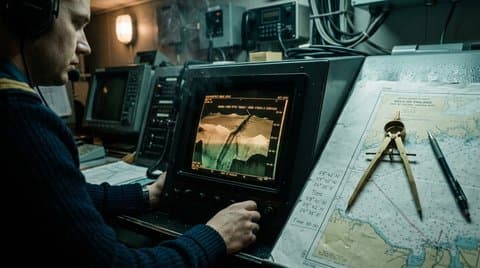 Tactical chartroom and seabed sonar bathymetry
Yet each sonar sensor laid on the granite bed, each naval escort assigned to escort a cable-repair ship, and each exclusion zone established around critical infrastructure tightens the operational friction. The seabed is no longer an invisible commercial foundation; it is a live minefield of surveillance apparatus where an errant fishing trawl or a malfunctioning civilian scientific probe can trigger a naval alert across three national capitals.
The Strategic Weight of Gotland and the Åland Islands
Geopolitics is ultimately the revenge of geography over diplomatic theory. In the Baltic, all tactical calculations converge on two archipelagos: the Swedish island of Gotland and the demilitarized Finnish territory of the Åland Islands.
For thirty years, Gotland was systematically disarmed. Its tank regiments were disbanded, its coastal artillery batteries filled with concrete, and its airfields preserved as civilian tourist amenities. Today, Gotland has been rapidly re-fortified as an unsinkable radar and missile platform dominating the central Baltic basin. Long-range surface-to-air missile batteries and anti-ship cruise missile launchers deployed on its limestone bluffs can deny airspace and sea transit across a three-hundred-kilometer radius, turning the maritime transit lanes of the eastern Baltic into an operational trap for any surface fleet.
The situation in the Åland Islands is even more legally delicate. Demilitarized since the 1856 Treaty of Paris and reaffirmed by the 1921 League of Nations convention, this archipelago of six thousand islands commands the entrance to the Gulf of Bothnia. For a century, its demilitarized status was revered as a triumph of international law. Today, defense planners in Helsinki and Stockholm confront a brutal dilemma: in a crisis characterized by sub-threshold airborne landings or disguised merchant sabotage, how does a sovereign state honor a nineteenth-century demilitarization treaty without leaving the throat of its northern supply lines wide open to rapid seizure?
International law depends on the mutual restraint of sovereign entities. When one faction decides that treaty obligations are merely decorative paper to be exploited for tactical surprise, the legal regime collapses from within.
The End of Nordic Quietude
There is an understandable melancholy that pervades Scandinavian chancelleries as this reality hardens. The Nordic countries built the most prosperous, egalitarian, and trusted societies in human history partly because they spent eighty years insulated from the immediate necessity of total militarization. They could afford generous welfare states, world-class educational systems, and generous development aid because their borders were quiet and their seas were calm.
That quiet era has ended. The defense budgets that have surged past two and three percent of GDP are not temporary responses to an isolated crisis; they represent a permanent structural reallocation of national capital from social investment to raw sovereign survival. High schools must once again prepare adolescents for territorial conscription; civilian telecommunications providers must harden their subsea repeaters against military EMP strikes; and coastal communities must accept the perpetual presence of grey naval hulls patrolling their fishing grounds.
On the bridge of the survey cutter, the radio crackles with an automated coastal navigation warning: naval exercises underway off the Estonian coast, live firing restrictions in the Bornholm Basin, and a designated exclusion corridor around an unexploded historic ordnance clearance operation.
The Baltic Sea will not return to the peaceful innocence of the 1990s. Its waters are cold, its depths are shallow, and beneath its gray waves, the iron cables of the modern world must now be defended by steel.