

The Gutenberg Secession: How Physical Print Shops and Hand-Bound Presses Are Reclaiming Cognitive Sanctuaries
In 1455, when Johannes Gutenberg completed his forty-two-line Bible in Mainz, movable metal type was celebrated as the ultimate engine of epistemic liberation. By decoupling text from the agonizing labor of monastic scribes, the printing press democratized literacy, catalyzed the Scientific Revolution, and created the modern public sphere. For five centuries, the trajectory of print was an unyielding sprint toward velocity, scale, and friction-free reproduction.
Today, across the quiet backstreets of Edinburgh, Leipzig, Bologna, and Kyoto, that five-hundred-year vector has violently reversed itself.
Inside drafty converted textile warehouses and sun-bleached stone courtyards, a growing international guild of independent authors, typographers, and bookbinders is staging a deliberate secession from the digital commons. They are salvaging nineteenth-century cast-iron Albion and Heidelberg cylinder presses from industrial scrap yards. They are setting cold lead type by hand, letter by letter, in composing sticks. They are folding sheets of heavy cotton-rag paper with polished cattle-bone folders, and stitching signatures together with unbleached linen thread rubbed in raw beeswax.
This movement is not an exercise in quaint bourgeois nostalgia, nor is it a sterile aesthetic fetish for the antique. It is an act of militant cognitive defense.
In an era where every pixel on a glowing liquid-crystal screen is tracked by telemetry daemons, scraped by autonomous ingestion crawlers, and flattened into statistical tokens for generative language models, the physical book has ceased to be merely an old container for information. It has transformed into an impenetrable fortress: an unscrapable cognitive sanctuary that protects human contemplation from algorithmic enclosure.
The Ecology of Friction: Why Paper Remembers What Glass Erases
To understand the Gutenberg Secession, one must first examine the neurobiology of the reading mind when confronted with digital glass versus physical rag.
For more than a decade, cognitive psychologists and neurobiologists have documented the phenomenon of "screen degradation." When a human being reads text on a backlit smartphone or tablet, the brain treats the medium not as a landscape to be traversed, but as a frictionless stream to be scanned, triaged, and discarded. The constant, subliminal demand of the glass—the ambient flicker, the phantom threat of incoming push notifications, the ability to jump hyper-links into infinite digressions—keeps the prefrontal cortex in a state of chronic vigilance.
On glass, spatial memory dissolves. You cannot remember whether a pivotal philosophical insight occurred in the upper-left quadrant of the third chapter or toward the trailing foot of the epilogue, because the text was an unmoored scroll slipping endlessly beneath a thumb.
Cognitive & Somatic Dimension | Reading on Digital Glass (Extractive Scanning) | Reading on Bound Paper (Cognitive Sanctuary) |
|---|---|---|
Light Source & Sensory Trigger | Backlit active screen → Ambient glare | Reflected natural daylight → Tactile surface resistance |
Autonomic Nervous State | High cortisol → Chronic prefrontal vigilance | Parasympathetic activation → Contemplative focus |
Textual Topography | Frictionless infinite scroll → Dissolution of spatial anchors | Fixed three-dimensional geometry → Dense somatosensory mapping |
Hermeneutic Retention | Working memory overload → Epistemic evaporation | Somatic mechanical resistance → Deep conceptual retention |
A physical, hand-bound volume imposes sensory friction. The weight of the buckram-wrapped boards in the palms anchors the reader in physical space. The deckle edges of uncut paper require a conscious rhythm of the hand. The faint, intoxicating scent of vanillin and drying linseed-oil ink engages the olfactory bulb, embedding the decoded sentences directly into the hippocampus.
When you turn a heavy, twenty-four-pound rag page, you perform an irreversible mechanical act: you alter the center of gravity of the physical object in your hands. That somatic feedback loop gives thought three-dimensional geometry. Paper does not simply display thought; it provides the physical scaffolding that allows thought to endure.
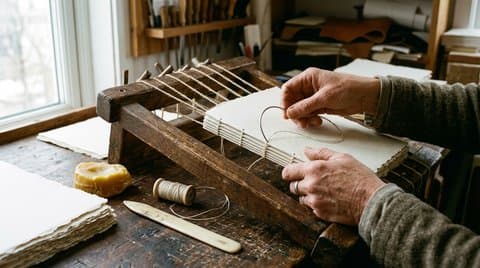 Hand-stitching folded rag paper signatures with linen thread on wooden bookbinding sewing frame
The Unscrapable Word: Why Print Resists the Data Sieve
Beyond cognitive comfort, the Gutenberg Secession represents the first organized cultural insurgency against the universal commercial harvesting of human thought.
Between 1994 and 2022, authors and essayists willingly deposited their intellectual lifeblood onto the open internet under an unwritten covenant: in exchange for public discovery, the web offered a global, participatory audience. Over the past twenty-four months, that covenant was unilaterally abrogated by synthetic technology conglomerates. Autonomous ingestion spiders crawled every open paragraph, essay, and academic repository, ingesting hundreds of millions of human hours into commercial model weights without consent, credit, or compensation.
The immediate consequence has been the catastrophic dilution of the digital sphere. The open web has been inundated with synthetic slop: machine-generated prose engineered to capture algorithmic search intent, devoid of genuine experience, somatic pain, or intellectual peril.
In response, independent thinkers are drawing an absolute perimeter around their work. By withdrawing from the digital feed and publishing exclusively in limited, physical print editions, the secessionist author achieves what no digital paywall or copyright notice can guarantee: immunity from the ingestion crawler.
The Physical Air-Gap: A letterpress volume printed in an edition of three hundred numbered copies cannot be indexed by a headless Chrome browser running in an Ashburn datacenter. To read the text, one must purchase the object, carry it home, part its leaves with an ivory paper knife, and sit in physical stillness.
The Refusal of the Prompt: When a text exists only on paper, it cannot be weaponized against its creator. It cannot be ingested to synthesize automated derivative articles, nor can it be digested into twenty-second bulleted answer snippets on a search engine results page.
The Return of the Patron: Deprived of programmatic banner advertising, independent publishers are rediscovering the economics of direct patronage. Readers willingly pay sixty, eighty, or one hundred euros for a hand-set, linen-bound monograph because they recognize that they are not buying disposable information; they are investing in the physical survival of unfiltered human reflection.
"A letterpress volume printed in an edition of three hundred copies cannot be indexed by a headless browser in an Ashburn server farm. It is an air-gapped sanctuary for human thought."
Inside the Secessionist Atelier: The Discipline of Cold Metal
To step inside an independent print shop in 2026 is to witness an alternate industrial timeline. Here, the values of Silicon Valley—velocity, frictionless optimization, infinite scale—are treated as aesthetic heresies.
Consider the physical mechanics of hand-set typography:
The Composing Stick: The printer stands before a California job case, selecting individual lead sorts from compartments organized by letter frequency. Each character must be placed upside down and from left to right into a brass composing stick. There is no automated backspace; if a typo occurs in the sixteenth line of a forme, the typesetter must physically disassemble the lead lines and re-justify the margin with thin brass and copper spacing slips.
The Polymer Rejection: While commercial letterpress often uses photopolymer plates exposed via digital vector files, true secessionist presses insist on foundry metal or hand-carved boxwood woodcuts. The impression of metal into damp cotton rag creates a debossed relief—a subtle three-dimensional topography where ink is physically stamped into the fiber rather than laid flat on a plastic coating.
The Sewing Frame: In the bindery, signatures are not glued with synthetic polyurethane hot-melts that crack and dissolve after fifteen years. They are sewn by hand onto raised linen cords or hemp tapes fastened to a traditional sewing frame. A book sewn with French linen thread and bound in acid-free millboard possesses an archival lifespan measured not in software update cycles, but in centuries.
The Great Bifurcation: Disposable Tokens vs. Enduring Artifacts
What the Gutenberg Secession reveals is that human culture is entering a profound bifurcation:
On one side lies the Synthetic Stream: an infinite, frictionless, free-flowing torrent of machine-generated text, adaptive video, and automated summaries tailored in real time to the dopamine receptors of an isolated consumer. It is fast, ephemeral, ubiquitous, and completely devoid of human soul.
On the other side stands the Analog Archipelago: small, resilient networks of independent bookstores, letterpress workshops, private subscription libraries, and dedicated human reading circles. In this sanctuary, knowledge is slow, scarce, physically heavy, and deliberately expensive.
The digital utopians believed that by digitizing every word, they would create the Library of Alexandria. Instead, they built an infinite landfill of synthetic noise.
The Gutenberg Secession is the quiet counter-reformation. It reminds us that reading is not an act of information extraction; it is an intimate communion between two embodied mortal consciousnesses across space and time. And so long as human beings retain the desire to think deeply, to feel the paper resistance of a turned page, and to preserve their minds from programmatic colonization, the press will continue to turn—slowly, loudly, and with the unmistakable clanking music of cast iron striking paper.