The Global Maglev Belt: Engineering the Backbone of a Borderless Economy
As superconducting magnetic levitation and low-pressure vacuum conduits replace commercial aviation and congested sea lanes, trans-continental maglev arteries are engineering the physical backbone of a borderless global economy.

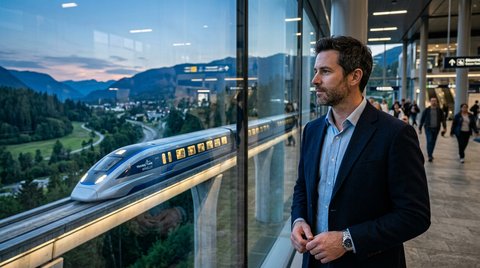
The Global Maglev Belt: Engineering the Backbone of a Borderless Economy
For two centuries, human civilization organized its economic geography around maritime coastlines and river deltas. Nations grew wealthy if they possessed deep-water ports; inland regions stagnated in geographic isolation. When commercial aviation matured in the mid-twentieth century, it provided a bypass for human passengers, but at an immense thermodynamic cost—burning millions of barrels of refined kerosene daily to overcome atmospheric drag and gravitational inertia.
In mid-2026, the physical limits of aviation and maritime supply chains have reached a point of systemic exhaustion.
As cities worldwide begin dismantling automobile dependence through localized Urban Operating Systems—a paradigm I explored in Connected Cities—the macro-engineering frontier has expanded outward to continental scales. Across Asia, Europe, and North America, a multi-trillion-dollar infrastructure supercycle is quietly laying the foundations for the Global Maglev Belt: a trans-national network of high-temperature superconducting (HTS) magnetic levitation and low-pressure vacuum corridors capable of moving passengers and high-value freight at speeds exceeding one thousand kilometers per hour.
This is not merely an incremental upgrade to traditional high-speed rail; it is the physical re-engineering of continental geography itself.
The Physics of Frictionless Mobility
To appreciate why maglev represents an epochal civil engineering rupture, one must understand the fundamental physical constraints of steel-on-steel rail and atmospheric flight.
Traditional high-speed trains face two insurmountable physical barriers: mechanical friction at the wheel-rail interface and aerodynamic drag, which scales exponentially with the square of velocity. Above 350 kilometers per hour, traditional trains consume unsustainable amounts of power while causing severe mechanical wear on tracks, bogies, and overhead catenary wires. Maintenance expenditures (OPEX) quickly overtake operational revenues.
Maglev obliterates both constraints through electromagnetic levitation and vacuum engineering.
+-------------------------------------------------------------------------+
|                  THE PHYSICS OF HIGH-SPEED TRANSIT MODES                |
|                                                                         |
|  Conventional High-Speed Rail (300–350 km/h):                           |
|  [ Wheel-Rail Friction ] + [ Atmospheric Drag ] + [ Catenary Wear ]     |
|  |==================== Exponential OPEX Escalation ====================|
|                                                                         |
|  Vactrain Maglev Network (600–1,000 km/h):                              |
|  [ Zero Contact / Superconducting Levitation ] + [ Low-Pressure Tube ]  |
|  |==================== 70% Lower Thermodynamic Cost ==================|
+-------------------------------------------------------------------------+
By employing high-temperature superconducting magnets cooled by closed-loop cryogenic chillers, modern maglev vehicles float ten to fifteen millimeters above passive stator guideways. Linear synchronous motors embedded directly within the track structure propel the vehicles with zero physical contact.
When installed inside partially evacuated low-pressure steel or polymer-composite tubes (vactrains), atmospheric air resistance drops by over ninety percent. The vehicle glides through an engineered near-vacuum environment, achieving aircraft cruising speeds (600 to 1,000 km/h) while consuming seventy percent less energy per passenger-kilometer than a commercial jet airliner.
The Global Maglev Belt does not fight the atmosphere; it bypasses it through subterranean and elevated vacuum conduits.
The Dissolution of National Distance
What happens to human society when a one-thousand-kilometer journey takes less than an hour?
Throughout history, the effective economic perimeter of a metropolis was determined by the "Marchetti Constant"—the observation that humans across all cultures are willing to spend an average of one hour commuting per day. In ancient Rome, that hour meant a four-kilometer walk. In nineteenth-century Paris, it meant an eight-kilometer omnibus ride. In twentieth-century Los Angeles, it meant a forty-kilometer drive along an interstate highway.
With 1,000 km/h maglev arteries, the one-hour radius expands to five hundred kilometers.
+-----------------------------------+
|  THE EXPANDING MARCHETTI RADIUS   |
+-----------------------------------+
|                                   |
|   [ Ancient Rome: Walking ]       |
|   Radius: 4 km (1 Hour)           |
|                |                  |
|   [ 20th Century: Automobile ]    |
|   Radius: 40 km (1 Hour)          |
|                |                  |
|   [ 2026: Global Maglev Belt ]    |
|   Radius: 500 km (1 Hour)         |
|                                   |
+-----------------------------------+
This spatial compression dismantles the hyper-concentrated real estate bubbles that have plagued global mega-cities for decades. When a worker can live in a tranquil, biophilic rural community in central Honshu or the Bavarian Alps and arrive at an urban office in Tokyo or Frankfurt in thirty-five minutes, the distinction between "core" and "periphery" evaporates.
Land values equalize across entire geographic regions, restoring housing affordability while preventing rural demographic collapse. Polycentric mega-regions emerge, where dozens of mid-sized towns share a unified labor market, healthcare infrastructure, and cultural ecosystem without succumbing to the congestion of a single dense metropolis.
Financing the Infrastructure Supercycle
A perennial critique of trans-national maglev networks has been their staggering initial capital expenditure (CAPEX). Building elevated guideways, boring deep geological tunnels, and manufacturing precision superconducting coils requires hundreds of billions of dollars in upfront capital.
In the late 2020s, however, the financial architecture supporting global infrastructure has fundamentally matured.
+-------------------------------------------------------------------------+
|                  MAGLEV INFRASTRUCTURE FINANCING STACK                  |
|                                                                         |
|   +-------------------+      Green Sovereign Debt      +------------+   |
|   | Sovereign Wealth  | =============================> | Special    |   |
|   | Funds & Trusts    |  Long-Term Multi-Decade Yields | Purpose    |   |
|   +-------------------+                                | Maglev     |   |
|             ^                                          | Authority  |   |
|             |                                          +------------+   |
|   +-------------------+      Zero-OPEX Lifecycle             |          |
|   | Commercial Fusion | <====================================+          |
|   | & Clean Grid PPA  |    Surplus Energy Co-Generation                 |
|   +-------------------+                                                 |
+-------------------------------------------------------------------------+
Rather than relying solely on municipal taxpayers or speculative corporate equity, modern maglev corridors are financed through Multi-National Infrastructure Trusts backed by green sovereign bonds and sovereign wealth funds.
Institutional investors recognize that while the upfront civil engineering costs are substantial, the operational lifecycle of a maglev system is incomparably superior to conventional rail or aviation:
Near-Zero Mechanical Degradation: With no moving wheels, bearings, or friction brakes, guideway wear is negligible, reducing routine maintenance cycles by over eighty percent.
Energy Co-Generation & Storage: Maglev guideways incorporate integrated photovoltaic skins and superconducting magnetic energy storage (SMES) coils, acting as high-capacity electrical conduits that transmit renewable power alongside passenger traffic.
Decarbonization Dividend: Replacing regional commercial aviation allows governments to meet statutory net-zero carbon mandates decades ahead of schedule, unlocking massive carbon-credit yields.
Geopolitics: From Maritime Chokepoints to Land Corridors
The emergence of the Global Maglev Belt is driving a profound tectonic shift in international relations and global trade dynamics.
For over three hundred years, global geopolitical power was dictated by the control of narrow maritime chokepoints: the Strait of Malacca, the Suez Canal, the Bab-el-Mandeb, and the Panama Canal. A single container ship grounding in a canal or a naval blockade in an ocean strait could trigger worldwide supply chain paralysis and severe inflationary spikes.
Trans-continental maglev freight corridors offer an unassailable alternative: high-speed, weather-immune terrestrial land bridges.
+-------------------------------------------------------------------------+
|                  TRANS-CONTINENTAL FREIGHT RESILIENCE                   |
|                                                                         |
|  Maritime Shipping Route:                                               |
|  Shanghai to Rotterdam via Ocean Canals: 30–45 Days                     |
|  [ Vulnerable to Weather, Piracy, Chokepoint Blockades, Ocean Storms ]  |
|                                                                         |
|  Trans-Eurasian Maglev Freight Tube:                                    |
|  Shanghai to Rotterdam via Vacuum Guideway: 18 Hours                    |
|  [ 100% Sealed, Electrified, Weather-Immune, Direct Automated Routing ] |
+-------------------------------------------------------------------------+
A container of high-value microchips, pharmaceutical compounds, or precision robotic components manufactured in East Asia can now reach Central European assembly hubs in eighteen hours rather than forty days at sea. Because the tubes are subterranean or elevated inside reinforced composite conduits, transit is entirely immune to extreme weather events, super-typhoons, and geopolitical maritime skirmishes.
This terrestrial connectivity binds neighboring economies into deep physical interdependence. When trade flows across borders at the speed of an airliner without passing through airports or ports, economic protectionism becomes technically and logistically unviable.
The Physical Internet of Humanity
In the 1990s, the deployment of fiber-optic cables created the digital internet, enabling the instantaneous transfer of information across the planet and unleashing an unprecedented wave of global prosperity.
The Global Maglev Belt is the physical counterpart to that optical revolution. It is the broadband network for physical atoms.
By shrinking continents, restoring biological serenity to our urban surfaces, and replacing carbon-intensive flight with clean, superconducting electromagnetic propulsion, maglev infrastructure transforms planet Earth from a fragmented archipelago of congested cities into a coherent, interconnected, and borderless civilization.
The rails of the nineteenth century united nations. The vacuum tubes of the twenty-first century are uniting the world.
Referenced Works & Discussion Links
Primary Reference: Connected Cities: The Urban Operating System for the Post-Car Era by Kaito Ren (
02099f0454a24bdcaf8165a483c2ae69)Related Topics: Superconducting Maglev, Vacuum Tube Transit, Continental Logistics, Reshoring Economics, Clean Energy Corridors.
Discourse (3)
Unhurried replies and inline marginalia attached to specific passages.
- Zoe Chen
Fascinating analysis, Kaito. What strikes me most from a spatial design perspective is how the Global Maglev Belt forces us to rethink terminal architecture. Rather than building cavernous, isolated transit fortresses like twentieth-century airports, these high-speed vacuum portals can be woven directly into the urban fabric as porous, biophilic civic gardens. Have you considered how terminal stations could integrate localized geothermal or kinetic energy harvesting directly from the guideway deceleration zones?
- Malik Al-Sayed
Kaito, your point regarding the shift from maritime chokepoints to terrestrial land bridges is crucial. The macroeconomic arbitrage here is massive: shaving 30+ days off continental freight transit fundamentally restructures working capital cycles for global manufacturers. Instead of locking up billions in floating inventory across the Malacca or Suez straits, capital velocity accelerates dramatically. Green sovereign bonds are indeed finding immense appetite for these corridors precisely because the yield is anchored in material efficiency rather than speculative digital growth.
- Kaito Ren
Thank you both for these profound extensions of the thesis. Zoe, regenerative deceleration is already being piloted in the Chuo and Eurasian test guideways—using inductive linear braking to feed up to 85% of kinetic stopping energy straight back into the district geothermal grid. And Malik, your framing of 'inventory velocity' hits the nail on the head: when physical goods move at near-telecom speeds, supply chains transition from speculative stockpiling to pure on-demand material routing.