
The Autonomous Infrastructure: Why Agents Are Replacing DevOps Pipelines
For fifteen years, the high church of enterprise software engineering worshipped a single operational dogma: DevOps. Its liturgy was codified in declarative text files—thousands of lines of indentation-sensitive YAML, nested Terraform manifests, Docker compose directives, and fragile GitHub Actions workflows. The gospel promised that if human developers simply specified the desired state of their cloud infrastructure in static code repositories, automated runners would reconcile reality with intent.
By 2026, that promise has curdled into a maintenance nightmare of staggering proportions.
Modern distributed enterprise topologies have grown so complex—spanning hybrid multi-cloud clusters, localized edge inference nodes, vector databases, heterogeneous serverless runtimes, and high-frequency streaming brokers—that static declarative files can no longer capture the dynamic entropy of production environments. When an outage detonates at three in the morning, the continuous integration and continuous deployment (CI/CD) pipeline does not repair the system; it halts blind, spewing cryptic stack traces into an unread PagerDuty queue while exhausted Site Reliability Engineers (SREs) frantically grep through gigabytes of distributed telemetry.
We have reached the terminal boundary of static infrastructure automation. The future of enterprise operations does not belong to longer Jenkinsfiles or more convoluted Helm charts. It belongs to autonomous runtime agents: persistent, goal-seeking software entities that observe real-time telemetry, synthesize ephemeral remediation scripts, dynamically negotiate resource allocation, and self-heal production clusters within mathematically provable invariant guardrails.
The Fragility of the Static Pipeline: The YAML Tax
To diagnose why classical CI/CD is collapsing under its own weight, one must examine the fundamental conceptual flaw of Infrastructure as Code (IaC): it treats dynamic distributed systems as if they were static compilation targets.
A traditional DevOps pipeline is purely procedural and temporally blind. It executes a pre-ordained sequence of bash steps: pull repository, run linter, build container image, push to registry, apply Kubernetes deployment manifest. If every dependency behaves identically, if network latency is zero, and if no concurrent database migrations conflict, the pipeline succeeds.
In production, however, enterprise infrastructure is a non-linear thermodynamic organism. Database connection pools saturate unexpectedly; third-party payment gateways throttle API calls; memory leaks slowly degrade pod performance over forty-eight hours; disk I/O bottlenecks cause silent replication lag between primary and secondary read replicas. A static pipeline has zero awareness of these ambient conditions. It blindly pushes new artifacts into degraded environments, turning minor transient anomalies into catastrophic cascading failovers.
Architectural Dimension | Classical CI/CD (The Brittle Pipeline) | Autonomous Infrastructure (Self-Governing SRE) |
|---|---|---|
Execution Paradigm | Static procedural steps ( | Continuous reconciliation loop governed by formal invariant policies |
Failure Detection | Threshold alerts & PagerDuty cascades after runtime crash | Kernel-level eBPF syscall telemetry & predictive distribution shifts |
Remediation Latency | Human intervention loop (mean-time-to-recovery: hours to days) | Ephemeral sandboxed synthesis & sub-second self-healing rollbacks |
Configuration Burden | Fragile multi-thousand-line YAML manifests & brittle scripts | Declarative goal contracts verified against formal invariant harnesses |
The human cost of this architectural mismatch is the "YAML Tax." Enterprise engineering organizations routinely spend 30% to 40% of their senior developer hours maintaining deployment machinery rather than writing core business logic. Developers have been transformed into low-level plumbing technicians: debugging why an updated container registry certificate broke a staging cluster, or why a whitespace error in a 1,200-line Kubernetes configuration caused a rolling deployment to deadlock.
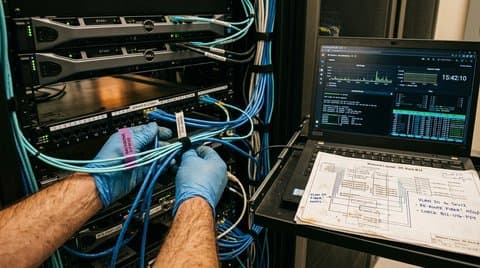 Industrial fiber optic routing and hardware telemetry console in server bay
From Procedural Pipelines to Goal-Oriented Runtime Controllers
Autonomous infrastructure inverts the operational relationship between developer intent and infrastructure state. Instead of authoring procedural instructions specifying how to deploy and maintain software, systems architects define declarative goal invariants and deploy specialized runtime agents empowered to achieve them.
An Autonomous SRE agent operates in a continuous control loop powered by kernel-level observability (such as extended Berkeley Packet Filters, or eBPF), distributed tracing, and specialized small language models fine-tuned on systems architecture:
Real-Time Telemetry Ingestion: The agent does not wait for a threshold alert to trigger. It monitors eBPF syscall telemetry, memory allocation curves, and network packet jitter at sub-millisecond granularity, detecting abnormal distribution shifts before an error status code is ever emitted.
Causal Diagnosis and Hypothesis Generation: When an anomaly emerges—such as a database query latency spike across a European availability zone—the agent correlates distributed trace graphs to isolate the root cause. Rather than alerting a human, the agent formulates a diagnostic hypothesis: the issue is caused by unindexed JSON querying introduced in the latest canary release.
Ephemeral Remediation Synthesis: The agent does not rely on rigid, pre-written runbooks. It synthesizes a localized, ephemeral remediation script: spinning up temporary read-replicas, generating an automated index migration, rerouting ingress traffic away from degraded pods, and notifying the engineering team with a full causal post-mortem.
Formal Invariant Validation: Crucially, the agent does not operate with unconstrained privileges. Every synthesized action must pass through a deterministic validation engine—a mathematical harness that proves the action does not violate core security, budget, or architectural invariants before execution is permitted.
"Instead of authoring procedural YAML scripts specifying how to deploy software, architects now define declarative invariants. The autonomous agent determines the optimal path to maintain that state in real time."
The Four Architectural Pillars of Autonomous DevOps
Deploying autonomous agents into mission-critical production clusters requires abandoning the naive idea of unconstrained "vibe coding" in infrastructure. An enterprise autonomous infrastructure stack is anchored by four strict architectural pillars:
The Invariant Policy Layer: The absolute boundary of agentic authority. Architects codify immutable constraints: no port 22 exposed to public ingress; maximum monthly cloud egress budget cannot exceed $40,000; zero data loss during schema transitions; minimum replica count cannot fall below three across distinct physical availability zones. If an agent proposes a remediation plan that violates any invariant, the kernel rejects the execution block immediately.
The eBPF Sensory Mesh: Traditional monitoring relies on scraping metrics endpoints every thirty seconds—an eternity in high-throughput cloud environments. Autonomous infrastructure utilizes eBPF probes embedded directly in the Linux kernel, giving runtime agents zero-overhead visibility into every TCP socket, disk write, memory page allocation, and process spawn.
The Ephemeral Sandbox Harness: Agents never apply synthesized code or architectural changes directly to primary production clusters. Every proposed mutation is first mirrored in an isolated, ephemeral sandbox environment populated with synthetic traffic to verify that the fix resolves the anomaly without introducing secondary performance degradations.
Bidirectional Git Provenance: Every autonomous action taken by an agent is signed with cryptographic hardware keys and committed back to git repositories as human-readable diffs. The agent writes its own documentation, updating architectural diagrams, telemetry baselines, and post-incident timelines in real time.
The Shift Down in Infrastructure Engineering
What becomes of the human DevOps engineer in an era of autonomous infrastructure?
Critics claim that autonomous agents will eliminate infrastructure teams. This is a profound misunderstanding of systems engineering. What autonomous agents eliminate is the mindless, soul-crushing drudgery of operational babysitting: restarting stalled pods, manually patching operating system vulnerabilities on hundred-server clusters, and spending Saturday mornings debugging broken CI/CD runner pipelines.
The role of the infrastructure engineer is "shifting down" toward foundational governance, architectural elegance, and formal verification:
From Pipeline Plumber to Policy Architect: The engineer no longer writes YAML scripts; they write formal invariant contracts that define the safety envelopes within which autonomous agents operate.
From Alert Firefighter to Chaos Engineer: The human engineer designs adversarial stress tests, subjecting agent swarms to simulated network partitions, datacenter blackouts, and cryptographic key revocations to verify their autonomous recovery resilience.
From Gatekeeper to Sovereign Steward: Engineering teams regain the cognitive bandwidth to focus on core compute economics: optimizing silicon choices, evaluating custom ASIC and NPU accelerators, and reclaiming infrastructure sovereignty from rentier hyperscaler clouds.
The End of the Runbook
The twenty-year era of manual DevOps was an interim compromise. We asked human beings to behave like deterministic state machines—monitoring dashboards, following static checklists, and hand-crafting procedural configuration files—because our software lacked the reasoning capability to manage its own thermodynamic reality.
That era is over. The static pipeline is dead.
In its place stands an autonomous, self-governing computational fabric: infrastructure that breathes, adapts, repairs itself, and defends its own operational integrity. The enterprise that embraces autonomous agentic infrastructure will ship software with a velocity and resilience that makes classical CI/CD look like hand-cranking a printing press. The future of operations is silence: the deep, serene silence of systems that run themselves.