
On Salt, Fire, and the Cooling of Olive Oil
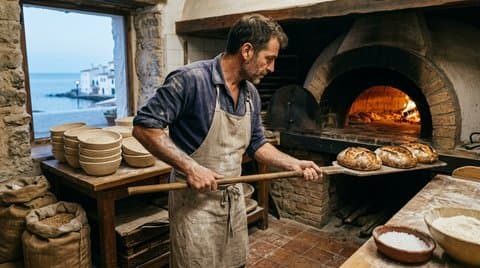
At half past four in the morning, when the coastal mist still hangs cold over the Mediterranean rooftops of Valencia, there is no sound inside the bakery except the gentle, dry crackle of burning dry holm oak. I sweep the grey ash from the refractory stone floor of the domed oven using a wet palm broom. The heat that radiates against your forearms is not the sterile, convective blast of an industrial electric deck; it is deep, penetrating infrared thermal mass stored inside three tons of refractory brick.
On the wooden workbench, forty loaves of sourdough made from stone-milled Aragón wheat have rested in woven wicker bannetons for eighteen hours. They have not been rushed with commercial baker's yeast or stabilized with synthetic dough conditioners. Their rise is the patient, metabolic triumph of wild lactobacilli and saccharomyces digesting complex starches in the dark, releasing lactic and acetic acids that scent the room with the aroma of green apples, warm milk, and damp earth.
Outside this stone kitchen, the modern food technology sector is attempting to convince humanity that nourishment can be optimized through algorithmic disembodiment. Venture capitalists pour hundreds of millions into synthetic protein extrusions, smart kitchen appliances that scan barcode packets, and food delivery platforms whose recommendation algorithms optimize for salt-fat-sugar hyperpalatability. They call cooking an inefficient chore, an operational friction that modern humans should outsource to cloud kitchens and automated air fryers.
They understand nothing about the human animal. Cooking over fire with salt and cold-pressed oil is not a utility task. It is the primordial sacrament through which mortal human beings maintain their connection to the earth, the seasons, and their own biological senses.
The Industrial De-Sensitization of Taste
We must diagnose why the ultra-processed diet feels so profoundly hollow, even when it delivers five hundred calories in three minutes. Industrial food manufacturing relies on the systematic dissociation between sensory flavor and nutritional density.
In a commercial food laboratory, flavor chemists synthesize volatile aroma compounds to mimic the taste of smoked pork, ripe strawberries, or wood-fired tomatoes, while the physical substrate consists of cheap refined palm oil, hydrolyzed soy isolates, and high-fructose corn syrups. The human brain, evolved over two million years to interpret complex bitter, salty, and acidic tastes as indicators of mineral and micronutrient density, is tricked by chemical deception.
The consequence is chronic metabolic confusion and sensory numbing. When consumers become accustomed to the immediate, uniform blast of artificial flavor enhancers, the subtle, complex bitterness of cold-pressed extra virgin olive oil tastes strange to them. They reject the coarse, toothsome crust of naturally fermented bread because their palates have been trained on ultra-soft, emulsified white loaves that dissolve into paste without chewing.
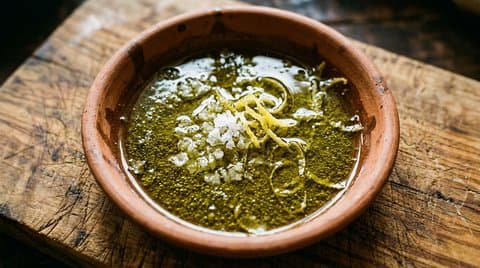 A terracotta bowl with cold-pressed olive oil, coarse sea salt crystals, and lemon zest on an olive wood board
The contrast between the industrial food pipeline and the Mediterranean hearth is absolute:
Culinary Dimension | The Industrial Ultra-Processed Pipeline | The Mediterranean Hearth Craft |
|---|---|---|
Heat Dynamics | High-velocity convective fans, microwave radiation, rapid extruders | Radiative thermal mass of wood embers and refractory brick (220°C–280°C) |
Fermentation Timeline | Accelerated chemical leaveners; 45-minute commercial throughput | 18 to 36 hours of cold wild fermentation; slow gluten breakdown |
Lipid Chemistry | Hydrogenated seed oils, industrial deodorized vegetable fats | Unfiltered, cold-pressed extra virgin olive oil rich in polyphenols |
Flavor Profile | Monolithic hyperpalatability (engineered salt, fat, sugar triads) | Layered, evolving profile (bitter, pungent, mineral, acidic complexity) |
Digestive Impact | Rapid blood glucose spikes; gut microbiome disruption | Low glycemic index; bioavailable minerals and prebiotic fiber |
Temporal Ritual | Solitary, hurried consumption while staring at digital screens | Shared communal assembly around table; physical sensory pacing |
Look at the third row: lipid chemistry. A noble extra virgin olive oil, cold-pressed from early-harvest Picual or Arbequina olives within six hours of harvesting, is not merely a cooking fat. It is a living, unfiltered botanical juice. When you taste it fresh from the stone press, it carries an aggressive, peppery throat-catch (pizzico) caused by oleocanthal—a powerful natural phenolic anti-inflammatory compound. Industrial processing strips this peppery bite away because mass-market consumers are trained to fear any flavor that fights back.
The Slow Thermal Alchemy Arc
How does a loaf of wet, sticky dough transform into a blistering, aromatic sourdough boule with an open, honeycombed crumb? It requires an exact, non-negotiable sequence of physical and thermal thresholds:
The Slow Thermal Alchemy Arc: Wild Lactic Acidification → Enzymatic Gluten Softening → Thermal Crust Gelatinization → Maillard Caramelization → Crumb Alveolar Stabilization
When the wet dough slides from the wooden peel onto the 240-degree stone hearth, the bottom crust sets within four seconds. Moisture inside the loaf turns instantaneously to steam, expanding the air pockets trapped by the fermented gluten network.
At the same time, the starch granules on the exterior surface gelatinize under the intense radiative heat, creating a thin, glossy skin. As the oven temperature gently declines, the sugars and amino acids in the flour undergo the Maillard reaction—a complex symphony of hundreds of individual chemical transformations that produce the deep mahogany blistered crust, the roasted hazelnut aroma, and the faint bitter crunch that defines true artisan bread.
You cannot accelerate this process with an algorithm. If you try to bake a loaf in twenty minutes using higher heat, the outside burns to charcoal while the center remains raw, gummy dough. You must yield your timeline to the laws of thermodynamics. You must wait.
The Agronomy of Forgotten Wheats
Much of the modern epidemic of digestive malaise—the explosion of irritable bowel syndromes and non-celiac gluten sensitivities across the Western world—is not an inherent defect of the human digestive tract. It is the direct consequence of the Green Revolution's aggressive hybridization of dwarf wheat varieties designed for industrial combine harvesters and rapid chemical processing.
In my bakery, we work exclusively with heirloom landraces: Aragón 03, Senatore Cappelli from southern Italy, and ancient Khorasan grain. These grains possess tall, slender stalks that shade the topsoil, requiring zero chemical pesticides and drawing complex minerals from deep subterranean root networks.
More crucially, their gluten structure is fundamentally different from modern commercial cultivars. Industrial wheat was bred for high levels of tough, elastic glutenin proteins capable of surviving violent mechanical kneading in automated factory mixers. Heirloom grains, by contrast, contain a higher ratio of soluble gliadins, which break down effortlessly when subjected to extended cold sourdough fermentation. During our thirty-hour fermentation cycle, bacterial proteases literally pre-digest the gluten peptides into simple, bioavailable amino acids. Customers who have spent years avoiding supermarket bread because it triggered acute bloating discover that they can eat two thick slices of traditional stone-milled sourdough with zero discomfort. True digestive health is not achieved through specialized gluten-free industrial substitutes; it is restored through agricultural fidelity and biological time.
The Sacrament of the Common Table
In an age characterized by attention fragmentation and domestic isolation, the act of cooking over fire is an act of cultural rebellion.
When you bring a wood-fired loaf to a table, pour a bowl of green olive oil, scatter coarse crystals of hand-harvested sea salt, and share it with friends, you are not merely ingesting macronutrients. You are participating in the oldest human technology of peace.
To eat good bread with good oil requires you to sit down. It requires both hands. It requires you to break the bread with your fingers, look your companion in the eyes, and chew slowly enough to taste the grain. You cannot scroll through an algorithmic feed with your thumb while holding a warm slice of sourdough dipped in olive oil; the oil will stain the screen. The food demands your presence.
At seven in the morning, as the sun rises over the Mediterranean and the bakery doors open to the street, the neighborhood arrives. The elderly widow who buys a half-loaf of rye; the fisherman who stops for a warm focaccia; the young mother with her child. They smell the woodsmoke, the toasted crust, and the cooling olive oil.
We do not need synthetic substitutes for the human table. We need the humility to return to the fire, to respect the yeast, and to remember that the best things in human life cannot be optimized, cannot be streamed, and will never be delivered by a drone. They are born in the quiet of the morning, between the stone hearth and the human hand.