

On Refusing to Delegate the Mind
There is an ancient, deliberate severity to the Duke Humfrey’s Library at Oxford that resists the frantic pace of the outside century. As afternoon fades into twilight, the soft, grey light filtering through the stone tracery of the north windows illuminates not screens or glowing silicon panels, but centuries of leather bindings, vellum folios, and the quiet, rhythmic scratching of steel nibs against laid paper. Here, silence is not merely the absence of acoustic disturbance; it is an active, sovereign architecture designed to protect the fragile apparatus of human attention.
To sit in such a room with a single clothbound volume—perhaps Günther Anders’ Die Antiquiertheit des Menschen or Jacques Ellul’s The Technological Society—and to read without the assistance of a predictive summarizer, an automated semantic filter, or an algorithmic search retrieval engine is increasingly regarded by the contemporary world as an act of perverse, obstinate inefficiency.
"Why spend three hours wrestling with the dialectical obscurities of a mid-century philosopher," the technological optimist asks with genuine bewilderment, "when a frontier model can synthesize the core premises into four bullet points in less than five seconds?"
The question itself reveals the catastrophic epistemic blindness of our era. It proceeds from the unexamined assumption that knowledge is an inert commodity—a collection of informational tokens to be extracted, compressed, and deposited into the memory banks of the brain with the minimum possible expenditure of metabolic energy. It fails to recognize that the value of intellectual inquiry does not reside in the terminal conclusion; it resides in the agonizing, unhurried labor of the journey itself.
When you delegate the struggle of comprehension to an automated system, you do not save time. You surrender the sovereign capacity to think.
The Promethean Gap and the Illusion of Mastery
Seventy years ago, Günther Anders identified what he called the Promethean gap (das prometheische Gefälle): the ever-widening abyss between humanity's capacity to produce colossal, world-altering technical apparatuses and our absolute inability to intellectually comprehend, emotionally assimilate, or ethically govern the consequences of what we have built.
In the twentieth century, this gap manifested primarily in the terror of industrial warfare and nuclear annihilation—situations where the destructive yield of our weapons dwarfed the moral imagination of the political leaders who commanded them. In the twenty-first century, however, the Promethean gap has taken an inward, insidious turn. It has colonized the interiority of the human subject.
┌─────────────────────────────────────────────────────────────┐
│          The Mechanics of Cognitive Exaptation & Atrophy    │
│                                                             │
│   [Epistemic Ambiguity] ──► [Algorithmic Shortcut]          │
│            │                        │                       │
│   (Pain of Confusion)       (Frictionless Digest)           │
│            │                        │                       │
│            ▼                        ▼                       │
│   [Synaptic Pruning]   ──► [Loss of Tacit Memory]           │
│   (Atrophy of Circuits)    (Inability to Synthesize)        │
│            │                        │                       │
│            ▼                        ▼                       │
│   [Promethean Surrender]──►[Subservient Administrative Mind]│
└─────────────────────────────────────────────────────────────┘
Rather than using technology to extend our cognitive reach, we have begun to use generative systems to relieve ourselves of the burden of conscious reflection. We allow neural networks to draft our correspondence, formulate our legal briefs, summarize our historical archives, and evaluate our ethical dilemmas. We congratulate ourselves on our unprecedented operational velocity, entirely blind to the reality that we are systematically dismantling the tacit scaffolding upon which human judgment depends.
Dimension | The Autonomous Delegated Routine | The Sovereign Unassisted Inquiry |
|---|---|---|
Epistemic Agency | Outsourced to proprietary statistical loss functions | Borne entirely by the individual conscious subject |
Cognitive Friction | Systematically eliminated to maximize velocity | Deliberately embraced as the sole catalyst of insight |
Memory Architecture | Ephemeral, just-in-time retrieval via query tokens | Deeply integrated, associative, embodied tacit memory |
Vulnerability to Error | Susceptible to invisible statistical hallucinations | Exposed to explicit, humbling human fallibility |
Moral Accountability | Dispersed across model weights and corporate vendors | Centered squarely on the author's conscience |
Civic Consequence | Produces compliant, frictionless administrative consumers | Forges independent citizens capable of democratic dissent |
The danger is not that artificial intelligence will achieve consciousness and wage war upon its creators. The danger is that human beings, seduced by the convenience of frictionless answers, will voluntarily abdicate the rigorous, painful habits of mind that distinguish a conscious citizen from an automated terminal.
The Crucial Necessity of Confusion
To learn anything of enduring consequence requires that one endure a prolonged period of humiliating confusion. When an individual confronts a difficult text—whether it is Spinoza’s Ethics, Kant’s Critique of Pure Reason, or an intricate historical treaty—the mind does not assimilate the argument smoothly. It stumbles. It reads a paragraph four times without comprehension; it pacing across the room in frustration; it experiences that sharp, visceral discomfort that accompanies the realization that one’s existing categories of thought are inadequate to the reality being described.
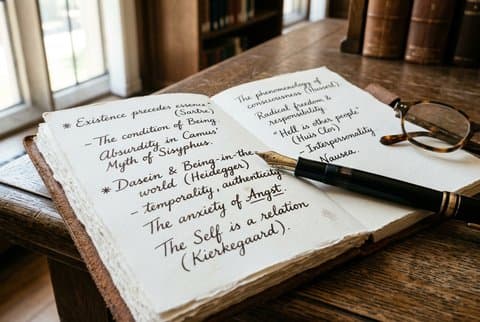 Scholarly notebook with fountain pen and laid paper
This confusion is not an administrative defect to be optimized away by an AI assistant. It is the biological and psychological mechanism through which the mind expands its borders.
When you struggle with a difficult passage for two hours with a fountain pen in your hand, writing marginal notes on cream-colored laid paper, crossing them out, and re-reading the primary sources, your brain is physically re-wiring its neural pathways. You are forcing your synapses to forge new associative links, creating a dense, resilient cognitive architecture that will remain with you for the rest of your life.
The Epistemic Atrophy Sequence: Frictionless Querying → Bypass of Intellectual Confusion → Suppression of Tacit Assimilation → Decay of Internal Dialectic → Complete Dependence on External Synthesis
If you replace that two-hour struggle with a thirty-second synthetic summary generated by an algorithmic engine, you receive the illusion of comprehension without its substance. You possess the propositional conclusion, but you have bypassed the intellectual transformation required to truly understand why that conclusion matters. You have become an intellectual tourist, photographing the summit without ever climbing the mountain.
The Myth of Technical Inevitability
Whenever one suggests that certain cognitive functions should never be delegated to automated machinery, the response from the technological establishment is swift and uniform: "You cannot stop progress. The technology is here, it is inevitable, and those who refuse to adapt will be left behind."
We must learn to recognize this rhetoric for what it is: not an empirical observation about the nature of history, but a coercive, self-serving ideology designed to paralyze democratic resistance.
There is nothing inevitable about the total delegation of human thought. Technology does not possess autonomous agency; it does not deploy itself; it does not make laws. Every algorithm that monitors a worker, every automated pipeline that replaces a classroom seminar, and every generative tool that displaces an essayist is the direct result of deliberate capital allocation by a handful of monopolistic corporations seeking to maximize shareholder value.
To accept this corporate agenda as an immutable law of nature—comparable to the rotation of the Earth or the second law of thermodynamics—is an act of profound intellectual cowardice.
A free society retains the absolute moral right to say: No. We retain the right to declare that certain domains of human existence—the education of our young, the administration of justice, the creation of literature, and the philosophical contemplation of our mortality—are too precious, too sacred, and too fragile to be entrusted to statistical prediction engines.
The Quiet Fortresses of Sovereignty
As evening settles over Oxford, the great bell of Christ Church begins to chime its hundred and one strokes across the rooftops. In the library, readers begin to gather their papers, close their notebooks, and return their folios to the wooden shelves.
There are no notifications flashing in their eyes. There are no algorithmic recommendations nudging their next thought. There is only the quiet, dignified exhaustion of men and women who have spent an entire afternoon exercising the highest, most demanding faculty bestowed upon our species: the capacity to deliberate, to doubt, to synthesize, and to choose without permission.
Let the digital world accelerate into its synthetic spiral of infinite, frictionless noise. Let the corporations flood the internet with trillions of automated words that nobody asked for and nobody needs.
Here, in the presence of the bound volume and the unhurried mind, the line is drawn. We will read slowly. We will write by hand. We will endure the fertile pain of confusion. And we will refuse, with every ounce of our intellectual sovereignty, to delegate the human mind to a machine.