

Mining the Encrypted Past
Across the coastal perimeter of Cornwall, where transatlantic fiber cables emerge from the Atlantic seabed to enter heavily guarded terrestrial repeater stations, an unspoken industrial operation has been running uninterrupted for over a decade. Every night, terabytes of high-entropy ciphertext—exchanges between central banks, diplomatic cables, biometric identity databases, and proprietary commercial patents—are mirrored and copied into subterranean cold storage arrays.
To a casual network engineer observing the packet streams with traditional inspection tools, these archives represent useless noise: a solid wall of pseudorandom hex characters generated by RSA-4096 and elliptic-curve Diffie-Hellman handshakes. The math protecting these streams is mathematically intractable under classical von Neumann architectures. Factoring a 2048-bit integer would require more compute cycles than the thermal budget of our solar system permits.
Yet the security apparatuses of the G7 and rival eastern superpowers continue spending billions annually on industrial tape storage to archive this illegible noise. They are not storing data they expect to read today. They are practicing the doctrine of Harvest Now, Decrypt Later (HNDL). They are waiting for the arrival of fault-tolerant quantum hardware capable of running Shor's algorithm at scale, turning thirty years of world history into an open, retroactively deciphered ledger.
The Asymmetric Decay of Digital Secrecy
The central illusion of the internet's security architecture has always been the assumption of static secrecy. When an engineer configures TLS 1.3 or generates an ephemeral public key pair, they assume that if the mathematical barrier cannot be broken within forty-eight hours, the confidentiality of the session is permanently secure.
This assumption fails to distinguish between computational hardness and temporal longevity. An enterprise's confidential quarterly revenue report loses its operational sensitivity within ninety days; if an adversary decrypts it five years later, the economic consequence is negligible. But state diplomatic treaties, human intelligence informant registries, critical infrastructure firmware keys, and medical DNA sequence databases retain high operational sensitivity for fifty to eighty years.
Cryptographic Epoch | Classical Public-Key Infrastructure | Post-Quantum Lattice Frameworks |
|---|---|---|
Foundational Hardness | Integer factorization and discrete logarithms | Shortest Vector Problem (SVP) in high-dimensional lattices |
Vulnerability to Shor's Algorithm | Total catastrophic collapse (polynomial time $O((\log N)^3)$) | Mathematically immune (no known quantum speedup advantage) |
Harvest Now, Decrypt Later Threat | Vulnerable across all historical stored archives | Immune going forward (retroactive decryption impossible) |
Key Encapsulation Overhead | Compact keys (32–256 bytes) with low bandwidth strain | High-density polynomials (1–3 kilobytes per handshake) |
Legacy Deployment State | 80%+ of historical web traffic and enterprise backups | Transition phase (ML-KEM / ML-DSA hybrid adoption) |
The table above illustrates the asymmetrical vulnerability that defines our current era. Any communication transmitted over public fiber between 1995 and 2025 using classical public-key cryptography must be considered mathematically compromised. It is not a question of if the plaintexts will be exposed, but merely a question of when the physical error rates of superconducting qubits cross the threshold of surface code fault tolerance.
The past is already an open archive; the key has simply not finished cooling in the dilution refrigerator.
The Cold Storage Architecture of Mass Interception
To appreciate the scale of retroactive decryption, one must look past the theoretical mathematical proofs and examine the physical routing topology of global internet traffic. The vast majority of intercontinental data flows through fewer than four hundred submarine cable systems. At landing stations and major internet exchange points (IXPs) in Frankfurt, London, Marseille, and Ashburn, optical splitters passively divert a percentage of photon traffic into high-capacity ingestion pipelines.
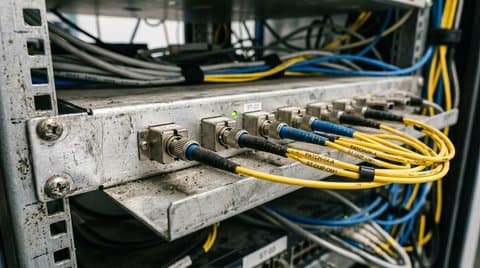 Fiber optic patch cords on metal distribution tray
These intercepted data streams are structured, indexed by IP metadata and SNI headers, and written to dense magnetic tape libraries. While solid-state drives degrade within years without power, modern enterprise barium ferrite magnetic tape cartridges boast archival longevities exceeding thirty years at zero electrical standby cost.
The Retroactive Decryption Pipeline: Optical Splitter Interception → Metadata Cataloging → Barium Ferrite Cold Storage → Fault-Tolerant Quantum Epoch → Automated Retrospective Decryption
When a fault-tolerant quantum processor with approximately 10,000 logical qubits becomes operational, it will not need to wage complex social engineering campaigns or hunt for zero-day vulnerabilities in active operating systems. Analysts will simply query the tape library.
The confidential correspondence of foreign ministries during pivotal treaty negotiations in 2018, the proprietary clinical trial formulas of multinational pharmaceutical corporations in 2022, and the whistleblower communications submitted to investigative journalists in 2024 will be decrypted systematically in batch jobs overnight.
The Mirage of Post-Quantum Migration Deadlines
Recognizing this existential hazard, the US National Institute of Standards and Technology (NIST) and European cybersecurity authorities published the first standardized post-quantum cryptographic algorithms in mid-2024, centered on lattice-based primitives such as ML-KEM (Kyber) and ML-DSA (Dilithium). Major enterprise software vendors promptly announced roadmaps targeting complete migration by 2030 or 2035.
These timelines reflect a profound failure of risk modeling. A migration deadline in 2032 provides comfort only to organizations whose secret data has an operational shelf life of less than zero days. Every single day that an institution delays the complete transition to hybrid post-quantum key encapsulation, it continues to feed the adversary's cold-storage archive with plaintext destined for retroactive exposure.
Furthermore, post-quantum migration is plagued by architectural inertia:
Embedded Legacy Hardware: Thousands of industrial supervisory control and data acquisition (SCADA) systems, satellites in geostationary orbit, and maritime transponders possess microcontrollers lacking the RAM or clock cycles to execute lattice polynomial multiplication. They cannot be patched over the air and will remain classical for their entire operational lifespan.
Packet Fragmentation and MTU Breaches: Lattice-based public keys and ciphertexts are an order of magnitude larger than their RSA equivalents. In older network infrastructures, handshake packets exceed standard 1500-byte Maximum Transmission Units, causing silent packet drops, performance degradation, and automated fallbacks to legacy classical ciphers.
The Unpatchable Past: Most critically, no post-quantum algorithm can retroactively heal data that has already crossed an optical splitter. You cannot reissue a quantum key to protect a transmission that occurred five years ago.
Establishing Cryptographic Invariants for the Longue Durée
To survive in an ecosystem where all classical traffic has been harvested, institutions and individuals must discard the casual assumption of digital permanence. Confidentiality cannot be entrusted to mathematical promises that decay over time.
We must enforce three non-negotiable operational invariants:
Epistemic Pruning and Radical Ephemerality: If a secret does not need to exist in digital form, it must never touch an optical network. Critical negotiations, strategic deliberations, and intimate human confessions must return to physical, air-gapped rooms where acoustic and optic signals cannot be captured by remote collectors.
Immediate Hybrid Post-Quantum Enforcement: Every TLS endpoint, internal microservice mesh, and backup repository must mandate hybrid lattice-classical encapsulation immediately, rejecting connections from clients that fail to negotiate post-quantum ciphers. Compromising performance is vastly preferable to feeding the harvest.
Forward Secrecy Beyond Ephemeral Keys: We must design cryptographic systems under the assumption that all public-key handshakes will be broken. Symmetric ciphers like AES-256 remain robust against quantum attacks through Grover's algorithm (which provides only a quadratic speedup), making pre-shared symmetric keys and physical one-time pads the only true guarantees of generational confidentiality.
The golden age of effortless digital secrecy was an anomaly born of a temporary mathematical asymmetry. That era is over. The harvest is already in the vaults; our only remaining choice is how much of our future we choose to surrender to it.