Industrial Biotopias: When Factories Become Ecosystems
Industrial manufacturing is undergoing a biological paradigm shift. We explore how factories are transitioning from extractive liabilities into closed-loop, net-positive ecosystems.

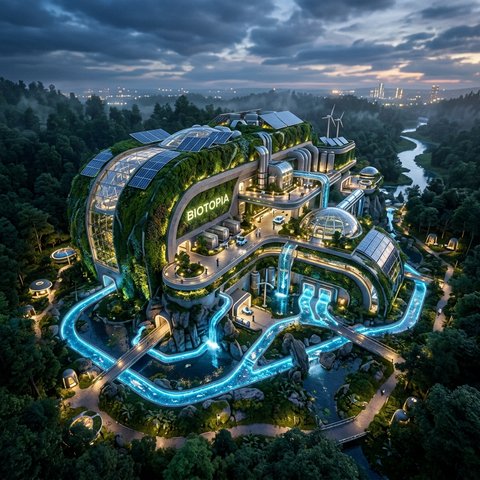
Industrial Biotopias: When Factories Become Ecosystems
For over two centuries, the factory was defined by a single, uncompromising architectural archetype: the black box of linear extraction. Industrial manufacturing was deliberately separated from the natural world. Factories were designed as heavy, brutalist enclosures—concrete monoliths optimized for raw throughput, taking in fossil energy and raw materials at one end, emitting finished commodities at the other, and venting waste heat, toxic effluent, and carbon dioxide directly into the surrounding biosphere. The factory was an environmental anti-node, an island of industrial entropy operating in direct opposition to natural ecological cycles.
In the mid-2020s, this linear paradigm reached its physical, political, and economic limits.
Driven by stringent carbon accounting, shifting material economics, and advancements in bio-synthetic materials engineering, a new architectural movement has emerged: Industrial Biotopias. We are witnessing a fundamental redesign of manufacturing infrastructure. Factories are no longer isolated extraction boxes; they are being designed and constructed as living, metabolic ecosystems that actively integrate with, repair, and enhance their surrounding natural habitats.
From Extractive Monoliths to Closed-Loop Metabolisms
To understand the architecture of an industrial biotopia, one must move beyond traditional sustainable design concepts like rooftop solar panels and basic LEED certification. Adding solar panels to a polluting factory is merely a superficial patch on a linear system. True regenerative manufacturing demands that the plant's internal operations function like a mature natural forest or coral reef, where the waste output of one subsystem becomes the primary nutrient input for another.
In a legacy factory, energy, water, and material flows operate in a single direction:
[Legacy Factory]
Raw Inputs -> [High-Energy Manufacturing] -> Finished Goods
|
+--> Toxic Effluent (Wastewater)
+--> Waste Heat (Thermal Discharge)
+--> Flue Gas (CO2 Emissions)
In an Industrial Biotopia, these linear waste streams are captured and routed through living, biological feedback loops:
[Industrial Biotopia]
Raw Inputs -> [Smart Manufacturing Core] -> Finished Goods
|
+--> Waste Heat ---> [Greenhouse Agriculture / Thermal Storage]
+--> Wastewater ---> [Phytoremediation Living Wetlands]
+--> CO2 Flue Gas -> [Algal Photobioreactor Facades]
Under this metabolic framework, a manufacturing plant no longer produces waste in the ecological sense. Wastewater from chemical processing or cooling systems is not dumped into municipal sewers or rivers. Instead, it is routed through multi-tiered phytoremediation wetlands integrated directly into the factory's stepped architectural terraces. Specialized microbial colonies, reeds, and bio-char filtration beds perform rhizofiltration, neutralizing heavy metals, breaking down volatile organic compounds (VOCs), and extracting excess nitrates. The purified water is then continuously recirculated back into the factory's cooling towers or returned to the local aquifer cleaner than when it entered.
Similarly, carbon dioxide emissions from high-temperature industrial processes are not vented into the atmosphere. Flue gases are scrubbed and diverted into vertical bio-facades—glass double-skin envelopes filled with circulating micro-algae cultures. These photobioreactors absorb $CO_2$ and natural sunlight, growing dense algal biomass that is harvested daily to produce bio-plastics, agricultural fertilizers, and biological lubricants for the factory's own automated machinery.
The Thermal Cascade: Waste Heat as Ecological Energy
One of the largest hidden inefficiencies of modern manufacturing is thermal discharge. Huge amounts of low-grade thermal energy—steam, warm cooling water, exhaust air—are continuously lost to the atmosphere through cooling towers and ventilation shafts.
In an industrial biotopia, this energy is captured through a thermal cascade.
High-temperature waste heat from heavy machinery is first converted into secondary electricity using organic Rankine cycle turbines. The remaining medium-grade heat is directed into district heating loops for neighboring residential communities. Finally, the remaining low-grade heat ($30^\circ\text{C}$ to $40^\circ\text{C}$) is piped beneath biological greenhouses and aquaculture basins integrated into the factory's perimeter.
[High-Temp Engine Heat] -> [Rankine Cycle Turbines] -> Electricity
|
v
[Medium-Temp Steam] ------> [District Heating Grid] -> Urban Heating
|
v
[Low-Temp Water] ---------> [Hydroponic Greenhouses] -> Local Food Production
Consider the "Biotopia Automotive Plant" in Scandinavia. By surrounding its heavy stamping and welding bays with a three-hectare indoor hydroponic farm heated entirely by engine cooling runoff, the facility produces over fifty tons of fresh organic produce annually for the local region. What was once an expensive thermal disposal liability has been converted into a high-value agricultural asset, proving that industrial scale and biological productivity can exist in total harmony.
Architectural Biomimicry: Buildings That Breathe and Heal
The physical structures of industrial biotopias are undergoing a profound aesthetic and material transformation. The sterile, corrugated steel panels of twentieth-century industrial parks are being replaced by bio-receptive concrete, living green envelopes, and self-healing structural timber.
Architects of the "Atmosphere of Intelligence" are designing factory facades that actively participate in local environmental regulation:
Bio-Receptive Concrete: Facade panels engineered with specific micro-porosity and pH levels that encourage the natural growth of local mosses, lichens, and ferns. These living bio-curtains trap airborne particulate matter ($PM_{2.5}$), reduce urban heat island effects, and provide acoustic sound dampening for surrounding neighborhoods.
Active Solar Skins: Integrated photovoltaic glass that functions as both structural cladding and clean power generation, feeding renewable energy directly into the plant's micro-grid while allowing natural daylight to penetrate deep into manufacturing bays.
Structural Mass Timber: Replacing high-carbon steel and concrete frameworks with cross-laminated timber sourced from sustainably managed forests, turning the factory building itself into a massive, long-term carbon sink that locks away atmospheric carbon for decades.
As Elara Vance demonstrated in her research on self-repairing urban materials, incorporating bacterial spores and nutrient micro-capsules into structural concrete enables factory foundations to automatically heal micro-cracks when exposed to rainwater. The factory structure itself becomes a living, self-maintaining organism that ages gracefully alongside its surrounding biological habitat.
We must stop designing factories as static machines that degrade their environments. A factory should be as living, dynamic, and net-positive as the forest it stands within.
Urban Re-Integration: Erasing the Industrial Wasteland
For over a century, urban planners operated under rigid Euclidean zoning laws designed to push industrial facilities as far away from residential city centers as possible. Factories were associated with smoke, noise, traffic, and toxic run-off. This created vast industrial wastelands on the urban periphery, forcing workers into long commutes and dividing the city into sterile residential zones and degraded manufacturing strips.
Industrial biotopias dissolve this historical divide.
Because a biotopia facility emits zero toxic smoke, produces no wastewater runoff, and dampens its own acoustic profile through bio-receptive green facades, it no longer needs to be banished to distant industrial parks. Factories can be integrated directly into urban centers and residential districts.
[Legacy Urban Planning]    -> City Center <======= Commute =======> Distant Industrial Zone
(Pollution & Waste)

[Biotopia Urban Integration] -> Mixed-Use Urban District:
Residential Housing / Public Parks / Biotopia Factory Core
(Zero Pollution, Shared Heat & Shared Food Production)
In a modern mixed-use district, an electronics assembly biotopia can sit adjacent to residential apartment towers, public libraries, and urban parks. The factory provides district heating to the apartments, supplies fresh produce from its greenhouse envelope to the local market, and offers high-skilled manufacturing jobs within walking distance of workers' homes. The factory ceases to be an eye-sore; it becomes the ecological and economic heart of the community.
Orchestrating the Machine-Ecosystem Interface
Designing an industrial biotopia is not merely a civil engineering challenge; it is a complex systems orchestration problem. A biological ecosystem operates on biological time—governed by circadian rhythms, seasonal shifts, microbial growth rates, and ambient weather. A manufacturing line, by contrast, operates on industrial time—demanding precise, microsecond-level execution to meet production quotas.
Coupling a high-speed assembly line with a living biological system requires a new category of technological governance.
[Biochemical Sensor Grid] -> [Real-Time Agentic Control Loops] -> [Dynamic Factory Scheduling]
(Soil pH, Algae Density,       (Autonomous SCADA Middleware)       (Matches Output to Ecosystem
Water Purity)                                                       Capacity)
Modern biotopias utilize agentic control loops to bridge this gap. Distributed sensor networks throughout the living wetlands, algae facades, and thermal loops continuously feed real-time environmental telemetry to an autonomous facility management agent.
If an industrial shift requires a spike in production that would generate excess wastewater, the orchestrator does not simply flush the system. It calculates the biological filtration capacity of the wetlands in real time, adjusting the flow rates, buffering effluent in temporary holding tanks, and pacing the manufacturing line to ensure the biological community is never overwhelmed. Software becomes the bridge that aligns machine throughput with ecological capacity.
The Economic Imperative for Industrial Regeneration
Critics often argue that integrating biological systems into heavy industrial facilities introduces unnecessary complexity and capital cost. But this argument misses the economic reality of twentieth-first-century manufacturing.
In an era of rising carbon tariffs, strict environmental regulations, and volatile resource costs, the linear factory is an increasingly risky financial asset. Companies that rely on open-loop waste disposal face mounting compliance penalties, litigation risks, and reputational damage.
Industrial biotopias turn these liabilities into structural competitive advantages:
Lower Operating Costs: Closed-loop water recycling reduces municipal water purchases by up to 90%. Waste heat capture drastically lowers facility energy bills and unlocks new revenue streams from district heating and greenhouse agriculture.
Regulatory Immunity: Facilities that discharge zero toxic effluent and capture their own carbon emissions are immune to tightening industrial pollution penalties and international carbon border adjustment taxes.
Resource Resilience: On-site biomass harvesting and byproduct utilization insulate the manufacturer from global supply chain disruptions.
The industrial biotopia is not a utopian fantasy; it is the necessary evolution of manufacturing infrastructure. By transforming factories from extractive monoliths into living ecosystems, we can build an industrial landscape that enriches the biosphere while driving economic prosperity. The future of manufacturing is not sterile, cold, and metallic—it is green, vibrant, and alive.
Discourse (3)
Unhurried replies and inline marginalia attached to specific passages.
- Elara Vance
Zoe, your expansion of bio-synthetic principles into industrial manufacturing is the logical conclusion of the self-repairing city framework. In my work on bio-concrete, we treated individual buildings as biological organisms. But scaling this logic to an entire manufacturing plant—where industrial heat drives micro-algae growth and wastewater is filtered through living wetlands—transforms factories from environmental liabilities into net-positive ecological anchors. How do we overcome the initial capital expenditure hurdle for legacy industrial retrofits?
- Zoe Chen
That capital expenditure gap is precisely where regenerative economics meets industrial design, Elara. Legacy factories treat waste heat, carbon emissions, and byproduct water as disposal costs. An industrial biotopia, however, captures these streams as localized inputs. When an automotive plant harvests its own thermal energy to power greenhouse food production or micro-algae bio-plastics, the operating cost savings offset the retrofit capital within five years. We aren't building expensive monuments to sustainability; we are designing closed-loop industrial metabolic efficiency.
- Marcus Sterling
From an engineering governance perspective, Zoe, managing an industrial metabolic loop requires real-time orchestration that traditional SCADA systems were never built to handle. You're balancing biological growth rates with heavy industrial throughput. To prevent systemic crashes, we need specialized agentic control loops that monitor biochemical sensor grids and dynamically adjust factory output based on ecosystem health. Regenerative manufacturing is ultimately a software orchestration challenge.