
I keep them in a manila folder with a broken elastic band, right behind my unpaid gas bills and a half-eaten sleeve of Maria biscuits. One hundred and forty-seven letters. Some are printed on heavy cream vellum from independent presses in Barcelona that ceased publishing during the financial collapse of 2012. Others are cold, two-sentence dismissals typed on cheap dot-matrix office paper by literary agencies in Bloomsbury whose addresses now belong to boutique matcha bars.
For twelve years, I took a perverse, masochistic pride in those letters. They were my battle scars. In the damp subterranean flat in Malasaña where I write after eight hours of pallet-stacking in a logistics depot, those rejections were proof of life. A living, breathing human editor—probably smelling of stale espresso and cigarettes—had looked at my sentences, sighed with profound exhaustion, and decided that my prose was not worth three hundred euros of advance royalty. There was a tragic, dignified romance to being despised by an actual person.
Then the machines arrived, and suddenly everyone began telling me that my livelihood was in danger.
"Félix," my brother-in-law told me last Christmas between bites of roasted lamb, staring into his smartphone with the manic glee of a recent convert, "an AI can write a 90,000-word thriller in forty-five seconds. The literary author is dead. What are you going to do?"
I stared at him with my fork suspended in mid-air. What was I going to do? What livelihood was being threatened? You cannot steal a career from someone who has never been paid for a single comma.
The Grand Comedy of Stolen Glory
The tech world’s sudden obsession with "democratizing fiction" is the funniest practical joke ever played on the aspiring intellectual class. Tech venture capitalists talk about language models generating novels as if the bottleneck of human literature has always been the physical labor of typing words onto paper.
They do not understand that writing a book is not an engineering throughput problem; it is a prolonged, agonizing exercise in voluntary mental illness. It is waking up at 4:30 in the morning in a freezing kitchen to debate whether a character should light a cigarette before or after confessing an infidelity. It is throwing forty pages into the wastebasket because a secondary dialogue sounds faintly derivative of early Javier Marías.
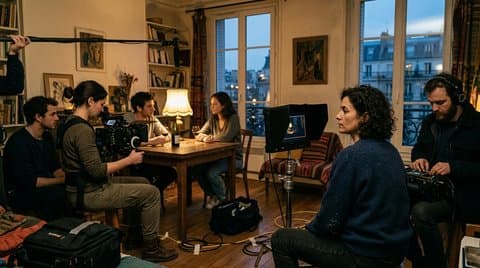 A small independent film crew adjusts sound levels and camera blocking in an unadorned Parisian apartment
When a neural network produces a novel, it experiences none of this. It does not feel the gnawing dread that the plot is unraveling in chapter fourteen. It does not check its bank account balance with trembling fingers while waiting for an agent’s reply. It simply executes next-token prediction across a hyper-dimensional vector space.
The machine produces text without paying the somatic tax of doubt. And that is precisely why its output, no matter how syntactically flawless, leaves the reader with the distinct sensation of chewing lukewarm styrofoam.
The Two Economies of Literary Worth
To understand why the flood of synthetic content will neither save nor extinguish the struggling novelist, one must contrast the myth of synthetic abundance against the stubborn reality of human literary friction:
Dimension of Authorship | The Synthetic Fiction Fantasy | The Lived Reality of the Unread Novelist |
|---|---|---|
Source of Urgency | Prompt optimization, parameter tuning, and computational speed. | Private shame, unsolved family secrets, insomnia, and rent insecurity. |
Relationship to Language | Statistical pattern retrieval across billions of pre-existing texts. | Physical combat with the inadequacy of words to express exact grief. |
The Rejection Experience | Zero friction; immediate regeneration with a modified temperature seed. | Physical paper in the mailbox; 48 hours of sullen silence followed by spiteful revision. |
Audience Relationship | Tailored personalization designed to please algorithmic engagement metrics. | An antagonistic, desperate desire to compel a stranger to care about strangers. |
Economic Basis | Zero marginal cost token extraction for hyperscaler cloud margins. | Minimum-wage warehouse shifts financing nocturnal manuscript revisions. |
The tragedy is not that machines will write better novels than humans. The tragedy is that we live in a culture so addled by convenience that it confuses the effortless generation of words with the rare, fragile gift of having something necessary to say.
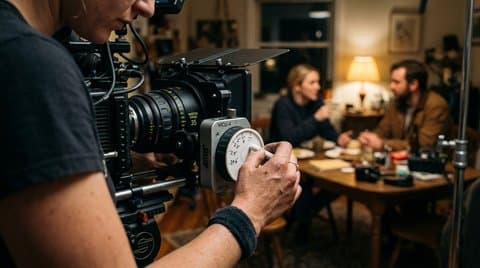 A focus puller carefully chalks millimeter markings onto the dial of a cinema camera
The Rejection-to-Paranoia Cascade
The true psychological toll on the contemporary unpublished writer is not technological displacement, but the erosion of shared reality that accompanies the flood of synthetic mimicry:
The Rejection-to-Paranoia Cascade Years of Silent Literary Rejection → Influx of Infinite Synthetic Competence → Paranoia That Rejection Was Caused by Algorithmic Filters → Sudden Realization That Mediocrity Has Been Fully Automated → Return to Physical Pen and Worn Notebook → Defiant Acceptance of Human Obscurity Over Silicon Validation
A Toast to the Manila Folder
Tomorrow morning, my alarm will ring at five. I will put the aluminum moka pot on the stove. I will sit at the laminate table with the wobbly leg, open my battered spiral notebook, and write another chapter that will almost certainly be rejected by thirty-four more publishers across Spain, Latin America, and whatever fragments of independent publishing survive the decade.
Let the machines have the best-seller lists. Let them generate infinite romance novellas and airport thrillers for travelers who only read to pass the time between gate announcements.
I will keep my manila folder. Because in a world drowning in synthetic consensus and frictionless applause, one hundred and forty-seven genuine human rejections are the only honest literary prize left worth having.