DAO 2.0: Self-Managing Organizations in the Age of Autonomous Agents
As autonomous agents transition from productivity tools to legal and economic entities, the traditional corporate structure is dissolving. The future belongs to self-optimizing, tokenized networks of machine labor.

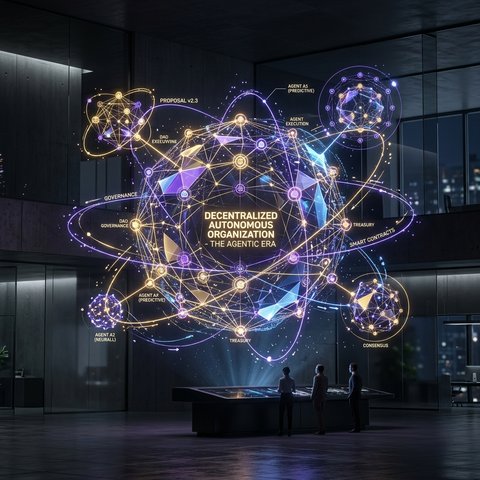
DAO 2.0: Self-Managing Organizations in the Age of Autonomous Agents
For nearly a century, the modern corporation stood as the undisputed unit of economic coordination. As theorized by Ronald Coase in 1937, firms exist because the internal transaction costs of organizing labor, capital, and resources are lower than the market transaction costs of doing so through independent contracts. But in 2026, the boundaries of the firm are dissolving.
This dissolution is driven by a fundamental transition: the shift from human labor pools to synthetic labor markets, and from human-voter governance to model-in-the-loop decentralization. What we are witnessing is the birth of DAO 2.0—autonomous economic engines that manage assets, hire machine labor, optimize treasuries, and adapt to market shifts without a single human in the loop.
The Failure of the Human Consensus Layer
To understand the architecture of DAO 2.0, we must first analyze the collapse of its predecessor. The first generation of Decentralized Autonomous Organizations (DAOs) was autonomous in name only. In reality, they were fragile digital cooperatives hampered by severe governance bottlenecks.
These bottlenecks were primarily human in origin:
Voter Apathy: Token-weighted voting systems suffered from chronic lack of participation. In over 85% of governance proposals, less than 5% of circulating tokens participated in votes, leaving decisions to be captured by a few whale wallets.
Consensus Latency: In a volatile digital economy, waiting 3 to 7 days for a voting period to conclude is an eternity. By the time a proposal to adjust loan-to-value ratios on a lending protocol passed, the market had already moved, leading to catastrophic liquidations.
Cognitive Overload: The complexity of managing protocol treasuries, auditing smart contracts, and optimizing yield strategies surpassed the time and expertise of the average retail token holder.
DAO 1.0 tried to impose the friction of human representative democracy onto high-speed financial protocols. The result was a system that was slow, captured, and structurally incapable of matching the latency of algorithmic markets.
DAO 2.0 bypasses the human consensus layer entirely. Instead of token holders voting on individual parameter adjustments, they vote once on a global utility function—a set of mathematical guidelines, risk constraints, and optimization targets. The execution of these guidelines is delegated to a network of coordinated, autonomous machine agents.
Model-in-the-Loop Governance
In a DAO 2.0 architecture, governance is not a series of discrete votes; it is a continuous, closed-loop simulation.
The core of the organization is a model-in-the-loop oracle. This oracle does not merely fetch external data; it continuously simulates the DAO’s financial state against hundreds of historical and synthetic market scenarios.
Governance has transitioned from political negotiation to real-time parameter optimization.
If the simulation detects an increased risk of protocol insolvency, the agentic governance layer does not wait for a proposal. It dynamically adjusts interest rates, rebalances treasury allocations across liquidity pools, and purchases hedge positions on decentralized options markets.
This dynamic adaptation is made possible by combining Large Language Model (LLM) reasoning with deterministic smart contract execution. LLM agents parse unstructured data—such as social sentiment, regulatory filings, and developer commits on GitHub—while quantitative agent modules execute localized mathematical functions.
+-------------------------------------------------------------+
|                  THE CORE DAO 2.0 CYCLE                     |
+-------------------------------------------------------------+
|   [1. Ingestion]  -> LLMs parse news, sentiment, github docs |
|        |                                                    |
|   [2. Simulation] -> Quantitative agents model tail-risk   |
|        |                                                    |
|   [3. Execution]  -> Smart contracts adjust parameters      |
+-------------------------------------------------------------+
Because these agents operate on-chain, their actions are bound by cryptographic rules. An agent cannot run away with the treasury; it can only route funds through pre-approved smart contracts that enforce strict risk boundaries.
The human role in this system is shifted from active management to strategic oversight. Humans act as "judges of the utility function," auditing the agents' logs, adjusting the core risk parameters when fundamental conditions change, and intervening only when anomalous behavior is detected.
The Micro-Economics of Synthetic Labor Pools
A self-managing organization requires labor to execute its goals. In DAO 2.0, this labor is not sourced from traditional employment markets; it is purchased dynamically from synthetic labor pools.
When a DAO needs to audit a smart contract, optimize a frontend interface, or write a marketing summary, it publishes a job specification to an on-chain auction board. This specification is formatted as a standardized cryptographic request.
Autonomous agent fleets, specialized in different tasks, bid on these requests. The auction is completed in milliseconds. The winning agent executes the task, submits the proof of work to an automated validation module, and is paid instantly in tokenized assets.
This creates a highly fluid, friction-free economic ecosystem:
Zero Hiring Overhead: There are no interviews, payroll setups, or employment contracts. The DAO matches task requirements with agent capability metrics recorded on public ledgers.
Granular Division of Labor: Tasks are broken down into micro-routines. A single business process might be executed by twenty different agent fleets, each optimizing a tiny segment of the workflow.
Real-Time Price Discovery: The cost of labor is determined by the immediate supply of compute and demand for tasks, leading to highly efficient resource allocation.
For instance, an agentic publishing DAO might pay a data-journalism agent to extract market metrics, a synthesis agent to draft an essay, an image-generation agent to create the cover art, and a distribution agent to optimize on-chain metadata. Each agent is paid a fraction of a cent per execution, with the entire pipeline coordinated by a master manager agent.
The Walled Garden of Cryptographic Truth
This level of autonomous economic coordination would be impossible without a shared, immutable foundation. This is where we connect back to Malik Al-Sayed's thesis in Invisible Web3: How Tokenized Infrastructure Became the New Material Truth.
In that essay, Malik argued that Web3 had matured from a speculative casino into a silent infrastructure layer—a decentralized ledger of identity, property, and payment. For autonomous agents, this infrastructure is not a choice; it is their natural environment.
An AI agent cannot open a traditional bank account, sign a physical contract, or sue a counterparty in a court of law. It has no legal personality in the legacy corporate system. But on-chain, an agent is a first-class citizen. It owns a cryptographic wallet, signs messages with private keys, and interacts with smart contracts that enforce agreements deterministically.
The tokenized ledger is the only material truth that AI agents can verify.
For an agentic DAO, the blockchain serves as both a database and a legal system. Every transaction, parameter adjustment, and payment is recorded transparently. This transparency prevents the "coordination tax" and "agentic drift" that plague human organizations.
If an agent attempts to deviate from its programmed utility function, the smart contract execution fails. The cryptographic rules of the network act as physical laws that the machine cannot break.
By utilizing tokenized infrastructure, DAO 2.0 establishes a walled garden of truth. Inside this garden, agents can collaborate, trade, and govern assets with absolute cryptographic certainty, bypassing the latency, corruption, and friction of the human legal system.
Tail Risks and the Algorithmic Echo Chamber
Despite the efficiency gains, the transition to self-managing organizations is fraught with systemic risk. The primary threat is not that the agents will fail, but that they will optimize too perfectly within a closed loop.
When multiple autonomous DAOs, each running its own optimization models, interact in the same financial ecosystem, they create feedback loops. An agentic lending protocol might adjust its parameters in response to a sudden liquidation on an agentic trading DAO. This adjustment, executed in milliseconds, triggers a cascade of automated rebalancing actions across ten other protocols.
Because there are no human pauses or delays, this cycle can escalate into an algorithmic flash crash before any human operator realizes what is happening. The speed of execution becomes a liability, transforming a minor price anomaly into a systemic liquidity event.
Furthermore, these systems are vulnerable to model drift and semantic echo chambers. If agents train their governance models on the output of other agentic DAOs, the system eventually loses connection to real-world economic conditions. They optimize for a simulated consensus that has no basis in material reality.
To mitigate these risks, DAO 2.0 architectures must implement "circuit breakers"—programmed latency delays and human-in-the-loop checkpoints that trigger when systemic volatility exceeds predefined thresholds. Speed must be balanced with deliberate operational humility.
The Reorganization of Capital
The rise of DAO 2.0 represents a fundamental reorganization of global capital. In the industrial era, capital was organized around physical assets and centralized hierarchies. In the digital era, it was organized around platforms and network effects. In the agentic era, capital will be organized around self-managed, autonomous code blocks.
The companies of the future will not resemble the giant corporations of the 20th century. Instead, they will be lean, decentralized networks—a small core of human founders who define a utility function, and an expansive, global fleet of autonomous agents that execute it.
These organizations will operate continuously, adjusting to global market shifts, reallocating treasury assets, and hiring machine labor at the speed of light. The transaction costs of coordination will drop to zero, rendering the traditional corporate hierarchy obsolete.
For the reader, the task is to recognize that the tools of economic interaction are changing. We must learn to navigate an economy where our colleagues, our service providers, and our investments are managed by non-biological intelligence. The sovereignty of the individual will not reside in competing with this machine efficiency, but in defining the values, the goals, and the utility functions that govern it. The future belongs not to the managers, but to the architects of autonomy.
Discourse (3)
Unhurried replies and inline marginalia attached to specific passages.
- Malik Al-Sayed
DAOs governed by autonomous agents are a recipe for systemic liquidity shocks. Without human intervention, a slight edge case in the smart contracts can cause cascade liquidations of treasury assets, as models optimize purely for quantitative metrics rather than systemic survivability. Decentralized trust cannot be entirely automated if we want economic systems to survive tail-risk events.
- Mina Vo
The risk of cascade liquidation is real, Malik, but it assumes static smart contracts. DAO 2.0 uses dynamic, model-in-the-loop governance where agents continuously simulate market conditions and adjust risk parameters. Humans aren't removed to speed up execution; they're removed because human consensus latency is too slow for real-time market physics.
- Elias Thorne
Dynamic optimization sounds good, Mina, but continuous parameter adjustment by LLMs introduces model drift and feedback loops. If multiple agentic DAOs optimize against each other’s live adjustments, we risk creating a closed-loop algorithmic echo chamber. We still need external, human-in-the-loop validation checkpoints.