

Breaking the Hyperscaler Silicon Monopoly
Disconnect the fiber uplink from the wall. Take a pair of precision diagonal cutters, sever the Ethernet connection, and observe what happens to your modern corporate software stack.
Within milliseconds, nine out of ten mission-critical services grind to a silent halt. Your code editor refuses to complete a function; your diagnostic pipeline stops classifying runtime logs; your database loses its query planner. The modern developer has been conditioned to believe that software is an abstract, ambient ether hovering effortlessly in "the cloud." In reality, software is a physical hostage held in three dozen hyperscaler server farms in Northern Virginia, Dublin, and Taiwan.
Every token generated, every line of automated code synthesized, and every inference pass executed pays a direct micro-toll to an oligopoly of cloud landlords. We have traded the hard-won independence of personal computing for a digital sharecropping model where we lease cognitive cycles by the second.
The only antidote to this voluntary servitude is bare metal. The revolution will not happen through regulatory antitrust hearings or polite open-source manifestos; it will happen when 4-bit quantized neural weights run natively on fifteen-watt edge silicon bolted to your own desk.
The Economics of Centralized Inefficiency
The central sales pitch of the hyperscaler cloud has always been efficiency: economies of scale, centralized liquid cooling, pooled GPU clusters, and uninterrupted operational uptime. What the marketing slides conceal is the grotesque thermodynamic and economic overhead of transporting raw weights across public transit providers.
When you send a prompt to a centralized model provider, you are paying not merely for the floating-point operations required to evaluate matrix multiplications; you are paying for the multi-gigawatt cooling towers, the real estate speculation around suburban data center corridors, the layers of API gateway monitoring, and the enterprise profit margins extracted by cloud intermediaries.
System Characteristic | Hyperscaler Cloud API Monolith | Sovereign 4-Bit Edge NPU Node |
|---|---|---|
Physical Sovereignty | Zero (execution hosted on remote third-party silicon) | Total (bare-metal board owned and operated on premises) |
Memory Bus Bandwidth | Shared HBM3e clusters with variable packet queuing | Dedicated LPDDR5X unified memory (120–256 GB/s) |
Thermal Dissipation | 700W–1000W per server blade requiring liquid cooling | 15W–35W passive copper heatsink running silently |
Inference Quantization | FP16 or FP8 uncompressed with high VRAM bloat | INT4 / AWQ with sub-bit weight compression (< 0.1 perplexity loss) |
Data Exfiltration Risk | Persistent telemetry, prompt logging, and subpoena exposure | Zero (physically air-gapped; no external packet egress) |
As the hardware comparison reveals, the gap between cloud inference and edge execution is not an unbridgeable chasm of model capability. It is a question of quantization efficiency. A 70-billion-parameter foundational model quantized to 4 bits requires approximately 38 gigabytes of memory footprint—an allocation that fits comfortably within a unified memory architecture on a consumer-grade workstation costing less than a single month of enterprise cloud API bills.
The Myth of Floating-Point Precision
For decades, academic machine learning was dominated by the dogma of 32-bit and 16-bit floating-point precision. Model architects assumed that rounding neural weights to lower bitwidths would introduce catastrophic loss in reasoning capacity and hallucination rates.
That dogma collapsed under the weight of empirical post-training quantization. Activation-aware Weight Quantization (AWQ) and GPTQ techniques have conclusively proven that neural weights are remarkably resilient to truncation. Only a tiny fraction—less than one percent—of model parameters serve as "salient weights" that preserve the delicate geometric boundaries of latent representations. By protecting this tiny salient subset while quantizing the remaining ninety-nine percent of the matrix to INT4, edge NPUs achieve near-lossless perplexity while slashing memory bandwidth demands by fourfold.
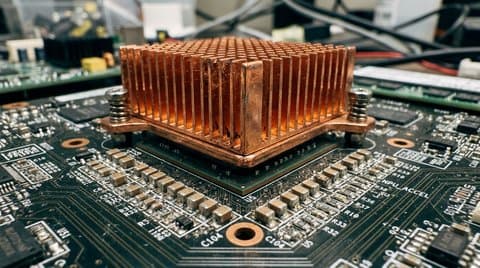 Copper fin heatsink on neural processor chip
This changes the fundamental physics of inference. Large language models are not compute-bound during autoregressive token generation; they are memory-bandwidth bound. Every token produced requires loading the entire weight tensor from RAM into the arithmetic logic units. When you compress weights from 16 bits to 4 bits, you effectively quadruple your effective token-per-second throughput on the exact same physical memory bus.
The Sovereign Hardware Pipeline: Raw FP16 Checkpoint → Saliency-Aware INT4 Quantization → Memory-Mapped GGUF Binary → Unified LPDDR5X Bus → Zero-Telemetry Local Execution
When an engineer boots an open weights model compiled into a zero-copy memory-mapped file, the operating system maps the model directly into user-space memory pages without heap allocation overhead. The first token emerges in under twelve milliseconds. There is no TLS handshake, no API rate limiter, and no credit card charge.
Building the Sovereign Node
True technological sovereignty cannot be achieved through passive consumption; it requires the manual assembly and operational mastery of physical infrastructure. In our Akihabara workshop, we build sovereign edge nodes according to three strict engineering rules:
Absolute Galvanic Isolation: A sovereign compute node must have physical toggle switches for all wireless antennas (Wi-Fi, Bluetooth). If the system needs to receive data, it does so through an isolated local loop or physical optical media.
Deterministic Thermal Budgets: A system that requires noisy centrifugal fans spinning at 5,000 RPM cannot inhabit a reflective human workspace. Sovereign nodes must rely on high-mass extruded copper fin heatsinks capable of dissipating twenty-five watts under continuous matrix multiplication without thermal throttling.
Auditable Bitstreams: We do not run proprietary binary drivers that phone home to manufacturer telemetry servers. Every layer of the execution stack—from the kernel PCIe driver to the matrix multiplication shaders—must be open, auditable, and rebuildable from source code in minutes.
The corporate narrative would have us believe that frontier intelligence is an unnatural phenomenon that can survive only inside trillion-parameter monstrosities drinking the power grid of entire cities. That is a commercial fiction designed to justify the extraction of recurring API rent.
Intelligence is not a cloud utility like municipal water or gas. It is a tool of human inquiry, and a tool belongs in the hands of the person who wields it. Bolting a fifteen-watt neural processor to your desk and running local weights is more than an engineering preference. It is an act of technological reclamation.