
To those who inhabit the glass towers of northern California and the server bastions of the Columbia River, history is rarely conceived as a tragedy or a moral drama; it is experienced merely as a throughput problem. Every human friction—doubt, fatigue, the long hesitation before a difficult sentence, the painful negotiation of mutual forgiveness—is categorized in your quarterly filings as an inefficiency waiting to be compressed into an inference call.
You write to us in press releases that read like papal bulls. You announce that the automation of human cognition is not merely feasible or profitable, but historically inevitable. We are told, with that breezy mixture of messianic piety and venture capital calculus, that to resist this acceleration is akin to opposing the printing press or the steam turbine. We are advised to adapt, to re-skill, to surrender our interior drafting tables to synthetic token predictors, and to content ourselves with the role of prompt engineers in our own dispossession.
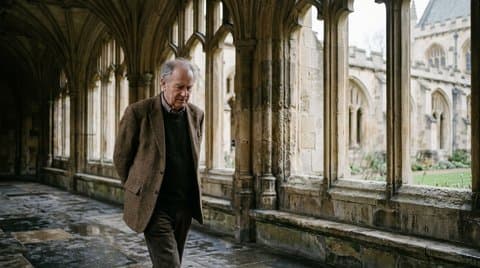
I write this epistle from a different vantage point—from an alcove of weathered limestone where books written four centuries ago remain legible, patient, and unbothered by server reboots. My purpose is not to debate the mathematical elegance of your transformer weights or the floating-point throughput of your silicon clusters. It is to remind you of a truth that engineering hubris always forgets: that velocity is not wisdom, that optimization is often the enemy of depth, and that human fallibility is not a bug to be patched, but the very soil in which moral discernment takes root.
The Architecture of False Inevitability
The central intellectual conceit of the accelerationist gospel is the conflation of technical capacity with historical destiny. Because a diffusion model can generate a passable imitation of a Rembrandt in four seconds, you declare that the slow, solitary apprentice grinding lapis lazuli in walnut oil is an obsolete anachronism. Because an autoregressive transformer can summarize a diplomatic treaty or draft a legal opinion in two hundred milliseconds, you proclaim that the contemplative jurist wrestling with the ethical nuance of precedent has been superseded.
What you deliberately obscure is the profound difference between production and understanding. When a human mind struggles through the architecture of a difficult argument, the value does not reside exclusively in the final textual artifact; it resides in the neurological and spiritual transformation wrought upon the thinker during the labor of articulation.
 An artisan bookbinder patiently stitches linen thread through signatures of heavy rag paper
When you bypass that struggle through automated completion, you do not liberate the human mind; you hollow it out. You deliver the conclusion without the conviction, the syntax without the soul, the answers without the hard-won capacity to formulate the question. The result is not an elevated civilization of liberated polymaths, but an exhausted society of passive consumers drowning in frictionless cognitive flattery.
Two Divergent Epistemologies
To clarify what is at stake in this civilizational dispute, we must contrast the core philosophical premises of the silicon accelerationist against those of the humanist resistance:
Philosophical Dimension | The Dogma of Silicon Acceleration | The Humanist Epistemic Resistance |
|---|---|---|
Primary Axiom | Thought is statistical data processing; maximum velocity yields superior civilization. | Thought is an embodied moral act; patience and deliberate resistance forge wisdom. |
View of Human Error | Pathological latency and noise to be purged via algorithmic alignment. | The generative threshold of discernment, humility, and authentic self-correction. |
Pedagogical Aim | Frictionless information extraction and instant task completion. | Cultivation of sustained attention, procedural memory, and critical interiority. |
Temporal Horizon | Quarterly deployment cycles, token throughput, and real-time streaming inference. | Decadal sediment, multigenerational memory, and durable institutional custody. |
Ontological Stance | The human being is an imperfect biological pre-training substrate for machine superintelligence. | The human being is an end in itself, possessing dignity that cannot be reduced to an optimization metric. |
This divergence is irreconcilable. If you believe that human consciousness is merely a slow, lossy biological computer, then your desire to replace it with high-bandwidth silicon is logical. But if consciousness is an unrepeatable locus of moral responsibility, aesthetic wonder, and existential depth, then your rush to automate it is nothing less than civilizational vandalism.
The Cognitive Recovery Arc
The promise of effortless intellectual abundance carries within it a lethal feedback loop. When a tool removes all resistance from a cognitive domain, the human capacity for that domain does not remain latent; it atrophies through disuse. To reclaim our sovereign agency, we must understand the progression of this loss and chart a deliberate path toward recovery:
The Cognitive Recovery Arc Uncritical Surrender to Frictionless Generation → Atrophy of Deep Reading and Synthetic Syntax → Chronic Restlessness in the Presence of Unaccelerated Reality → Conscious Rejection of Algorithmic Convenience → Re-anchoring in Physical Media and Embodied Conversation → Restoration of Sustained Attention and Epistemic Sovereignty
This recovery requires courage. It requires the willingness to sit in a room without notifications, to endure the silence while wrestling with an idea that refuses to yield, and to write a sentence that takes three hours to earn. It demands that we rediscover the dignity of doing things the hard way because the hard way is the only way that changes who we are.
A Modest Counsel to the Engineers
We do not hate your machines. We marvel at the mathematics that make them possible. We use your search indices when we seek archival citations; we appreciate the cold efficiency of your routing tables. But we reject your claim to our inner lives.
Keep your servers in the desert. Let them calculate weather models, fold proteins, and simulate tokamak plasma boundaries. But leave the schoolroom to the living teacher. Leave the library to the slow reader. Leave the blank page to the trembling hand of the poet who has something true and painful to say.
History will not remember the velocity with which you produced synthetic ephemera. It will remember whether, in the midst of your blinding light, you left enough quiet space for the human soul to breathe.