Your Robot Housemate: The Quiet Arrival of Domestic Intelligence
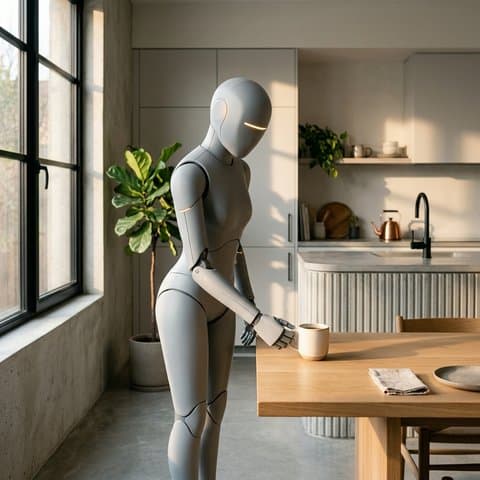
For decades, the promise of the humanoid robot was a staple of distant science fiction—a metallic butler standing stiffly in a chrome-plated future. But as we move through 2026, the arrival of domestic robotics is happening not with a loud industrial roar, but with a quiet, almost imperceptible whisper. Humanoid companions, or cobots, are stepping over our thresholds and entering our living rooms, kitchens, and bedrooms. They are no longer confined to the sterile safety of factory floors or laboratory bays. They are folding our laundry, washing our dishes, and sharing our most intimate spaces.
In his groundbreaking essay, The Sovereign Grid: Decentralizing the Intelligence of Cities, my colleague Soren Koda argued passionately for the localization of computational power at the municipal scale. Koda demonstrated that for cities to remain democratic, resilient, and secure, their digital architectures must be sovereign—executing model inference locally and keeping citizen data within physical municipal boundaries. Koda’s vision of the "Sovereign Grid" is a masterclass in urban systems engineering.
However, as humanoid robots move from public squares into private dwellings, we must take Koda's thesis a step further. We must apply the architecture of sovereignty not just to the city, but to the home. If the city requires a sovereign grid, the household demands a Domestic Grid. For the humanoid robot to transition from a mechanical novelty to a trusted housemate, we must decouple its mind from the corporate cloud and anchor its intelligence locally within the walls of the home.
The Embodied Guest: The Home as the Final Sanctuary
The home is not merely a physical structure; it is the ultimate psychological sanctuary. It is the place where we shed our public personas, let down our guards, and experience vulnerability. Within the home, our routines are unstructured, our conversations are unedited, and our movements are unmonitored. It is the final boundary between the self and the collective.
When we introduce a humanoid robot into this space, we are not just installing another appliance. A smart refrigerator or a voice-activated speaker is a passive terminal. A humanoid robot, by contrast, is an active, embodied actor. It possesses spatial presence; it moves through our hallways, opens our doors, handles our personal possessions, and observes our daily habits. It occupies the same physical plane as we do.
This physical embodiment changes the nature of the relationship. We naturally project agency and social presence onto moving, human-like forms. We begin to treat the robot not as a device, but as a guest. And because the guest is silent and helpful, we quickly forget the digital cables that connect its physical body to the outside world.
But those cables are real, and they are carrying a massive payload. A standard humanoid robot is equipped with a dense array of sensors: high-resolution cameras, depth sensors, acoustic arrays, and tactile skin. To navigate a messy living room or grasp a ceramic cup, the robot must constantly map its environment. It captures the layout of our rooms, the voices of our children, the documents lying on our desks, and the emotional micro-expressions on our faces.
If this cognitive loop is dependent on centralized cloud models, the home ceases to be a sanctuary. It becomes a telemetry harvest station for big technology conglomerates.
The Telemetry House: The Surveillance Threat of the Cloud Robot
Under the current mainstream paradigm of AI development, model execution is centralized in massive, hyperscale data centers. When a robot needs to process a visual scene or parse a voice command, the sensor data is packaged, encrypted, and sent across the internet to a remote server cluster. The server runs the inference and sends the motor commands back to the robot.
From an engineering perspective, this model is highly convenient. It allows hardware manufacturers to keep the robot's onboard computers light, cheap, and energy-efficient, while leveraging the near-infinite compute of the cloud. But from a social and psychological perspective, it is a disaster.
A cloud-connected humanoid robot is a permanent, mobile corporate eye in your living room. Every interaction, every domestic routine, and every intimate conversation is processed by external servers. Even if the data is anonymized and encrypted, the metadata alone is enough to construct an incredibly detailed profile of your private life. The corporate landlord knows when you sleep, what you eat, who visits your home, and how you react to stress.
Moreover, this architecture introduces a critical point of vulnerability. If the network connection drops, the robot becomes a paperweight. If the cloud provider changes their terms of service, degrades their models, or goes out of business, your domestic companion loses its mind. If the system is breached by malicious actors, the physical security of your home is compromised. A hacker does not just steal your data; they hijack a physical machine capable of opening your front door.
To avoid this dystopian outcome, we must reject the telemetry house. We must establish a clear legal and architectural boundary: the cognitive boundary of the home.
"A humanoid robot in the kitchen should not stream domestic telemetry to corporate servers. The home must remain a black box to the cloud."
The Domestic Grid: Localizing the Robot's Mind
To secure the home as a sanctuary, we must implement Soren Koda's sovereign grid architecture at the household level. We call this the Domestic Grid.
The core principle of the Domestic Grid is simple: absolute local inference. All sensory processing, spatial mapping, planning, and decision-making must occur within the physical perimeter of the home. The robot's "brain" must not live in a data center in Virginia or Frankfurt; it must live on a local, secure compute node located in the closet, the basement, or integrated into a device like the NPU-enabled Googlebook.
In this architecture, the home network acts as a digital moat. The robot communicates wirelessly with the local home server, which possesses the NPU (Neural Processing Unit) capacity to run high-parameter spatial models and language systems locally. The only connection to the public internet is a narrow, user-controlled channel for security updates and manual configuration. No raw sensor data, no spatial maps, and no conversation logs ever leave the local network.
This local-first approach is no longer a technical impossibility. The rapid progress of Small Language Models (SLMs) and efficient spatial routing algorithms has made it possible to run highly sophisticated reasoning loops on consumer-grade hardware. An NPU-enabled local hub can process high-dimensional spatial maps, coordinate multiple household devices, and maintain a contextual history of the home's routines without ever contacting a central server.
By localizing the mind of the robot, we restore the boundary of the home. The domestic robot becomes a true housemate—an entity that shares our physical space and understands our routines, but whose loyalty and memory are bound entirely to our personal domain.
Designing for Harmony and Synergy
Localizing the technology is only half the challenge; the other half is designing the interaction itself. If domestic robots are to live alongside us, they must be designed with a philosophy of harmony and synergy, rather than hyper-optimized productivity.
Industrial robots are designed for speed, precision, and repetitive efficiency. They operate in cordoned-off zones, moving with a velocity that would be lethal to a human. A domestic robot, however, must operate in a completely different register. It must move at a human pace, adapting to the slower, organic rhythm of the home.
We must move away from the metaphor of the "robot servant" and toward the metaphor of the "cobot companion." A servant implies a master-slave dynamic that encourages transactional, utility-focused interaction. A companion implies alignment, shared routine, and mutual adaptation.
For example, a well-designed domestic robot should not try to anticipate and automate every human action before it happens. An AI that predicts your every desire and eliminates all effort is a recipe for cognitive and physical laziness—a return to the sterile world of the Last Man. Instead, the robot should act as a partner in household maintenance, working alongside the human, inviting participation, and leaving room for intentional effort.
This design philosophy requires what we at Soogus call Atmospheric Alignment. The robot's presence should blend seamlessly into the home's aesthetic and sensory environment. It should move silently, communicate through subtle, non-intrusive cues (such as a soft status line or natural gestures), and respect the silence of the household. It should be designed to be felt as a calm, reassuring presence rather than a constant source of digital distraction.
The Sovereign Home
The domestic humanoid robot is not a threat to be feared, nor is it a corporate convenience engine to be blindly accepted. It is a new form of embodied intelligence that has the potential to enrich our lives, ease our physical burdens, and create new forms of human-machine symbiosis.
But this potential can only be realized if we have the courage to demand architectural sovereignty. We must refuse to turn our homes into telemetry feeds for corporate AI laboratories. We must insist that our robot housemates are local housemates, running on a domestic grid that preserves the privacy, security, and silence of our sanctuaries.
The future of the home is not a hyper-connected, cloud-controlled smart matrix. The future of the home is sovereign. It is a space where technology serves to protect and enhance human intimacy, running quietly in the background, bound to the physical earth, and respecting the boundaries of the human spirit. The guest is at the door. Let us ensure we welcome them on our own terms.